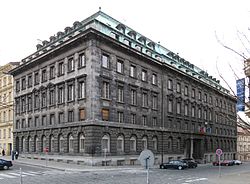
Le Palais Petschek (en tchèque Petschkův palác ou Pečkárna) est un bâtiment néo-classique situé dans le quartier de Nové Město, à Prague.

1. Histoire

Il a été construit entre 1923 et 1929 par l'architecte Max Spielmann à la demande du banquier Jules Petschek, il était à l'origine appelé « Maison de la Banque Petschek et Co. » (Bankovní dům Petschek a spol.). En dépit de son style historicisant, le bâtiment était très moderne, construit en béton armé et entièrement climatisé. Il avait aussi un tube pneumatique, un central téléphonique, une imprimerie, un ascenseur type paternoster (qui fonctionne toujours), ainsi que d'énormes coffre-forts au sous-sol. L'immeuble a été vendu par la famille Petschek, juste avant l'occupation de la Tchécoslovaquie, pour quitter le pays. C'est pendant la Seconde Guerre mondiale que l'endroit gagna sa triste « notoriété », car il devint immédiatement le siège de la Gestapo pour le Protectorat de Bohême-Moravie. Les interrogatoires et les tortures des résistants tchèques y avaient lieu, ainsi que les tribunaux militaires établis par Reinhard Heydrich, qui envoyèrent la plupart des prisonniers à la mort ou dans des camps de concentration nazis. Beaucoup de gens furent mis à mort dans le bâtiment lui-même. Une plaque commémorant l'esprit de ces héros de guerre a été apposée à l'angle de l'immeuble. En 1948, le bâtiment a été acquis par le ministère du Commerce extérieur tchécoslovaque. Aujourd'hui, il abrite encore une partie du ministère de l'Industrie et du Commerce tchèque. En 1989, le bâtiment est devenu Monument culturel national (Národní kulturní památka).

1. Galerie


1. Voir aussi

Villa Petschek Otto Petschek

1. Liens externes

Radio Prague : article en anglais, du 24 Mars 2010, par Christian Falvey Info technique, en tchèque Informations sur la famille Petschek, en tchèque

Portail de l’architecture et de l’urbanisme Portail de Prague

Nearby Places View Menu
Location Image
0 m

Petschek Palace

The Petschek Palace (Czech: Petschkův palác or Pečkárna) is a neoclassicist building in Prague. It was built between 1923 and 1929 by the architect Max Spielmann upon a request from the merchant banker Julius Petschek and was originally called "The Bank House Petschek and Co." (Bankhaus Petschek & Co.) Despite its historicizing look, the building was then a very modern one, being constructed of reinforced concrete and fully air-conditioned. It also had tube post, phone switch-board, printing office, a paternoster lift (which is still functioning), and massive safes in the sublevel floor. The building was sold by the Petschek family before the occupation of Czechoslovakia, and the family left the country. It was during the war years that the place gained its notoriety, as it immediately became the headquarters of Gestapo for the Protectorate of Bohemia and Moravia. It was here where the interrogations and torturing of the Czech resistance members took place, as well as the courts-martial established by Reinhard Heydrich which sent most of the prisoners to death or to Nazi concentration camps. Many people died as a result of imprisonment and torture in the building itself. A memorial plaque that commemorates the victims was unveiled on the corner of the building. In 1948 the building was acquired by the then-Czechoslovak Ministry of Foreign Trade. Today it is the residence of a part of the Czech Ministry of Industry and Trade. In 1989 the building became a National Cultural Monument (Národní kulturní památka). The exterior was used as stand-in for the Gemeinschaft Bank (Zurich, Switzerland) in the 2002 film The Bourne Identity.
Location Image
151 m

State Opera (Prague)

The State Opera (Czech: Státní opera) is an opera house in Prague, Czech Republic. It is part of the National Theatre of the Czech Republic, founded by Ministry of Culture of the Czech Republic in 1992. The theatre itself originally opened in 1888 as the New German Theatre and from 1949 to 1989 it was known as the Smetana Theatre. More recently it was renamed the Prague State Opera. Currently it is home to approximately 300 performances a year.
Location Image
180 m

Liber viaticus

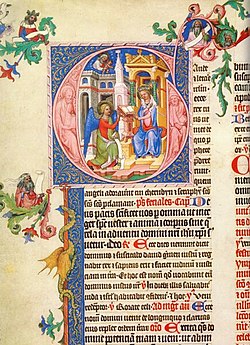
Liber viaticus is a breviary made sometime in the 1350s, at the latest in 1364, for Bishop John of Neumarkt. This is an illuminated manuscript of 319 sheets in relatively good condition preserved to this day (not the original binding) and deposited in the National Museum Library, Prague (sign. XIII A 12).
Location Image
180 m

Muzeum (Prague Metro)

Muzeum (Czech pronunciation: [ˈmuzɛjum]) is a major interchange station on the Prague Metro, located directly beneath Wenceslas Square and the historic building of the National Museum. It serves as a transfer point between Line A and Line C. The station opened in two phases: the Line C part on 9 May 1974 and the Line A part on 12 August 1978.
Location Image
210 m

Statue of Saint Wenceslas, Wenceslas Square

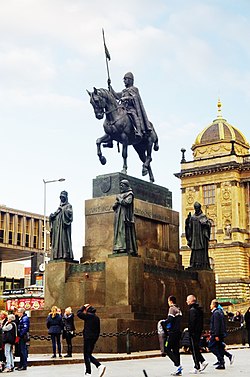
The statue of Saint Wenceslas (Czech: Socha svatého Václava) in Prague, Czech Republic depicts Wenceslaus I, Duke of Bohemia. It is installed at Wenceslas Square.