

 English
 Français

Martin House Hospice
Martin House is a charity that provides hospice care for children and young people across West, North and East Yorkshire. It provides family-led care to children and young people with life-limiting and life-threatening illnesses, either at the hospice or in families' own homes.
The hospice was founded by Rev Richard Seed and officially opened by The Duchess of Kent in 1987.
Services include planned respite care, emergency care, symptom control, community care, end of life care and bereavement support. The charity also supports families whose child has died from a life-limited condition but did not access hospice care. Conditions treated include long term progressive disorders such as Duchenne muscular dystrophy, Batten's disease, cystic fibrosis, and sometimes cancer. Care can take place at the hospice in Boston Spa, or in families' own homes.
The hospice's facilities include nine specialist children's bedrooms, eight family rooms for parents and siblings, six bedrooms in an adjoining unit for teenagers and young adults – Whitby Lodge – sitting rooms, playrooms, a multi-sensory room, Jacuzzi, library and a music room. The hospice's 6-acre (24,000 m2) landscaped gardens incorporate socially-inclusive outdoor play areas with wheelchair swings, a roundabout, water play area, and adventure trail.
It costs Martin House in excess of £9 million each year to provide its services across the region.

Beckfoot Quarry
Beckfoot Quarry is a Site of Special Scientific Interest (SSSI) within Lake District National Park in Cumbria, England. It is located between Beckfoot and Eskdale, near to the River Esk and near the Ravenglass & Eskdale railway.
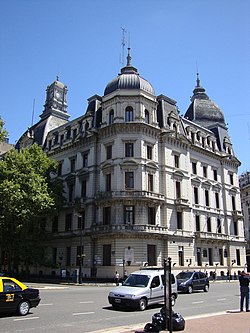
Buenos Aires City Hall
Buenos Aires City Hall (Spanish: Palacio Municipal de la Ciudad de Buenos Aires; lit. "Municipal Palace") was, until 2015, the seat of the Office of the Chief of Government of Buenos Aires, the capital city of Argentina. From its construction in 1914 to the reformation of the city's constitution in 1996, the building was the seat of the City Municipality. It faces the Plaza de Mayo, across from the Casa Rosada presidential palace, in the barrio of Monserrat.
Since 2015, the Office of the Chief of Government has been located at a new building (Casa de la Ciudad) in the barrio of Parque Patricios (south side Uspallata facing Parque de los Patricios). The City Hall still houses various government offices of the city government.

Halton Lea Gate
Halton Lea Gate is a small village in Northumberland, England, on the A689 road close to the boundary of the counties of Northumberland and Cumbria. The village is part of the parish council area called Hartleyburn, and borders the North Pennines Area of Outstanding Natural Beauty (AONB). Halton Lea Farm has a Grade II listed farmhouse, the eastern end of which probably represents a large bastle. The Pennine Way long-distance footpath runs just to the east of the village.
The population of Halton Lea Gate was 310 in 1901.
The area was subject to extensive coal mining activity in the nineteenth century, with a later phase of mining being undertaken from the 1930s to 1958.

Beckermet railway station
Beckermet railway station is a disused rail station located in the village of Beckermet in Cumbria.
Tracks were laid southwards from Whitehaven and Moor Row as far as Egremont by the Whitehaven, Cleator and Egremont Railway, opening to passengers on 1 July 1857.
By the 1860s, the Whitehaven, Cleator and Egremont Railway company sought to extend southwards from Egremont to meet the coastal line at Sellafield, aiming for Millom, Barrow-in-Furness and beyond. The Whitehaven and Furness Junction Railway company opposed this, so the two companies came to an accommodation and built the Egremont to Sellafield extension as a joint line. Beckermet was the sole intermediate passenger station on the extension.
The station was on the western edge of the village in Cumbria, England.

Little Strickland
Little Strickland is a small village and civil parish in the Westmorland and Furness district of Cumbria, England. It is about 7 miles (11 km) from Penrith and 8 miles (13 km) from the small town of Appleby-in-Westmorland. The village has one place of worship and a telephone box. The population of the civil parish as taken at the 2011 Census was less than 100. Details are included in the parish of Great Strickland. On 1 April 2019 Thrimby parish was merged with Little Strickland.

Alexandra Parade railway station
Alexandra Parade railway station is a railway station in Glasgow, Scotland. The station is 1+3⁄4 miles (2.8 km) east of Glasgow Queen Street on the Springburn branch of the North Clyde Line. The station is managed by ScotRail.
It was built as part of the City of Glasgow Union Railway which provided a link across the Clyde (between the Glasgow and Paisley Joint Railway at Shields Junction and the Edinburgh and Glasgow Railway at Sighthill Junction).
The station's westbound platform was closed for routine maintenance works on January 18, 2025, during which the platform was demolished and rebuilt. It reopened on May 17, 2025.

Buckhill Colliery Halt railway station
Buckhill Colliery Halt railway station was an unadvertised halt for workers at Buckhill Colliery north east of Camerton, near Cockermouth in Cumberland (now in Cumbria), England.

Western General Hospital
The Western General Hospital (often abbreviated to simply ‘The Western General’) is a health facility at Craigleith, Edinburgh, Scotland. It is managed by NHS Lothian.

Balmore railway station
Balmore railway station was opened in 1879 on the Kelvin Valley Railway and served the coal mining area, farms and the village of Balmore in East Dunbartonshire until 1951 for passengers, and to freight on 31 July 1961.
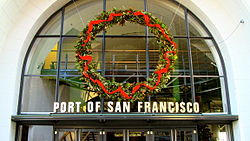
Port of San Francisco
The Port of San Francisco is a semi-independent organization that oversees the port facilities at San Francisco, California, United States. It is run by a five-member commission, appointed by the mayor subject to confirmation by a majority of the San Francisco Board of Supervisors. The Port is responsible for managing the larger waterfront area that extends from the anchorage of the Golden Gate Bridge, along the Marina district, all the way around the north and east shores of the city of San Francisco including Fisherman's Wharf and the Embarcadero, and southward to the city line just beyond Candlestick Point. In 1968, the State of California, via the California State Lands Commission for the state-operated San Francisco Port Authority (est. 1957), transferred its responsibilities for the Harbor of San Francisco waterfront to the City and County of San Francisco/San Francisco Harbor Commission through the Burton Act AB2649. All eligible state port authority employees had the option to become employees of the City and County of San Francisco to maintain consistent operation of the port of San Francisco.
The port of San Francisco lies on the western edge of the San Francisco Bay near the Golden Gate. It has been called one of the three great natural harbors in the world, but it took two long centuries for navigators from Spain and England to find the anchorage originally called Yerba Buena: a port, as was said in its early days, in which all the fleets of the world could find anchorage.
The port area under the commission's control comprises nearly eight miles of waterfront lands, commercial real estate and maritime piers from Hyde Street on the north to India Basin in the southeast. The list of landmarks under port control include Fisherman's Wharf, Pier 39, the Ferry Building, Oracle Park (formerly AT&T Park, SBC Park and Pacific Bell Park), located next to China Basin and Pier 70 at Potrero Point. Huge covered piers on piles jut out into San Francisco Bay along much of the waterfront, bordered by the Embarcadero roadway. In 2015, the city, acting through the port of San Francisco, launched the San Francisco Seawall Earthquake Safety and Disaster Prevention Program (Seawall Program).

Church of St Bridget, Liverpool
The Church of Saint Bridget is in Bagot Street, Wavertree, Liverpool, Merseyside, England. It is recorded in the National Heritage List for England as a designated Grade II* listed building, and is an active Anglican parish church in the diocese of Liverpool, the archdeaconry of Liverpool and the deanery of Toxteth and Wavertree.

Whitehall Building
The Whitehall Building is a three-section residential and office building next to Battery Park in Lower Manhattan, New York City, near the southern tip of Manhattan Island. The original 20-story structure on Battery Place, between West Street and Washington Street, was designed by Henry Janeway Hardenbergh, while the 31-story Whitehall Building Annex on West Street was designed by Clinton and Russell. The original building and annex are both at 17 Battery Place. Another 22-story addition at 2 Washington Street, an International Style building located north of the original building and east of the annex, was designed by Morris Lapidus.
The original Whitehall Building and its annex has a Renaissance Revival style facade, and the two original structures' articulations consist of three horizontal sections similar to the components of a column—namely a base, shaft, and capital. Since the building is located on landfill along the Hudson River, its foundation incorporates a non-standard design.
The Whitehall Building is named after the nearby estate of New Amsterdam colonial governor Peter Stuyvesant. The original building was built as a speculative development in 1902–1904 for Robert A. and William H. Chesebrough, a real estate company. The annex was built in 1908–1910, and 2 Washington Street was built in 1972. In 2000, the New York City Landmarks Preservation Commission (LPC) designated the Whitehall Building as an official city landmark. The upper floors of the original building and annex were converted to apartments, while the lower floors remain in use as an office building.

Grainger Town
Grainger Town is the historic commercial centre of Newcastle upon Tyne, England. It covers approximately 36 ha (89 acres). Almost all of Grainger Town is in Newcastle's Central Conservation Area, one of the first designated in England. The area includes a medieval 13th-century Dominican priory, pieces of the historic Town Walls, and many fine Georgian and Victorian buildings.
The area is named after Richard Grainger, a developer who built several classical streets between 1824 and 1841, including Grey Street, Grainger Street, and Clayton Street. Richard Grainger was said to “have found Newcastle of bricks and timber and left it in stone” (echoing what Augustus claimed to have done for Rome).
Some of Newcastle's finest buildings are in Grainger Town, including Grainger Market and Theatre Royal. These buildings are predominantly four stories, with vertical dormers, domes, turrets, and spikes. The architecture is dubbed “Tyneside Classical”. Grainger Town has 450 buildings, and 244 are listed (29 at grade I and 49 at grade II*). The majority of buildings remain in private ownership.
Sir Nikolaus Pevsner described Grey Street as “one of the finest streets in England”. The area around it and Grey's Monument is expanding quickly, with high-quality shopping, including designer fashions and jewelry. The Central Exchange, containing the Edwardian Central Arcade, is located in Grainger Town.

Wincobank (hill fort)
Wincobank (grid reference SK377910) is an Iron Age hill fort near Wincobank in Sheffield, England.

Parque Centenario
Parque Centenario is an extensive public park in the Caballito district of Buenos Aires, Argentina.

Clydebank (district)
Clydebank (Scottish Gaelic: Bruach Chluaidh) was, from 1975 to 1996, one of nineteen local government districts in the Strathclyde region of Scotland, covering the town of Clydebank and adjoining areas to the north-west of the city of Glasgow.
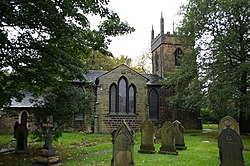
Ainsworth, Greater Manchester
Ainsworth (archaically known as Cockey) is a village and former civil parish in the Bury district, now in Greater Manchester, England. It lies on the western fringe of Bury, 2.2 miles (3.5 km) northwest of Radcliffe, and 2.9 miles (4.7 km) east of Bolton. The city of Manchester is 8.7 miles (14.0 km) south-southeast of Ainsworth. Author and ghostwriter Paul Stenning is a former resident and pupil of Ainsworth County Primary School.

Hemsworth
Hemsworth is a town and civil parish in West Yorkshire, England. Historically within the West Riding of Yorkshire it had a population of 13,311 at the 2001 census, with it increasing to 13,533 at the 2011 Census. The town lies 7½ miles from Barnsley, 7 miles from Pontefract and 9 miles from Wakefield.

Steeple Church
The Steeple Church occupies the western part of the historic "City Churches" building in Dundee, Scotland. It is a congregation of the Church of Scotland.
The "City Churches" are located in the city centre, adjacent to the Overgate shopping centre. The building is unusual as having two congregations within the same structure – the other congregation (at the eastern end) is Dundee Parish Church (St Mary's). The middle building ceased functioning as a place of worship in the early 1990s.
St Mary's Tower, the clock tower at the western end of the City Churches, is the oldest part of the church, and is currently operated by Dundee City Council's heritage department and is commonly referred to as the Old Steeple by locals.
During the war between Scotland and England known as the Rough Wooing, Dundee and Broughty Castle were occupied by English forces. In January 1548, an English commander, Thomas Wyndham placed a garrison of 20 "tall men" in the steeple, with the help of Andrew Dudley and the Scottish Lord Gray. Their armaments included cannon described as "a saker and a falcon and four double bases" and small guns called "hackbuts of crook".