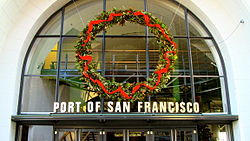
The Port of San Francisco is a semi-independent organization that oversees the port facilities at San Francisco, California, United States. It is run by a five-member commission, appointed by the mayor subject to confirmation by a majority of the San Francisco Board of Supervisors. The Port is responsible for managing the larger waterfront area that extends from the anchorage of the Golden Gate Bridge, along the Marina district, all the way around the north and east shores of the city of San Francisco including Fisherman's Wharf and the Embarcadero, and southward to the city line just beyond Candlestick Point. In 1968, the State of California, via the California State Lands Commission for the state-operated San Francisco Port Authority (est. 1957), transferred its responsibilities for the Harbor of San Francisco waterfront to the City and County of San Francisco/San Francisco Harbor Commission through the Burton Act AB2649. All eligible state port authority employees had the option to become employees of the City and County of San Francisco to maintain consistent operation of the port of San Francisco. The port of San Francisco lies on the western edge of the San Francisco Bay near the Golden Gate. It has been called one of the three great natural harbors in the world, but it took two long centuries for navigators from Spain and England to find the anchorage originally called Yerba Buena: a port, as was said in its early days, in which all the fleets of the world could find anchorage. The port area under the commission's control comprises nearly eight miles of waterfront lands, commercial real estate and maritime piers from Hyde Street on the north to India Basin in the southeast. The list of landmarks under port control include Fisherman's Wharf, Pier 39, the Ferry Building, Oracle Park (formerly AT&T Park, SBC Park and Pacific Bell Park), located next to China Basin and Pier 70 at Potrero Point. Huge covered piers on piles jut out into San Francisco Bay along much of the waterfront, bordered by the Embarcadero roadway. In 2015, the city, acting through the port of San Francisco, launched the San Francisco Seawall Earthquake Safety and Disaster Prevention Program (Seawall Program).

Nearby Places View Menu
Location Image
73 m

The Embarcadero and Washington station

The Embarcadero and Washington station is a light rail station in San Francisco, California, serving the San Francisco Municipal Railway's E Embarcadero and F Market & Wharves heritage railway lines. It is located on The Embarcadero at Washington Street. The station opened on March 4, 2000, with the streetcar's extension to Fisherman's Wharf. The stop is served by the L Owl bus route, which provides service along the F Market & Wharves and L Taraval lines during the late night hours when trains do not operate.
Location Image
138 m

Ferryboat Santa Rosa

Santa Rosa was a Steel Electric-class ferry built in Alameda, California, for Northwestern Pacific Railroad. She started out serving Southern Pacific Railways on their Golden Gate Ferries line on San Francisco Bay. She was purchased by the Puget Sound Navigation Company in 1940, and moved to Puget Sound. Puget Sound Navigation Company, believing that a single ended ferry would be more economical and faster, replaced her engines and converted her to a single-ended ferry, effectively making her no longer a true Steel Electric-class ferry. She was also renamed MV Enetai, which is the name she kept when she was later acquired by Washington State Ferries who took over operations in 1951. The ferry was returned to San Francisco after her sale in 1968, but sat largely unused until purchased by Hornblower Cruises in 1989. Hornblower restored her aft wheelhouse in an attempt to make her look like her original profile from 1927, however the passenger cabin retained the remodeled outline from her 1941 single-end conversion. She is currently moored at Pier 3 in San Francisco, where she serves as office space for Hornblower's Northern California Operations and also as Corporate Headquarters for Hornblower's suite of companies which include: Hornblower Cruises & Events Alcatraz Cruises Statue Cruises Niagara Cruises Liberty Landing Ferry Hornblower Classic Cable Cars NYC Ferry Service The Ferryboat Santa Rosa has since been retired from rental events.
Location Image
182 m

Abraham Lincoln Brigade Monument

The Abraham Lincoln Brigade Monument is a steel and onyx art installation in Embarcadero Plaza in San Francisco's Financial District, in the U.S. state of California. The Monument was designed by Ann Chamberlain and Walter J. Hood with US$400,000 in funding from the Abraham Lincoln Brigade Archives to honor the Lincoln Battalion and XV International Brigade, formed to fight for the Spanish Republic during the Spanish Civil War. It was dedicated on March 30, 2008 and is part of the San Francisco Arts Commission collection. One side of the monuments' panels show portraits of the volunteers. The other side of the panels contain annotated maps of the front lines between 1936 and 1938, as well as quotes of volunteers Abe Osheroff, Dave Smith, Alvah Bessie, Edwin Rolfe, Frederick Martin, Ruth Davidow, Robert Colodny, and Steve Nelson. The remainder panels contain words about that period from historians, labor organizers, writers, and musicians, such as Dolores Ibarruri, Albert Camus, Ernest Hemingway, and Paul Robeson. Intermittent repairs occurred in the decade since the Monument was installed. In August 2018, the onyx stone panels were removed and taken offsite for repair, due to a combination of design issues and neglect. The Monument was restored by May 2020.
Location Image
196 m

Vaillancourt Fountain

Vaillancourt Fountain, sometimes called Québec libre!, is a large fountain in Embarcadero Plaza in San Francisco, designed by the Québécois artist Armand Vaillancourt in collaboration with the plaza's landscape architect, Lawrence Halprin, and completed in 1971. It is about 40 feet (12 m) high and is constructed out of precast concrete square tubes. Long considered controversial because of its stark, modernist appearance, there have been several unsuccessful proposals to demolish the fountain over the years. It was the site of a free concert by U2 in 1987, when lead singer Bono spray painted graffiti on the fountain and was both praised and criticized for the action. The city determined the fountain to be a historic resource in 2025, and later voted to remove it citing concerns about structural deterioration.