

 English
 Français

Tallentire
Tallentire is a village and former civil parish, now in the parish of Bridekirk, in the Cumberland district of Cumbria, England. It is about 2.5 miles (4.0 km) north of Cockermouth. The village is located just outside the Lake District National Park. In 1931 the parish had a population of 184.

Rhodeswood Reservoir
Rhodeswood Reservoir is a man-made lake in Longdendale in north Derbyshire, England. It was constructed by John Frederick Bateman between 1849 and June 1855 as part of the Longdendale Chain of reservoirs to supply water from the River Etherow to the urban areas of Greater Manchester. It is third in the chain, and it is from here that the water is extracted to pass through the Mottram Tunnel to Godley for Manchester.
The Manchester Corporation Waterworks Act 1847 (10 & 11 Vict. c. cciii) gave permission for the construction of the Woodhead and Arnfield reservoirs; the Manchester Corporation Waterworks Act 1848 allowed the construction of Torside and Rhodeswood Reservoirs, and an aqueduct to convey the water to the Arnfield reservoir where it would pass through the Mottram Tunnel to Godley.
During construction, landslips were a problem. On the night of 6 February 1852, 30 acres (120,000 m2) of land beneath the contractors' village of New Yarmouth moved 6 inches (150 mm) obliquely to the watercourse. Bateman consulted the engineers Robert Stephenson and Isambard Kingdom Brunel. Pipes were sunk to draw off the water from the underlying shale.
The purest water in a reservoir lies between 1.5 and 3 metres (4 ft 11 in and 9 ft 10 in) beneath the water's surface, so water was extracted by means of syphons. The water now flows directly to the Arnfield Treatment Works in Tintwistle and to the Mottram Tunnel.
A statutory report, prepared under the Reservoir Safety Act 1975 and dated 12 June, stated that all five reservoirs could be overtopped during a Probable Maximum Flood. Woodhead as the fountainhead would have the most extensive improvements, and with these completed there was no danger at Rhodeswood of overtopping; however, there was weakness in the north spillway. To reduce the pressure, the roadway was consolidated to protect the north spillway from erosion, the embankment was raised by 40 millimetres (1.6 in) above the road, the wave wall was heightened by 1.2 m (3 ft 11 in) and the south spillway tunnel was remodelled. The work took place between 1994 and 1995.

Cables Wynd House
Cables Wynd House, better known as the Leith Banana Flats or the Banana Block because of its curved shape, is a nine-storey local authority housing block in Leith, Edinburgh. The building has ten storeys. The ground floor is called Cables Wynd and the nine floors above constitute Cables Wynd House. This often leads to confusion in postal and other services.

Birley Spa
Birley Spa is a community bath hall and a Victorian bathhouse in the Hackenthorpe district of the City of Sheffield, England. It is a Grade II listed building.

Felling mine disasters
The Felling Colliery (also known as Brandling Main) in Britain suffered four disasters in the 19th century, in 1812, 1813, 1821 and 1847. By far the worst of the four was the 1812 disaster which claimed 92 lives on 25 May 1812. The loss of life in the 1812 disaster was one of the motivators for the development of miners' safety lamps such as the Geordie lamp and the Davy lamp.

Rift House
Rift House is an area of south-west Hartlepool in the borough of Hartlepool, County Durham, England. It has a secondary school with a sixth-form college and two primary schools; English Martyrs, Kingsley and Rift House. It was a ward of the town for the 2011 UK Census, for the 2015 UK general election it was split between two wards Manor House (with Owton) and Foggy Furze.

St Mary and St Cyril's Coptic Orthodox Church
St Mary and St Cyril's Coptic Orthodox Church, previously known as the Church of St Paul, is a Coptic church in Stoneycroft, Liverpool, England. It is recorded in the National Heritage List for England as a designated Grade II* listed building. It was designed by Giles Gilbert Scott, who also designed the Anglican Liverpool Cathedral.
In 2016 the building was closed with a view to selling it to the Coptic Orthodox Church. Its Anglican benefice was united with that of St Anne, Stanley. The Coptic Orthodox Youth Society of the Liverpool Guild of Students is highly involved with the church and frequently takes part in Tasbeha and youth meetings.

Arnside and Silverdale National Landscape
Arnside and Silverdale National Landscape (legally and previously known as an Area of Outstanding Natural Beauty or AONB) in England, is on the border between Lancashire and Cumbria, adjoining Morecambe Bay. One of the smallest National Landscapes, it covers 29 square miles (75 km2) between the Kent Estuary, the River Keer and the A6 road. It was designated in 1972.

River Wiske
The River Wiske is a tributary of the River Swale in Yorkshire, England. The Wiske gives its name to several villages it passes through. The name Wiske is derived from an Old English word wisca meaning a water meadow. It was once known as the Foulbroke, a name for which some writers commented that it was well deserved.
The river was maintained by the River Wiske Internal Drainage Board, which was part of the Shires Group of IDBs. It is within the national character areas (NCAs) of the Vale of Mowbray and the Tees Lowlands.
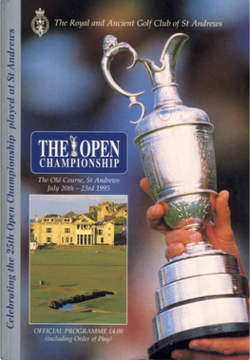
1995 Open Championship
The 1995 Open Championship was a men's major golf championship and the 124th Open Championship held from 20 to 23 July at the Old Course at St Andrews in St Andrews, Scotland. John Daly won his first Open Championship and second major title in a four-hole playoff over Costantino Rocca.
This was the final Open appearance for two-time champion Arnold Palmer and the first appearance for three-time champion Tiger Woods.

Manston, Leeds
Manston is a suburb and former village to the east of Cross Gates, Leeds, England, situated 4 miles (6 km) east of Leeds city centre.

St. Joseph's Church and Complex
St. Joseph's Church and Complex is a historic church built in 1906, and located at 1401–1415 Howard Street in the South of Market neighborhood of San Francisco, California, United States.
It was added to the National Register of Historic Places on January 15, 1982; and added to the list of San Francisco Designated Landmarks on October 5, 1980.

Leader Water
Leader Water is a small tributary of the River Tweed in Lauderdale in the Scottish Borders. It flows southwards from the Lammermuir Hills through the towns of Lauder and Earlston, joining the River Tweed at Leaderfoot.

Sleights railway station
Sleights is a railway station on the Esk Valley Line, which runs between Middlesbrough and Whitby via Nunthorpe. The station, situated 2 miles 78 chains (4.8 km) south-west of Whitby, serves the villages of Briggswath and Sleights in North Yorkshire, England. It is owned by Network Rail and managed by Northern Trains.


Benburb F.C.
Benburb Football Club is a Scottish football club, based in Govan, Glasgow. Formed in 1885, the club is a member of the Scottish Junior Football Association and currently competes in the West of Scotland Football League. Benburb's colours are blue and white.
The team have been managed since February 2024 by Marty Campbell. Campbell took over from former Airdrie defender Paul Lovering (who had in turn succeeded his father Frank who had been in the job for the previous thirteen seasons.)

White Wells
White Wells is a spa bath on Ilkley Moor in West Yorkshire, England.
White Wells was built around 1700 at the back of the current Spa Cottage as an open air spa bath. They were later enclosed, A single plunge pool survives today inside the Cottage.

Newtown St Boswells
Newtown St Boswells (Scots: Newtoon; Scottish Gaelic: Baile Ùr Bhoisil [ˈpaləˈuːɾˈvɔʃɪl]) is a village in the Scottish Borders council area, in south-east Scotland. The village lies south of the Eildon Hills on the Sprouston and Newtown burns, approximately 40 miles (64 km) south-east of Edinburgh. It is the administrative centre of the Scottish Borders, and was historically in the county of Roxburghshire.

Meadowbank and Willowbrae Church
Meadowbank and Willowbrae Church (known until 2017 as Holyrood Abbey Church, and then until 2025 as Meadowbank Church) is a congregation of the Church of Scotland in Edinburgh, Scotland. It is based in a late-Victorian church building on London Road, Abbeyhill, around 0.5 miles (0.80 km) north of Holyrood Abbey. The church building was opened in December 1900 as Abbeyhill United Free Church.
The 12th-century Holyrood Abbey served as the parish church of the Canongate until the construction of the Kirk of the Canongate in 1688. Following the Disruption of 1843 in the Church of Scotland, part of the congregation of the Kirk of the Canongate left to form Holyrood Free Church. A new building was constructed by them on Abbey Strand, in front of the Palace of Holyroodhouse. In 1915 this congregation united with Abbeyhill United Free Church, henceforth using the church buildings at 83 London Road. When the United Free Church of Scotland united with the Church of Scotland in 1929, the congregation became known as Holyrood Abbey Church.
The former Holyrood United Free Church building adjacent to the Palace was used for many years as a storeroom, but in 2002 was extensively renovated and reopened as The Queen's Gallery, for art exhibitions from the Royal Collection.
The building at 83 London Road was designed by R M Cameron, and is protected as a category B listed building. It was extensively upgraded in 2006–2007.
The name Meadowbank and Willowbrae Church was adopted following a union between the congregations of Meadowbank Church of Scotland and Willowbrae Parish Church in September 2023. A closing service was held in the Willowbrae building (formerly known as New Restalrig) in June 2025 and that building is expected to be put up for sale by the end of 2025.
In 2014 the minister of Holyrood Abbey Church resigned over his disagreement with the Kirk's decision to accept homosexual ministers in marriages and civil partnerships. He led many of the congregation to set up Holyrood Evangelical Church, an independent congregation.
Due to the shortage of Church of Scotland ministers, and following the schisms within Holyrood Abbey and the nearby New Restalrig Parish Church, the Presbytery of Edinburgh decided to close the building on the corner of London Road and Easter Road used by London Road Church and unite that congregation with the remaining members of the Holyrood Abbey congregation. The union took place in February 2017 and the combined congregation was known as Meadowbank Church.

Charles H. Roe
Charles H Roe was a Yorkshire coachbuilding company. It was for most of its life based at Crossgates Carriage Works, in Leeds.
In 1947 it was taken over by Park Royal Vehicles. Two years later, along with its parent, it became part of Associated Commercial Vehicles (ACV) in 1949, which was merged with Leyland Motors in 1962. In 1965, 30% of Park Royal and Roe's shares were exchanged by Leyland Motor Corporation for shares in Bristol Commercial Vehicles and Eastern Coach Works held by the Transport Holding Company (THC). Later the THC was succeeded by the National Bus Company (NBC) and Park Royal Vehicles, Charles H Roe, Bristol Commercial Vehicles, Eastern Coach Works and Leyland National Limited became subsidiaries of a new company Bus Manufacturers Holdings, 50% owned by British Leyland and 50% by NBC. Leyland took complete control in 1982 and closed Charles H Roe in September 1984. In the following year, a group of employees from the former business, began the Optare coachbuilding business in the former Roe carriage works.