

 English
 Français

Newton MRT station
Newton MRT station is an underground Mass Rapid Transit (MRT) interchange station on the North–South (NSL) and Downtown (DTL) lines. It is located in Newton, Singapore, at the junction of Scotts Road and Bukit Timah Road near Newton Circus. The station serves the offices and condominiums around Newton Circus including Goldbell Towers and Scotts Highpark, and it is within walking distance to the Newton Food Centre.
The NSL station opened on 12 December 1987 as part of the line's extension to Outram Park via Raffles Place station. The NSL station is designated as a Civil Defence Shelter with a reinforced structure. With the opening of DTL Stage 2 on 27 December 2015, Newton became a interchange station. An additional entrance, designed by SAA Architects, serves the new DTL station, which features an artwork Newton by Messymsxi as part of the network's Art-in-Transit programme.

Treasure Island Development
The Treasure Island Development is a 405-acre (164 ha) major redevelopment project under construction on Treasure Island and parts of Yerba Buena Island in San Francisco Bay between San Francisco and Oakland, within San Francisco city limits. The Treasure Island Development Authority (TIDA) is a nonprofit organization formed to oversee the economic development of the former naval station. The Treasure Island Project is being developed by a joint venture between Lennar and Kenwood Investments. The development is expected to cost US$1.5 billion.

RAF Burtonwood
Royal Air Force Burtonwood (or RAF Burtonwood) is a former Royal Air Force and United States Army Air Forces base that was located in Burtonwood, 2 miles (3.2 km) Northwest of Warrington in Cheshire, England. The base was opened in 1940 in response to World War II by the RAF and in 1942 it was transferred to the United States of America for war operations.
The base was home to 18,000 American servicemen at the end of the war. In 1946 the base was transferred back to the United Kingdom however United States operations continued. The base officially closed in 1991 and since then the runway and most of the associated buildings have been demolished. RAF Burtonwood Heritage Centre was opened on part of the former base and focuses on the lives of the servicemen, the war and the airplanes at the base.

Cockpen
Cockpen is a parish in Midlothian, Scotland, containing at its north-west corner the town of Bonnyrigg, which lies two miles (3.2 km) south-west of Dalkeith. It is bounded on the west and north by the parish of Lasswade, on the east, by Newbattle and on the south by Carrington. It extends about three miles (4.8 km) from north to south and its greatest breadth is about 2+1⁄2 miles (4.0 km).
The parish lies between the rivers North Esk and South Esk, which join about 2 miles north of the parish. At Lasswade the parish reaches the North Esk which at that point forms the boundary on the north-west side, such that the suburb of Westmill on the south-east bank lies in the parish of Cockpen. The South Esk briefly forms the southern boundary of the parish then flows northward through the parish past Dalhousie Castle, exiting in the north-east into Newbattle parish.
A Parochial Board was established under the Poor Law (Scotland) Act 1845. Within the parish of Cockpen a police burgh was created at Bonnyrigg in 1865 (although part lay in the parish of Lasswade). Police burghs were communities over a certain size which were entitled to police many of their own affairs, such as cleansing, street lighting and water supply as well as public order. Police burghs were run by elected commissioners or magistrates.
With the Local Government (Scotland) Act 1894 the Parish Council was established, but this only administered the “landward” part of the parish, i.e. outside Bonnyrigg. Under the terms of the Local Government (Scotland) Act 1929, Bonnyrigg and Lasswade were united to become the burgh of Bonnyrigg and Lasswade. The burgh was abolished in 1975 and subsumed into Midlothian district of Lothian region The parish council ceased in 1930 when parish councils in Scotland were abolished, but civil parishes persist for census and other non-administrative purposes.
From the 12th to the 19th centuries the parish of Cockpen comprised the same area as the Barony of Dalhousie (a corruption of Dalwolsie). The lands of Dalhousie have been owned by the Ramsays since the 12th century having been given to them by the monks of Newbattle Abbey. The patronage of the parish church belonged anciently to this family. In May 1542, James V granted to Nicol de Ramsay, of Dalhousie, a power of Justiciary over his lands of Dalhousie, and Carrington, in the county of Midlothian (Edinburghshire), but this appears to have expired on his death in 1554. There have been a succession of fortresses at their seat, Dalhousie Castle, which lies on the north bank of the South Esk. The castle was successfully defended against Henry IV in 1400, and in 1648, it was occupied by Cromwell. The present building dates from the 15th century.
The parish church is one mile (1.6 km) south-east of Bonnyrigg on rising land on the west bank of Dalhousie Burn. The building dates from 1820 and replaced an earlier structure.
The South Esk, after leaving Dalhousie Castle, passes close by the romantic place where Cockpen House stood, the mansion of the Laird o' Cockpen, the subject of the traditional Scottish song of that name.
The area of the parish is 2,938 acres (1,189 ha).
The civil parish has a population of 10,466 (in 2011).


Kirkstall Power Station
Kirkstall Power Station was a coal-fired unit opened in 1930, serving the city of Leeds, West Yorkshire, England.
It was situated in Kirkstall by the River Aire north-west of Leeds and had its own wharf for delivery of coal via the Leeds and Liverpool Canal.

Whitestake
Whitestake is a small village in the South Ribble district of Lancashire, England, on the eastern edge of New Longton It is at the boundary of the parishes of Farington, Longton and Penwortham. It falls in what is called the "Western Parishes" area of South Ribble.
The name Whitestake supposedly originated because residents could stake a claim with a white stick so that their livestock could graze on the moss. This is said to have taken place once a year at the Farmers Arms Public House (still extant).
It is the site of the Turbary Woods Owl and Bird Sanctuary.

St Paul's Square, Liverpool
St Paul's Square is a square in Liverpool City Centre and is bordered by Old Hall Street, East Street and Rigby Street.

River Calder, Cumbria
The River Calder is a river in Cumbria, England.
The river rises at Lankrigg Moss and flows southwards for 10 miles (16 km) through an ancient landscape, flowing under Monks Bridge (a packhorse bridge) and by the site of Calder Abbey, as well as several tumuli and other mysterious monuments. It also runs past and (indirectly) gives its name to Calder Hall, site of the world's first commercial nuclear reactor.
Near its mouth the river runs through the Sellafield nuclear site in an artificially straightened section before flowing into the Irish Sea at the same point as the River Ehen, just southwest of Sellafield.

Whitmore Hall
Whitmore Hall is the home of the Cavenagh-Mainwaring family at Whitmore, Staffordshire. A Grade I listed building, the hall was designated a house of outstanding architectural and historical interest and is a fine example of a small Carolean style manor house.

St Michael's Church, Great Edstone
St Michael's Church is an Anglican church in Great Edstone, a village in North Yorkshire, in England.
There has been a church on the site since the Saxon period, and the sundial set above the main doorway is from this period. It is inscribed "Orologicum viatorium. Lodan me wrohte a". The oldest part of the current building is the 13th-century nave. The chancel was rebuilt in the 18th century, and there were further alterations when it was restored by C. Hodgson Fowler from 1898 to 1899. The church was grade II* listed in 1955.
The church is built of limestone with a slate roof, and consists of a nave and a chancel in one unit. On the west gable is a square timber bellcote with louvred bell openings and a pyramidal roof. The south doorway has voussoirs and a moulded hood mould springing from imposts, and above it is the sundial. Inside, the bells date from the 14th century, and the altar rail is 16th century. The font is Norman, with a carved base. The west window is a lancet and contains 19th-century stained glass.

All Saints' Church, Brompton
All Saints' Church is the parish church of Brompton, a village near Scarborough, North Yorkshire in England.
The church is most famous as the location where, in 1802, William Wordsworth married Mary Hutchinson. In 2002, a festival celebrated the 200th anniversary of the wedding.
There was a church on the site by the 12th century. The oldest parts of the current building are the tower and nave, which date from the 14th century, although some fragments of the earlier building are incorporated into it. The arcade, south aisle and chancel were added in the 15th century. The church was restored in 1878, and the south porch was added in 1895. The building was Grade I listed in 1967.
The church is built of sandstone with a slate roof. The steeple has a tower with three stages, large diagonal buttresses, a northeast stair turret, and bell openings with ogee-headed lights and pointed hood moulds. On the tower is an octagonal broach spire with lucarnes and a weathervane. There are embattled parapets on the porch, the aisles and the chapel, and in the nave and south wall of the chancel are three-light Perpendicular windows. The walls of the church contain re-set Norman fragments, notably including two figures of women, one seated, who may represent the Virgin Mary. Inside, the gallery and organ case date from 1893 and were designed by Temple Moore. The font is circular and is 13th century. There are several monuments, including a tablet of 1580, and a wall brass from 1688.

Castleford railway station
Castleford railway station serves the town of Castleford, in West Yorkshire, England. It lies on the Hallam and Pontefract lines, 11 miles (18 km) south-east of Leeds.
In February 2016, West Yorkshire Metro opened the new Castleford bus station close to the railway station, featuring an integrated and staffed transport interchange. Work on the new £6 million bus station was started in October 2014.

Shipton, North Yorkshire
Shipton (also known as Shipton-by-Beningbrough) is a village and civil parish in the county of North Yorkshire, England, about 5 miles (8 km) north-west of York.

Unthank, Glassonby
Unthank is a village near Gamblesby in the civil parish of Glassonby in Cumbria, England. It is first mentioned in writing as Unthanke in 1332.

Thorpe le Street
Thorpe le Street is a hamlet and former civil parish, now in the parish of Hayton, in the East Riding of Yorkshire, England.

Appleby railway station
Appleby is a railway station on the Settle and Carlisle Line, which runs between Carlisle and Leeds via Settle. The station, situated 30 miles 60 chains (49.5 km) south-east of Carlisle, serves the market town of Appleby-in-Westmorland in Cumbria, England. It is owned by Network Rail and managed by Northern Trains.
The station was formerly known as Appleby West, with the older Appleby East station located nearby on the Eden Valley Railway. The buildings of Appleby East still survive.

Auchinstarry
Auchinstarry is a village in North Lanarkshire, Scotland, UK, near to Kilsyth. It is the site of a Roman fort.
Auchinstarry Basin is on the Forth and Clyde Canal, and a £1.2M regeneration project has created a mooring basin for boats with 56 pontoon berths, a hard standing area for 40 boats, and a customer facilities block, partly funded by British Waterways Scotland. The basin was officially opened in September 2005.
The Environment Advisory Service (EAS), a government agency, has implemented a number of sustainability features at Auchinstarry Basin:
Deploying recycled materials in all parts of the construction process
An innovative pump which draws heat from the canal; it is believed that this is the first such use of canal water in the UK
Plans for installing wind turbines, and a new pub which is self-sufficient in its energy needs

Musselburgh railway station (1847)
Musselburgh railway station served the town of Musselburgh, Scotland. Services were provided by trains on the Musselburgh Branch.
An existing station also named Musselburgh had opened a year earlier in 1846, on the East Coast Main Line, this station was renamed as Inveresk railway station when the 1847 Musselburgh station opened.
Baron of Aiket
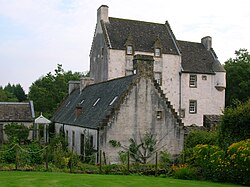
Baron of Aiket is a title of nobility in the Baronage of Scotland for the holder of the Barony of Aiket with its castle, lay within the old feudal bailiary of Cunninghame. The barony lands equate to the extant Parish of Dunlop, East Ayrshire, Scotland.