

 English
 Français
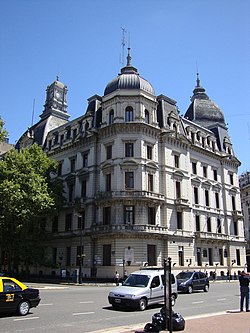
Buenos Aires City Hall
Buenos Aires City Hall (Spanish: Palacio Municipal de la Ciudad de Buenos Aires; lit. "Municipal Palace") was, until 2015, the seat of the Office of the Chief of Government of Buenos Aires, the capital city of Argentina. From its construction in 1914 to the reformation of the city's constitution in 1996, the building was the seat of the City Municipality. It faces the Plaza de Mayo, across from the Casa Rosada presidential palace, in the barrio of Monserrat. Since 2015, the Office of the Chief of Government has been located at a new building (Casa de la Ciudad) in the barrio of Parque Patricios (south side Uspallata facing Parque de los Patricios). The City Hall still houses various government offices of the city government.
Nearby Places View Menu

0 m
Plaza de Mayo
The Plaza de Mayo (Latin American Spanish pronunciation: [ˈplasa ðe ˈmaʝo], Rioplatense: [- ˈmaʒo, - ˈmaʃo]; English: May Square) is the main city square of Buenos Aires, Argentina. It was formed in 1884 after the demolition of the Recova building, unifying the city's Plaza Mayor and Plaza de Armas, by that time known as Plaza de la Victoria and Plaza 25 de Mayo, respectively. The city centre of Buenos Aires, Plaza de Mayo has been the scene of the most momentous events in Argentine history, as well as the largest popular demonstrations in the country. On the occasion of the first anniversary of the May Revolution in 1811, the Pirámide de Mayo (English: May Pyramid) was inaugurated in the square's hub, becoming Buenos Aires' first national monument.
It is located in the financial district known as microcentro, within the barrio (English: neighborhood) of Monserrat. It is bounded by Bolívar, Hipólito Yrigoyen, Balcarce and Avenida Rivadavia streets; and from its west side three important avenues are born: Avenida Presidente Julio Argentino Roca, Avenida Roque Sáenz Peña and Avenida de Mayo. In the square's surroundings are several significant monuments and points of interest: the Cabildo, the Casa Rosada (seat of the President of Argentina), the Metropolitan Cathedral, the Buenos Aires City Hall, and the Bank of the Argentine Nation's headquarters. Underneath its lands are the Underground stations of Plaza de Mayo (Line A), Catedral (Line D), and Bolívar (Line E).
0 m
Revolution of 11 September 1852
The Revolution of 11 September 1852 was a conflict between the Province of Buenos Aires and the government of Justo José de Urquiza after the latter triumphed over Juan Manuel de Rosas at the Battle of Caseros.
A period known as "National Organization" was initiated after the Battle of Caseros. Every political faction agreed on authorizing a national Constitution. However, in opposition to the rest of the country, the ruling upper class in Buenos Aires aspired to impose political requirements on the Argentine provinces, so as to maintain the traditional political and economic preeminence of the capital city.
The result was a ten-year separation between the Argentine Confederation and the State of Buenos Aires. Both states claimed to be part of a single nation. But in reality, they behaved like separate states.

0 m
Bombing of Plaza de Mayo
On 16 June 1955, 30 aircraft from the Argentine Navy and Air Force bombed and strafed Plaza de Mayo, the main square of the Argentine capital Buenos Aires. The attack targeted the adjacent Casa Rosada, the seat of government, while a large crowd demonstrated in support of the president, Juan Perón. The strike took place during a day of official public demonstrations to condemn the burning of a national flag allegedly carried out by detractors of Perón during the recent Corpus Christi procession. The military reacted as a result of growing tension between Perón and his actions against the Roman Catholic Church. The action was to be the first step in an eventually aborted coup d'état. The number of identified bodies was put at 308, including six children, making it according to some sources the deadliest terrorist attack in Argentine history. Some victims could not be identified.
The heavy loss of civilian lives and the violence with which the act was carried out has prompted comparisons with the wave of state terrorism during the dictatorship of 1976–1983.

24 m
Pirámide de Mayo
The Pirámide de Mayo (Spanish pronunciation: [piˈɾamiðe ðe ˈmaʝo]; English: May Pyramid), located at the hub of the Plaza de Mayo, is the oldest national monument in the City of Buenos Aires. Its construction was ordered in 1811 by the Primera Junta to celebrate the first anniversary of the May Revolution. It was renovated in 1856, under the direction of Prilidiano Pueyrredón. In 1912, after having undergone many modifications, it was moved 63 metres (68.9 yards) to the east, with the idea that a much larger monument would eventually be constructed around it.
The monument is crowned by an allegory of Liberty, the work of the French sculptor Joseph Dubourdieu. From the ground to the peak of the statue's Phrygian cap, the Pyramid measures 18.76 metres (61.5 feet).