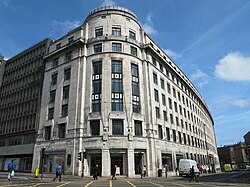
Grainger Town is the historic commercial centre of Newcastle upon Tyne, England. It covers approximately 36 ha (89 acres). Almost all of Grainger Town is in Newcastle's Central Conservation Area, one of the first designated in England. The area includes a medieval 13th-century Dominican priory, pieces of the historic Town Walls, and many fine Georgian and Victorian buildings.
The area is named after Richard Grainger, a developer who built several classical streets between 1824 and 1841, including Grey Street, Grainger Street, and Clayton Street. Richard Grainger was said to “have found Newcastle of bricks and timber and left it in stone” (echoing what Augustus claimed to have done for Rome).
Some of Newcastle's finest buildings are in Grainger Town, including Grainger Market and Theatre Royal. These buildings are predominantly four stories, with vertical dormers, domes, turrets, and spikes. The architecture is dubbed “Tyneside Classical”. Grainger Town has 450 buildings, and 244 are listed (29 at grade I and 49 at grade II*). The majority of buildings remain in private ownership. Sir Nikolaus Pevsner described Grey Street as “one of the finest streets in England”. The area around it and Grey's Monument is expanding quickly, with high-quality shopping, including designer fashions and jewelry. The Central Exchange, containing the Edwardian Central Arcade, is located in Grainger Town.

Nearby Places View Menu
Location Image
101 m

Alderman Fenwick's House

Alderman Fenwick's House is a grade one listed building of early Georgian appearance at 98-100 Pilgrim Street in Newcastle upon Tyne. As one of the few surviving merchant's houses it has both architectural and historic significance in the town.
Location Image
107 m

Carliol House

Carliol House is a Grade II listed building in Newcastle upon Tyne that curved the corner of Market Street East and Pilgrim Street in the city-centre. As of 2024 only the façade of the building remains.
Location Image
116 m

The Round

The Round was a theatre-in-the-round in the Ouseburn Valley, Newcastle upon Tyne, England. The region's first theatre-in-the-round, it specialised in theatre for children and young people. The Round opened in September 2007, and was home to the Bruvvers Theatre Company. The building in which The Round was housed is a former flax mill designed by John Dobson in 1848. The 180-seat theatre slotted behind a listed facade in a courtyard space between warehouses on Lime Street. The Round was conceived by the Bruvvers Theatre Company artistic director Mike Mould who bought the derelict Cluny building in 1982 with the intention of creating a theatre within its walls. In 2005, Mould sent a letter to his friends asking each to donate £1 to help fund the cost of building the theatre. Bruvvers director and television scriptwriter Julie Blackie suggested alternative methods of fundraising. The theatre had one wall with a fixed block of 40 seats and three balconies, with the remaining seats moveable according to the needs of each production According to the company, there was "one main route onto the stage for the performers, but also a few secret passages to add an element of surprise." The company filed for voluntary liquidation in May 2008, just eight months after its launch. The Round Theatre had been built with capital funding from a consortium of parties in the Ouseburn district of Newcastle but had failed to secure funding for programming or administrative costs beyond its first six months of trading. Directors Jeannie Adams and Julie Blackie decided to cease trading and begin liquidation proceedings. Average houses of just 52% fell far short of the 70% capacity the company had budgeted to break even. In May 2009, it was announced that The Cluny would be taking over the running of the adjacent former Round Theatre.
Location Image
116 m

Monument, Newcastle upon Tyne

Monument is an electoral ward and area of Newcastle upon Tyne. It was established as an electoral ward in 2018. It takes its name from Grey's Monument. It replaced most of Westgate ward, parts of South Jesmond and some of Ouseburn.