

 English
 Français

Monument, Newcastle upon Tyne
Monument is an electoral ward and area of Newcastle upon Tyne. It was established as an electoral ward in 2018. It takes its name from Grey's Monument. It replaced most of Westgate ward, parts of South Jesmond and some of Ouseburn.
Nearby Places View Menu

0 m
The Round
The Round was a theatre-in-the-round in the Ouseburn Valley, Newcastle upon Tyne, England. The region's first theatre-in-the-round, it specialised in theatre for children and young people. The Round opened in September 2007, and was home to the Bruvvers Theatre Company.
The building in which The Round was housed is a former flax mill designed by John Dobson in 1848. The 180-seat theatre slotted behind a listed facade in a courtyard space between warehouses on Lime Street.
The Round was conceived by the Bruvvers Theatre Company artistic director Mike Mould who bought the derelict Cluny building in 1982 with the intention of creating a theatre within its walls. In 2005, Mould sent a letter to his friends asking each to donate £1 to help fund the cost of building the theatre. Bruvvers director and television scriptwriter Julie Blackie suggested alternative methods of fundraising.
The theatre had one wall with a fixed block of 40 seats and three balconies, with the remaining seats moveable according to the needs of each production According to the company, there was "one main route onto the stage for the performers, but also a few secret passages to add an element of surprise."
The company filed for voluntary liquidation in May 2008, just eight months after its launch. The Round Theatre had been built with capital funding from a consortium of parties in the Ouseburn district of Newcastle but had failed to secure funding for programming or administrative costs beyond its first six months of trading. Directors Jeannie Adams and Julie Blackie decided to cease trading and begin liquidation proceedings. Average houses of just 52% fell far short of the 70% capacity the company had budgeted to break even.
In May 2009, it was announced that The Cluny would be taking over the running of the adjacent former Round Theatre.

29 m
Central Arcade, Newcastle upon Tyne
The Central Arcade is a small shopping centre in Newcastle upon Tyne, England.
76 m
GreyFriars, Newcastle-upon-Tyne
GreyFriars, Newcastle-upon-Tyne was a friary in Newcastle-upon-Tyne, Tyne and Wear, England, which was founded in Pilgrim Street in 1237, was sold after the Dissolution of the Monasteries, and then rebuilt as a private residence, as New Place and Anderson Place, before being demolished to become Grey Street.
89 m
Newcastle upon Tyne
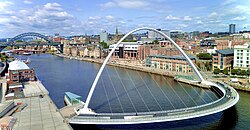
Newcastle upon Tyne, or simply Newcastle ( new-KASS-əl, RP: NEW-kah-səl), is a cathedral city and metropolitan borough in Tyne and Wear, England. It is England's northernmost city, located on the River Tyne's northern bank opposite Gateshead to the south. It is the most populous settlement in the Tyneside conurbation and North East England. The metropolitan borough had an estimated population of 320,605 in 2024.
Newcastle developed around a Roman settlement called Pons Aelius. The settlement became known as Monkchester before taking on the name of a castle built in 1080 by William the Conqueror's eldest son, Robert Curthose. It was one of the world's largest ship building and repair centres during the Industrial Revolution. Newcastle was historically part of the county of Northumberland, but governed as a county corporate after 1400. In 1974, Newcastle became part of the newly created metropolitan county of Tyne and Wear. The local authority is Newcastle City Council, which is a constituent member of the North East Combined Authority.