

 English
 Français
GreyFriars, Newcastle-upon-Tyne
GreyFriars, Newcastle-upon-Tyne was a friary in Newcastle-upon-Tyne, Tyne and Wear, England, which was founded in Pilgrim Street in 1237, was sold after the Dissolution of the Monasteries, and then rebuilt as a private residence, as New Place and Anderson Place, before being demolished to become Grey Street.
Nearby Places View Menu

26 m
Tyneside Cinema
The Tyneside Cinema is an independent cinema in Newcastle upon Tyne. It is the city's only full-time independent cultural cinema, specialising in the screening of independent and world cinema from across the globe. The last remaining newsreel theatre to be in full-time operation in the UK, it is a Grade II listed building. The Tyneside's patrons are filmmakers Mike Figgis and Mike Hodges, and musicians Neil Tennant of the Pet Shop Boys and Paul Smith of Maxïmo Park. Its cultural remit is set by the trustees and is a requisite for continued funding from sponsors such as the BFI and the Arts Council.
Alongside its core programme of cultural cinema, the newly refurbished Tyneside Cinema holds daily free screenings of archive newsreel footage and guided tours. The cinema also allows budding producers and digital artists to network and present their work. A £7m restoration and renovation project occurred between 2006 and 2008, and the venue now boasts digital projection and 3D facilities alongside traditional film projection.
54 m
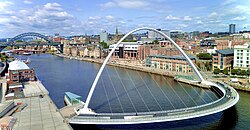
Newcastle upon Tyne
Newcastle upon Tyne, or simply Newcastle ( new-KASS-əl, RP: NEW-kah-səl), is a cathedral city and metropolitan borough in Tyne and Wear, England. It is England's northernmost city, located on the River Tyne's northern bank opposite Gateshead to the south. It is the most populous settlement in the Tyneside conurbation and North East England. The metropolitan borough had an estimated population of 320,605 in 2024.
Newcastle developed around a Roman settlement called Pons Aelius. The settlement became known as Monkchester before taking on the name of a castle built in 1080 by William the Conqueror's eldest son, Robert Curthose. It was one of the world's largest ship building and repair centres during the Industrial Revolution. Newcastle was historically part of the county of Northumberland, but governed as a county corporate after 1400. In 1974, Newcastle became part of the newly created metropolitan county of Tyne and Wear. The local authority is Newcastle City Council, which is a constituent member of the North East Combined Authority.

60 m
Grey's Monument
Grey's Monument is a Grade I-listed monument in the centre of Newcastle upon Tyne, England. It was built in 1838 in recognition of Charles Grey, 2nd Earl Grey, Prime Minister of the United Kingdom from 1830 to 1834. In particular, it celebrates the passing of the Great Reform Act 1832, one of Grey's most important legislative achievements. The act reorganised the system of parliamentary constituencies and increased the number of those eligible to vote.
The monument is located at the junction of Grey, Grainger and Blackett Streets and has a total height of 133 ft (41 m). It was funded via public subscription and consists of a statue of Earl Grey on a pedestal standing on top of a Roman Doric column. The column was designed by local architect, Benjamin Green, and the statue was created by the sculptor, Edward Hodges Baily.
A contemporary report of the unveiling ceremony described the monument as "a fine imaginative work of art" and other 19th century commentators praised it as "a noble effort of genius" and as having "a most commanding appearance". However, its location, then at the centre of the city's tram infrastructure, was criticised as unsuitable, with one newspaper declaring that "in its present situation, it will be a great nuisance" and, in the 1920s, there were calls to move the column to improve traffic flow. In 1981, the nearby station on the Tyne and Wear Metro was named after the monument. The pedestrianised area around the base is a popular meeting place and is used as a speakers' corner.

71 m
Newcastle Odeon
Newcastle Odeon was a 2,602-seat cinema located in Pilgrim Street in Newcastle upon Tyne, England. It opened as the Paramount Theatre on September 7, 1931 before being purchased by Odeon Cinemas on November 27, 1939 and renamed the Odeon on 22nd April 1940. During the 1960s and 1970s it was also used for pop and rock concerts.
In 1975 the cinema was tripled, with a 1,228-seat Screen 1 created from the original balcony and 158-seat (Screen 2) and 250-seat (Screen 3) screens created in the former stalls area. A 361-seat Screen 4 was added in 1980 using the former stage area.
In 1999, the cinema was Grade II listed by English Heritage due to its partially-surviving opulent interior. In 2001, Odeon Theatres successfully appealed the listing and the cinema closed in 2002. It lay empty until finally being demolished in 2017.