

 English
 Français

South Chadderton tram stop
South Chadderton is a Manchester Metrolink tram stop in Coalshaw Green, Chadderton, Oldham. It is on the Oldham and Rochdale Line and in fare zone 3. This stop was opened on 13 June 2012 as part of Phase 3a of the system's expansion and it has step-free access.
It is located at street-level, and is near to Coalshaw Green Park. It was also purpose-built for Metrolink on the route of the former Oldham Loop Line: the tram stop itself is not a converted railway station unlike some other tram stops along the Oldham and Rochdale Line.

Fairmont Golden Prague Hotel
The Fairmont Golden Prague is a historic 9-story, 320-room hotel on the bank of the Vltava River, near the Old Town, in Prague, Czech Republic. It is managed by Fairmont Hotels.

Stawardpeel Woods
Stawardpeel Woods is a Site of Special Scientific Interest (SSSI) in Northumberland, England. This protected area is located in the valley of the River Allen, near Bardon Mill. The protected area is owned by the National Trust, within the Allen Banks & Staward Gorge estate.

Westmorland County Football Association
The Westmorland County Football Association is the governing body of football in the county of Westmorland. The association was formed in 1897.
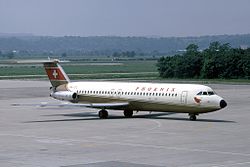
Austral Líneas Aéreas Flight 901
Austral Líneas Aéreas Flight 901 was a scheduled passenger flight from Teniente General Benjamín Matienzo International Airport to Buenos Aires Aeroparque Jorge Newbery, the aircraft crashed in a river near Buenos Aires, Argentina on May 7, 1981, after flying into a thunderstorm. All 31 people on board in the BAC-1-11 were killed in the crash.

Bradford Grammar School
Bradford Grammar School (BGS) is a co-educational private day school located in Frizinghall, Bradford, West Yorkshire, England.
Entrance is by examination. Sixth form admission is based on GCSE results. The school gives means-tested bursaries to help with fees. Like many other independent schools, BGS also offers a small number of scholarships based on academic achievement.

Northern Education Trust
Northern Education Trust is a multi-academy trust operating in the North of England, established in 2010. It operates both primary and secondary academies. The Northern Education Trust (NET) is a founder and member of the Northern Alliance of Trusts.

Thoralby
Thoralby is a village and civil parish in the county of North Yorkshire, England. It lies south of Aysgarth, is within a mile of both Newbiggin and West Burton and is in the Yorkshire Dales National Park. It is 23.5 miles (37.8 km) south-west of the county town of Northallerton.

St Magdalene distillery
St. Magdalene distillery was a Lowland single malt Scotch whisky distillery in Linlithgow, Scotland.
It operated between 1798 and 1983. The former distillery buildings were converted into apartments.

Temple Wood
Temple Wood (or Half Moon Wood) is an ancient site located in Kilmartin Glen, near Kintyre, Argyll, Scotland. The site includes two circles (north and south). The southern circle contains a ring of 13 standing stones about 12 metres (40 feet) in diameter. In the past it may have had 22 stones. In the centre is a burial cist surrounded by a circle of stones about 3 metres (10 feet) in diameter. Other later burials are associated with the circle. According to the Historic Scotland information marker at the site, the southern circle's first incarnation may have been constructed around 3000 BC.
The northern circle is smaller and consists of rounded river stones (which also fill the southern circle). In its centre is a single stone; another stone is found on the edge of the circle. This circle may have originated as a timber circle.
The name of the site originates in the 19th century (coinciding with the planting of trees around the circles) and has no relevance to the purpose of the site. It is located just south of the southern Nether Largie cairn. It is a designated scheduled monument.

Thornes Park
Thornes Park is a large public park situated close to the centre of Wakefield, West Yorkshire, England. Along with Clarence Park and Holmfield Park it forms a large parkland to the south west of the city.
The park hosts a model railway, formal gardens, a lake, an indoor leisure centre and an athletics track. The park also has 60 hectares of open spaces and a two-mile circular walkway around the park.
A mound lies in the centre of the park, once part of an old motte-and-bailey castle, which offers views across the city.

Odeon Sheffield
Odeon Sheffield is a multiplex cinema located at Arundel Gate in Sheffield city centre, South Yorkshire, England, adjacent to the city's O2 Academy.
It is operated by Odeon Cinemas and has ten screens. Screen 1 is the largest, having 252 seats, and is the only one with 3D capability. Both Screen 4 & 5 have the smallest number of seats at 113.
The building itself was built in the 1970s as the Fiesta nightclub and played host to such acts as The Jackson Five, The Beach Boys and Stevie Wonder. Opening as Odeon 7 on 5 March 1992, the cinema had seven screens before it expanded into what was previously the 'Showroom' in 1994 (not to be confused with Sheffield's Showroom Cinema).
Sheffield had two earlier Odeon cinemas, the 1956 Odeon on Flat Street (closed in 1971 and turned over to bingo) and the 1987 Odeon twin on Burgess Street (the parsimonious replacement for the large Gaumont) which survived only until 1994 and is now the Embrace nightclub.
It is now an Odeon Luxe from December 2018.

Kildwick Hall
Kildwick Hall is a historic building in Kildwick, a village in North Yorkshire, in England.
The manor house was probably built in about 1650 for Henry Currer. The kitchen was added in 1673, and the house was altered between 1722 and 1724, and again in the mid 19th century. In 1955, the building was sold and converted into a hotel, later becoming a country club and a restaurant, before being reconverted into a house in the 1990s. In 1967, the property was used to film the television adaptation of Wuthering Heights. The hall has been grade II* listed since 1954.
The house is built of gritstone, with quoins, and a stone slate roof with gable copings, moulded kneelers and pyramidal finials. It has three storeys and four gabled bays, the outer bays and the third bay, with a two-storey porch, slightly projecting. The porch contains a doorway with a moulded surround, and a triangular head, above which is a hood mould, and a moulded plaque with a coat of arms in relief. The windows in the lower two floors are mullioned and transomed, those in the upper floor are mullioned, two of them with ogee heads, and all have hood moulds. At the rear is a three-bay kitchen range from 1673 linked to the house. Inside, the fireplace in the front right room has a 17th-century overmantel, and 18th-century plasterwork on the ceiling, in the Gothick style. Several other rooms have early panelling and plasterwork, including 17th-century ceiling panels on the first floor landing. The main staircase is early and built of stone, and its first half-landing is lit by a window with early painted glass.

Harle Syke Mill
Harle Syke mill is a weaving shed in Briercliffe on the outskirts of Burnley, Lancashire, England. It was built on a green field site in 1856, together with terraced houses for the workers. These formed the nucleus of the community of Harle Syke. The village expanded and six other mills were built, including Queen Street Mill.
The Haggate Joint Stock Commercial Company opened it in 1858 as a production mill, but re-organised it in 1865 to become a 'room and power' company. Seven producer partnerships were formed by the shareholders who had been allocated looms on a pro rata basis. The companies consolidated into 4 main businesses. Shares in the room and power 'walls' company were traded resulting in a smaller number of shareholders with larger investments. In 1903, the 'walls' liquidated passing assets to the Harle Syke Mill Company which built a new larger shed, jokingly called Siberia Shed after a delay in providing a heating system. The new mill engine which is now displayed in the Science Museum, London, where it is run on occasions under steam power. The older part of the building is called Oxford Mill.

Gaiety Theatre, Manchester
The Gaiety Theatre, Manchester was a theatre in Manchester, England. It opened in 1884 and was demolished in 1959. It replaced a previous Gaiety Theatre on the site that had been destroyed by fire.
The new theatre was designed by Alfred Darbyshire for United Theatres Co. Ltd. and built on a plot of land near to the corner of Peter Street and Mount Street. It opened as the Comedy Theatre in 1884. On 9 November 1908, it was bought by Annie Horniman for £25,000 and reconstructed to plans by Frank Matcham, reducing its capacity from 2,500 to 1,300. The theatre reopened as the Gaiety Theatre in 1912. It was Britain's first regional repertory theatre. In 1920 the theatre was taken over by Samuel Fitton & Associates but closed in 1922. It was in use again between 1945 and 1947 but was demolished in 1959.
During the time the theatre was being run by Annie Horniman, a wide variety of types of plays was produced. Anne Horniman also encouraged local writers, who became known as the Manchester School of playwrights. They included Allan Monkhouse, Harold Brighouse, writer of Hobson's Choice, and Stanley Houghton, who wrote Hindle Wakes. Actors who performed at the Gaiety early in their careers include Sybil Thorndike and Basil Dean.
In 2008 Annie Horniman's centenary was celebrated by a performance of Houghton's play Independent Means, which had been recently "rediscovered" in the British Library by Chris Honer, the theatre's artistic director.

Apple Museum, Prague
The Apple Museum was a museum located in Old Town, Prague, Czech Republic. It showcased a collection of Apple memorabilia and products, and featured numerous visual and audio tributes to Steve Jobs. The collection included nearly every Apple product ever created. The museum was permanently closed in September 2020.

Alfred Dunhill Links Championship
The Alfred Dunhill Links Championship is a golf tournament on the European Tour. It is played in September or October, on three different links courses, centered on the "home of golf", St Andrews in Fife, Scotland.

Kirklands Hospital
Kirklands Hospital is a mental health facility in Bothwell, Scotland. It is managed by NHS Lanarkshire.

Black Brook, West Yorkshire
The Black Brook is a small river in Calderdale, West Yorkshire, England.
The Black Brook rises near the border of Calderdale and Kirklees next to Scammonden Dam. It flows downwards through Stainland Dean, and then between Greetland and Stainland. Most of the river, at this point, forms a parish border between the parishes of Greetland and Stainland. The Holywell Brook flows into the Black Brook before flowing into the River Calder at West Vale. The combined length of the two brooks is 8.85 miles (14.24 km) and they drain an area of 12 square miles (30 km2).
The valley that the Black Brook flows through is named the Blackburne Valley.

Eboracum
Eboracum (Classical Latin: [ɛbɔˈraːkũː]) was a fort and later a city in the Roman province of Britannia. In its prime it was the largest town in northern Britannia and a provincial capital. The site remained occupied after the decline of the Western Roman Empire and ultimately developed into the present-day city of York, in North Yorkshire, England.
Two Roman emperors died in Eboracum: Septimius Severus in 211 AD, and Constantius Chlorus in 306 AD.
The first known recorded mention of Eboracum by name is dated c. 95–104 AD, and is an address containing the settlement's name, Eburaci, on a wooden stylus tablet from the Roman fortress of Vindolanda in what is now Northumberland. During the Roman period, the name was written both Eboracum and Eburacum (in nominative form).
The name Eboracum comes from the Common Brittonic *Eburākon, of disputed meaning. One view is that it meant "yew tree place", if Proto-Celtic *ebura meant "yew" (cf. Old Irish ibar "yew-tree", Irish: iúr (older iobhar), Scottish Gaelic: iubhar, Welsh: efwr "alder buckthorn", Breton: evor "alder buckthorn"), combined with the proprietive suffix *-āko(n) "having" (cf. Welsh -og, Gaelic -ach) (cf. efrog in Welsh, eabhrach/iubhrach in Irish Gaelic and eabhrach/iobhrach in Scottish Gaelic, by which names the city is known in those languages). Other linguists, such as Andrew Breeze and Peter Schrijver, dispute the etymological connection of *eburos and "yew"; Schrijver suggests that *eburos meant "rowan", and that *iwo, giving Welsh yw and Old Irish éo, was the only Proto-Celtic word for "yew". Schrijver has suggested that the derivation from Latin ebur (ivory) instead refers to boar's tusks. The name was Latinized by replacing the Celtic neuter nominative ending -on by its Latin equivalent -um, a common use noted also in Gaul and Lusitania (Ebora Liberalitas Julia). Various place names, such as Évry, Ivry, Ivrey, Ivory and Ivrac in France would all come from *eburacon / *eburiacon; for example: Ivry-la-Bataille (Eure, Ebriaco in 1023–1033), Ivry-le-Temple (Evriacum in 1199), and Évry (Essonne, Everiaco in 1158).