

 English
 Français

Westmorland County Football Association
The Westmorland County Football Association is the governing body of football in the county of Westmorland. The association was formed in 1897.
Nearby Places View Menu

452 m
Kirkbie Kendal School
Kirkbie Kendal School is an academy school and known as a Business and Enterprise College in Kendal, Cumbria, Northern England, and serves the area around the town and rural countryside. Kirkbie Kendal School operates as a Foundation school, and has been regularly oversubscribed, accepting students based on a designated hierarchy. The school has 1048 pupils on roll, ages 11–18.

587 m
Kendal College
Kendal College is a further education college situated in Kendal on the edge of the Lake District National Park. The college provides a range of training and education programmes, including Further Education, Higher Education and training courses to support local employers, as well as more diverse work such as hospitality consultancy for Cambridge University.
The college has over 4,000 students and employs over 150 staff.
In the college's last full Ofsted Inspection in 2023, it was graded Requires improvement.
The college is a partner of the University of Cumbria and University of Central Lancashire and delivers a range of Higher Education courses, including Foundation Degrees and teaching qualifications.
The college consists of three campuses, the Main Site on Milnthorpe Road at the South side of Kendal The Arts and Media Campus at the North end of the town and The Westmorland Campus situated in the centre of town and above the Westmorland shopping centre.
On 15 May 2008 the college officially opened its £12.9 million new build project on the college's main site. The new build is the first capital development that the college has embarked on since the main campus was originally constructed in 1971. On 20 May 2009 the new build was shortlisted for the Learning and Skills Council / Royal Institute of British Architects Further Education Design Excellence Awards 2009. The college won the 2009 SCALA Civic Building of the Year Award.
The Arts and Media Campus comprises the Allen Building where creative and expressive arts are taught; Wildman Studios where arts courses are taught; Kendal Museum, which is managed by the college as part of a 10-year agreement with South Lakeland District Council; The Box, a 120-seat, a performance venue for drama and technical theatre students; and Castle Dairy, a 14th-century Grade 1 Listed building, which has been renovated for use as an art gallery and cafe, staffed by Kendal College hospitality and catering apprentices and officially opened on 18 October 2011 by Davie Starkey.
The college also manages Kendal Museum as part of a 10-year partnership agreement with South Lakeland District Council.
658 m
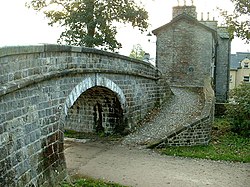
Change Bridge, Kendal
Change Bridge is a Grade II listed single-arch changeline bridge spanning what was formerly a section of the Lancaster Canal in the English market town of Kendal, Cumbria. The structure dates to around 1817. Horses pulling laden barges crossed from one side of the canal to the other, to avoid the coal wharves on the northwestern side of the bridge. It now carries Garden Road, and is believed to be the only change bridge in Cumbria.
The bridge is probably the work of John Fletcher, based on earlier designs by John Rennie the Elder. Rennie's route for the canal was authorised in 1792.
It is constructed of squared coursed limestone with limestone voussoirs. Ramped paths lead to and from either side, with the cobblestones of the western ramp still intact.
Kendal Civic Society restored the bridge in 2002 to celebrate the Golden Jubilee of Queen Elizabeth II.

675 m
Alavana
Alavana was a name tentatively (and probably wrongly) applied to the ruins of a Roman fort at Watercrook about 2 mi (3.2 km) south of Kendal in Cumbria, for which the Roman name Medibogdo is a perfect fit to its river-bend position. The fort at Watercrook was erected around AD 90, originally in timber but then rebuilt in stone around the year 130 during the reign of Hadrian. The fort was abandoned for about 20 years during the Antonine occupation of Scotland. It was refurbished under Marcus Aurelius and occupied until around 270, when its military units departed. Its remains are now largely buried beneath a local farm, while excavated artifacts are displayed at the Kendal Museum.
Alone was probably the name of a civilian settlement at Kendal. The Antonine Itinerary placed it 18 m.p. from Galava and 19 m.p. from Calacum. It is a spelling variant of Alauna, a very common ancient name in Britain (at least a dozen instances) and on the Continent, which served primarily as a river name, and was applied secondarily to forts and settlements on those rivers. Sorting out all their locations and their spellings in ancient sources is not easy.