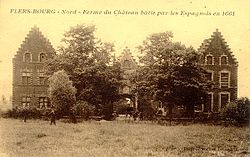
Cousinerie est un quartier de la ville de Villeneuve-d'Ascq dans le département du Nord.

1. Dénomination

Le quartier doit son nom à un ancien fief qui y était installé, appelé Cousinerie, Coisnerie ou Consignerie.

1. Géographie


1. = Délimitation =

Le quartier est délimité au sud par le parc urbain et le parc du Héron, à l'ouest par le boulevard du Breucq, au nord par l'avenue de Roubaix.

1. = Quartiers limitrophes =


1. Histoire

Autrefois, le territoire du quartier était séparé entre la commune de Flers à l'ouest et Annappes à l'est. Dans le quartier était installé l'aérodrome de Flers-lez-Lille. Le quartier commence à se créer en 1975. En septembre 1978 ouvre l'école Albert Camus. Fin 1978, la Cousinerie commence à s'étendre vers le sud. Fin 1979, la Cousinerie centre voit se dessiner son visage définitif. En 1981, les premiers commerces s'installent à la Cousinerie. Le Musée d'art moderne de Villeneuve d'Ascq ouvre en mai 1983 et est inauguré le 17 novembre 1983 en présence de Jack Lang, Ministre de la culture. Le 17 décembre 1983, la place Jean Moulin, cœur de la Cousinerie centre, est inaugurée. Le 4 mai 1984 est posée la première pierre du collège Camille Claudel. En 1986, la construction du quartier se termine. Le 14 novembre 2008, le centre ABA Camus, qui accueille des enfants autistes, a été inauguré en présence de l'acteur Francis Perrin, escorté des deux ministres Xavier Bertrand et Valérie Létard. C'est, à sa création, la meilleure structure pour traiter l'autisme en France. Le 25 septembre 2010, le Musée d'art moderne de Villeneuve d'Ascq rouvre après des travaux d'extension et change de nom pour devenir le LaM.

1. Sites remarquables

On trouve à la Cousinerie deux musées parmi les plus visités de la ville : le Musée des moulins de Villeneuve d'Ascq et le Lille Métropole Musée d'art moderne, d'art contemporain et d'art brut (LaM), sans oublier le Parc archéologique Asnapio. On trouve au sud du quartier une vaste zone verte composée du Parc du Héron et du Parc urbain de Villeneuve d'Ascq. Enfin, le quartier compte une église, l'église Notre-Dame de la Cousinerie.

1. Transport

Le quartier est desservi par les lignes de bus Liane 6, 32 et 34 du réseau Ilévia.

1. Notes et références

Portail de la métropole européenne de Lille

Nearby Places View Menu
Location Image
735 m

Lille Métropole Museum of Modern, Contemporary and Outsider Art

The Lille Métropole Museum of Modern, Contemporary and Outsider Art (LaM), formerly known as Villeneuve d'Ascq Museum of Modern Art, is an art museum in Villeneuve d'Ascq, France. With more than 4,500 artworks on a 4,000-square-metre (43,000 sq ft) exhibition area, the LaM is the only museum in Europe to present simultaneously the main components of the 20th and 21st centuries art : modern art, contemporary art and outsider art. LaM's holdings include some masterpieces of Pablo Picasso, Amedeo Modigliani, Joan Miró, Georges Braque, Fernand Léger, Alexander Calder and the biggest outsider art collection in France. LaM possesses also a library and a rich park of sculptures. The museum's collection offers an overview in modern and contemporary art, including drawings, painting, sculpture, photography, prints, illustrated books and artist's books, and electronic media.
Location Image
1.7 km

Château de Flers

The Château de Flers (French pronunciation: [ʃato də flɛʁs]) is a château located in Villeneuve d'Ascq, in the Nord department of France. It hosts the Château de Flers museum and the tourism office of Villeneuve d'Ascq city. The château is named after a former nearby village of Flers-lez-Lille.
Location Image
1.8 km

Stadium Lille Métropole

Stadium Lille-Métropole (French pronunciation: [stadjɔm lil metʁɔpɔl]) is a multi-purpose stadium in Villeneuve-d'Ascq, France. The stadium was built in 1976 and is able to hold 18,154 spectators. The architect of the stadium was Roger Taillibert. It was used as the temporary home stadium of Lille OSC before the completion of the nearby Stade Pierre-Mauroy. It was also the home stadium of ES Wasquehal, when the club played in Ligue 2 and National, between 1995 and 2005. The stadium has hosted several rugby matches, including France versus Argentina in 1988 and the Wallabies in 1989, All Blacks versus Canada in the 1991 Rugby World Cup quarter-finals, French Barbarians versus Springboks in 1992, Stade Français versus Scarlets in the 1998–99 Heineken Cup and the semi-final of the 2000-01 Heineken Cup between Stade Français and Munster. In the 1980s and 1990s, the stadium underwent various extensions. The most ambitious project was that for Lille's bid for the 2004 Olympic Games where the stadium, taking advantage of its Olympic status, would have been temporarily enlarged to 65,000 seats. It was called Stadium Nord until 2006. Also, the venue has an athletics track, which hosted the 2002 IPC Athletics World Championships and 2011 World Youth Championships in Athletics, as well as the annual Meeting Lille-Métropole. Pink Floyd performed at the stadium during their A Momentary Lapse of Reason Tour on July 28, 1988.
Location Image
1.8 km

Meeting Lille-Métropole

The Meeting Lille Métropole was an annual one-day outdoor track and field meeting at the Stadium Lille Métropole in Villeneuve-d'Ascq, France. It has featured on the Pro Athlé Tour of French track and field meetings, has received European Athletics permit meeting status, and was part of the IAAF Grand Prix circuit from 2003 to 2005. The history of the competition is connected to the Meeting de Paris, which was held in Lille from 1988–1994 due to ongoing work at the Stade Sébastien Charléty. Once the Paris meeting returned to the capital, the Lille meeting was established in its own right in 1995. The competition was incorporated into the national Pro Athlé Tour in 2009, 2010 and 2012. The meeting was not held in 2011 as the 2011 World Youth Championships in Athletics was held at the stadium instead. The 2012 meeting was the last edition to be held.
Location Image
1.8 km

Flers-lez-Lille

Flers-lez-Lille (French pronunciation: [flɛʁs le lil] , lit. 'Flers near Lille') is a former commune in the Nord department in northern France, merged into Villeneuve-d'Ascq in 1970.