
The Château de Flers (French pronunciation: [ʃato də flɛʁs]) is a château located in Villeneuve d'Ascq, in the Nord department of France. It hosts the Château de Flers museum and the tourism office of Villeneuve d'Ascq city. The château is named after a former nearby village of Flers-lez-Lille.

1. History

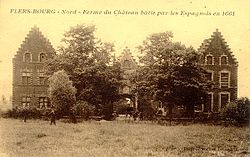
The château, completed in 1661, is very characteristic of the Flemish architecture of the 17th century. From 1667 to 1747, it belonged to the De Kessel family, the Seigneurs of Flers. In 1747, Philippe André de Baudequin, seigneur of Sainghin, obtains the seigneurie of Flers and the château from his De Kessel cousin. In 1770, Marie-Claire-Josephe de Baudequin married count Ladislas de Diesbach. When his wife died in 1791, he inherits the château and he will be the last seigneur of Flers. Around 1787, the château was modified: the mullions of the windows were removed, the French ceilings were replaced by box-section ceilings, and new chimneys were built. The original drawbridge was replaced by a new one, which still exists. The archway arcade is from this time. During the French Revolution, the family emigrated. The château, entrusted to the care of the former gardener, fell in disrepair and was eventually converted into a farmhouse (La ferme d'en bas). In 1937, Paul Delesalle-Dewas sold the château to the De Diesbach family. In 1951, it was listed as a historic monument. In 1969 it was purchased by the State of France, in 1973 it passed to the commune, and in 1986 to the city of Villeneuve d'Ascq. The restoration was completed by 1991. Since then, the building houses the tourism office and other municipal departments.

1. Architecture

The château is characteristic of the Flemish rural architecture of the 17th century.

1. Château de Flers Museum

Four rooms in the basement were doing up an archeologic museum in 1991. The museum hosts also temporarily exhibitions, about archeology, local history and regional ethography.

1. Gallery


1. References
Nearby Places View Menu
Location Image
281 m

Flers-lez-Lille

Flers-lez-Lille (French pronunciation: [flɛʁs le lil] , lit. 'Flers near Lille') is a former commune in the Nord department in northern France, merged into Villeneuve-d'Ascq in 1970.
Location Image
622 m

Stadium Lille Métropole

Stadium Lille-Métropole (French pronunciation: [stadjɔm lil metʁɔpɔl]) is a multi-purpose stadium in Villeneuve-d'Ascq, France. The stadium was built in 1976 and is able to hold 18,154 spectators. The architect of the stadium was Roger Taillibert. It was used as the temporary home stadium of Lille OSC before the completion of the nearby Stade Pierre-Mauroy. It was also the home stadium of ES Wasquehal, when the club played in Ligue 2 and National, between 1995 and 2005. The stadium has hosted several rugby matches, including France versus Argentina in 1988 and the Wallabies in 1989, All Blacks versus Canada in the 1991 Rugby World Cup quarter-finals, French Barbarians versus Springboks in 1992, Stade Français versus Scarlets in the 1998–99 Heineken Cup and the semi-final of the 2000-01 Heineken Cup between Stade Français and Munster. In the 1980s and 1990s, the stadium underwent various extensions. The most ambitious project was that for Lille's bid for the 2004 Olympic Games where the stadium, taking advantage of its Olympic status, would have been temporarily enlarged to 65,000 seats. It was called Stadium Nord until 2006. Also, the venue has an athletics track, which hosted the 2002 IPC Athletics World Championships and 2011 World Youth Championships in Athletics, as well as the annual Meeting Lille-Métropole. Pink Floyd performed at the stadium during their A Momentary Lapse of Reason Tour on July 28, 1988.
Location Image
622 m

Meeting Lille-Métropole

The Meeting Lille Métropole was an annual one-day outdoor track and field meeting at the Stadium Lille Métropole in Villeneuve-d'Ascq, France. It has featured on the Pro Athlé Tour of French track and field meetings, has received European Athletics permit meeting status, and was part of the IAAF Grand Prix circuit from 2003 to 2005. The history of the competition is connected to the Meeting de Paris, which was held in Lille from 1988–1994 due to ongoing work at the Stade Sébastien Charléty. Once the Paris meeting returned to the capital, the Lille meeting was established in its own right in 1995. The competition was incorporated into the national Pro Athlé Tour in 2009, 2010 and 2012. The meeting was not held in 2011 as the 2011 World Youth Championships in Athletics was held at the stadium instead. The 2012 meeting was the last edition to be held.
Location Image
1.0 km

Charles de Gaulle University – Lille III

The Charles de Gaulle University – Lille III (French: Université Lille 3 Charles-de-Gaulle) was a French university. Since 1974, the main campus of University of Lille III was located in Villeneuve d'Ascq in eastern Lille, at Pont de Bois metro station, and includes 21,000 students. The University of Lille III continues the long tradition of teaching the humanities in the area around Lille, which originates from the Université de Douai, established in 1559, and located 25 km away from the present modern campus. The university of Lille III even has an independent cinema named "Kino" (Cinema in German). Since 1970, science and technology have been taught at an independent campus of Université de Lille I - USTL, while the faculties of law, management, sports and health are part of the independent campus of Université de Lille II. Together, the universities of Lille include more than 90,000 students and 3,000 PhD students, supported by the universities' research laboratories. At the beginning of 2018, the three universities of Lille (Lille 1, Lille 2, Lille 3) merged to form the University of Lille.