

 English
 Français

Greenlink Cycle Path
The Greenlink Cycle Path is a cycle path in North Lanarkshire that is a direct route running from Strathclyde Country Park to Motherwell Town Centre. The path is 7 kilometres (4.3 miles) in length. The Greenlink project was established in 2005, and was part of a 3-year partnership between many organisations, such as North Lanarkshire Council, Scottish Natural Heritage and Forestry Commission Scotland.

Chinatown, Glasgow
Chinatown in Glasgow, Scotland is a Chinese shopping complex that opened in 1992 in Cowcaddens.

Red House Museum
Red House Museum was a historic house museum, built in 1660 and renovated in the Georgian era. It closed to the public at the end of 2016 but remains as a Grade II* listed building in Gomersal, Kirklees, West Yorkshire, England.

Redfern Building
The Redfern Building is a Grade II listed building which was completed in 1936 in Manchester, England. The building is situated on Dantzic Street and meets the junction of Mayes Street and Hanover Street. It overlooks Sadler's Yard, a public square and event space. Redfern was originally built for office and warehouse use.
The seven-storey building has a flat roof and consists of pale brown brick. A noticeable service tower exists to the north of the building. Architecture critic Clare Hartwell wrote in Pevsner in 2001, "It is a pity that this [building] does not enjoy a better site - its impact is partly lost due to its towering neighbours and its relationship with the adjoining Holyoake House."

Millport, Great Cumbrae
Millport (Scottish Gaelic: Port a' Mhuilinn) is the only town on the island of Great Cumbrae in the Firth of Clyde off the coast of mainland Scotland, in the council area of North Ayrshire. The town is 4 miles (6 km) south of the ferry terminal that links the island to the Scottish mainland.
Due to its small size, the island and its town are often linked in the minds of visitors and residents and Cumbrae is often referred to as Millport. The island offers views across to the Isle of Arran as well as of its smaller neighbour which lies barely a kilometre away, called Little Cumbrae. The Cumbraes are referred to as the Kumreyiar in the medieval Norse Saga of Haakon Haakonarson.


Lamel Hill
Lamel Hill is a scheduled monument about 1 mile (1.6 km) south-east of the centre of York, England. It is on the grounds of The Retreat and the northern part of Walmgate Stray, and in some medieval documents it is referred to as Siward's Mill Hill, or Siward's How Mill, in reference to its previous use as the base of a windmill. However it should not be confused with another site known as Siward's Howe which is about 220 yards (200 m) further east.
Lamel Hill is best known for having been the location of a Parliamentary gun-emplacement aimed at Walmgate Bar in the City Walls during the Siege of York in 1644. It was the site of York's first formal archaeological excavation in 1849, when traces of an Anglo-Saxon cemetery were found. Lamel Hill is part of a conservation area which was designated in 1975.

Willington Quay
Willington Quay is an area in the borough of North Tyneside in Tyne and Wear in northern England. It is on the north bank of the River Tyne, facing Jarrow, and between Wallsend and North Shields. It is served by the Howdon Metro station in Howdon. The area from 2006 onwards has been an area of new housing built on brownfield sites. The house building continues into 2013 and is changing the social and economic balance in the area. The area has also had a make over of the bowling green off Howdon Lane and further warehousing next to the bowling green has been demolished to make way for further new housing.

Leven, East Riding of Yorkshire
Leven is a village and civil parish in the East Riding of Yorkshire, England. It is situated approximately 7 miles (11 km) west of Hornsea town centre, and north-west of the A165 road.
According to the 2011 UK census, Leven parish had a population of 2,433, an increase on the 2001 UK census figure of 2,240.

Chaptelat
Chaptelat (French: [ʃaptəla]; Occitan: Chaptalac) is a commune in the Haute-Vienne department in the Nouvelle-Aquitaine region in western France.

YO1 Radio
YO1 Radio is a community radio station based in York, England. It broadcasts local news, weather, travel and information alongside music from the 1980s to the present day. It broadcasts to the city of York on 102.8 MHz FM, in Selby on 90.0 MHz FM with transmissions areas in parts of North Yorkshire on DAB+. It takes its name from a district of the YO postcode area covering central York.

East Tanfield
East Tanfield is a civil parish in North Yorkshire, England. There is no modern village in the parish, and the population was estimated at 30 in 2013. The deserted medieval village of East Tanfield lies near Manor Farm on the banks of the River Ure.
East Tanfield was mentioned in the Domesday Book, when it was in the possession of Count Alan of Brittany. It was a prosperous community in the medieval period, but appears to have been deserted in the 16th century.
East Tanfield was historically a township in the ancient parish of Kirklington in the North Riding of Yorkshire. It became a separate civil parish in 1866. It was transferred to the Richmondshire district of North Yorkshire in 1974. Richmondshire was abolished in 2023 and a new unitary authority, North Yorkshire Council, replaced it.
The parish shares a grouped parish council, Tanfield Parish Council, with the much larger parish of West Tanfield.
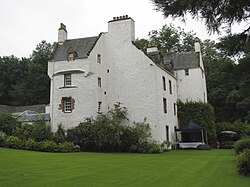
Newton Castle
Newton Castle, a Category A listed building dating to the mid-16th century, stands near the town of Blairgowrie in Perth and Kinross, Scotland. It had minor alterations in the 18th century, and in 1883 a wing was added to the northwest, possibly by Lake Falconer. A subterranean vault, possibly discovered in 1911, is listed separately.

Stonethwaite Woods
Stonethwaite Woods is a Site of Special Scientific Interest (SSSI) within Lake District National Park in Cumbria, England. It consists of two distinct patches located in Borrowdale on either side of Stonethwaite Beck, and either side of the village of Stonethwaite, 1km south of Rosthwaite. This woodland has an exceptional diversity of moss species.
The streams Little Stanger Gill and Big Stanger Gill flow through the southern patch of this protected area.

Balado railway station
Balado railway station served the villages of Balado and Cleish in the Scottish county of Perth and Kinross. It was located on a line which ran from Alloa railway station to Kinross Junction.
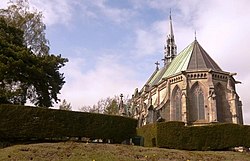
Lady Leng Memorial Chapel
Lady Leng Memorial Chapel (also known as Vicarsford Cemetery Chapel) is a church building in Leuchars, Fife, Scotland. Built between 1895 and 1897, to a design by Thomas Martin Cappon, it is now a Category A listed building. Historic Environment Scotland describes it as "a fine and rare example of a small ecclesiastical building type".
The building is also one of the few non-denominational chapels in Scotland. It was built by politician John Leng as a memorial to his wife, Lady Emily Leng, with the Saint-Chapelle, Paris, being the inspiration.
The adjacent Vicarsford Cemetery is Category B listed.

Inverneill House
Inverneill House is a country house in Argyll, western Scotland. It stands on the west shore of Loch Fyne, around 4 miles (6.4 km) south of Lochgilphead. Although the house is not listed, the walled gardens and mausoleum on the estate are protected as category B listed buildings.
The lands of Inverneill first came into Campbell hands in 1480 when the lordship of Knapdale was granted to Colin Campbell, 1st Earl of Argyll. In 1773, it passed to a branch of Campbell of Craignish: Sir Archibald Campbell became the owner of the estate. Though neither the largest nor the grandest of his several estates, it was Archibald's favourite, but he was unable to live on the land as he was appointed Governor of Jamaica and then of Madras in India, dying a few months after his return. It was his elder brother, Sir James Campbell of Killean, Perthshire, who first made a home at Inverneill, using it as a summer 'cottage' for his family.
The house was of a good size in those days, having dining and drawing rooms, 8 bedrooms, a housekeeper's room, servants' rooms, pantry, kitchen and scullery, as well as outhouses containing wash house, laundry and dairy. The walled garden with its 20-foot (6.1 m) high wall containing two turrets was reputed to be one of the finest in Scotland for fruit and vegetables of all kinds.
Lt Col. Duncan Campbell, 7th of Inverneill, added the three-storey wing around 1890. The house was occupied by the Campbell family until 1955 when it was sold, though the family continue to own Inverneill Island. The last two occupants were the Misses Olive and Una Campbell. Their sister had married and became Mrs. Ysobel Stewart of Fasnacloich was the founder of the Scottish Country Dance Society and became its first Secretary. A country dance named "Inverneill House" was composed in her honour.

Leeds Library
The Leeds Library is the oldest surviving subscription library of its type in the UK. It was founded in 1768, following an advertisement placed in the Leeds Intelligencer earlier that year. The first secretary was Joseph Priestley. In 1779, James Boswell wrote, "In Leeds, where one would not expect it, there is a very good public library, where strangers are treated with great civility." Notable members include the abolitionist Wilson Armistead.
The library moved twice before settling in the purpose built premises on Commercial Street, Leeds on 4 July 1808. This building is a grade II* listed Greek Revival building by Thomas Johnson with major 1880–81 extension to the rear by Thomas Ambler.
As of June 2020 the library has over 1,000 members who pay an annual subscription. The library is estimated to have a stock of over 140,000 titles with 1,500 new books being added annually. It also contains more modern items such as audiobooks and DVDs. The library is a registered charity
and its extensive collection is frequently used by researchers who are not members.
The library holdings also incorporate the stock of the short lived Leeds Foreign Library. The Foreign Library was founded in 1778 and incorporated into the Leeds Library in 1814.
The library is the setting for much of Frances Brody's 2014 novel Death of an Avid Reader.

St Wilfrid's Church, Hulme
St Wilfrid's Church in George Street, Hulme, Manchester, England, is a former Roman Catholic church. Designed by Augustus Pugin, it was his only known church building in that city.
Construction of St Wilfrid's began in 1839 and the church building was completed in 1842, although a planned tower was never built.
The church served a small number of Irish people who lived in the area. In July 1852, during a period of anti-Catholic demonstrations, the building was mistakenly rumoured to be the target of Protestant people who desired to burn it down. There had been sectarian riots in nearby Stockport in the previous month and the heightened tensions led to a fight in a pub becoming misconstrued as an imminent attack on the church. A large mob of Irish people arrived to defend the building against this non-existent threat and, although the priest, Reverend Toole, attempted to calm them and urged them to disperse, for several days afterwards a group of people stood watch over it. The church had the services of Irish priests from County Kerry continuously from the 1890s until the 1930s.
St Wilfrid's became a Grade II listed building in December 1963. Facing declining enrollment, the parish was suppressed and the church was deconsecrated in 1990. The church was converted into a factory that manufactured beds and in 1994 became an enterprise centre.
Among those buried at the church was William Bally, a Swiss sculptor and phrenologist.

Dock Road Edwardian Pumping Station
Dock Road Edwardian Pumping Station is a sewage pumping station in Northwich, Cheshire, United Kingdom. The pumping station is recorded in the National Heritage List for England as a designated Grade II listed building.