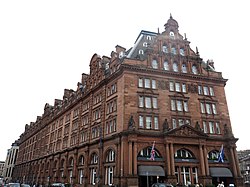
Standard Life Aberdeen (LSE : SLET) est une compagnie d'assurance ayant son siège social à Édimbourg, où ses 7 500 salariés en font un des grands employeurs de la capitale de l'Écosse. Elle compte 12 000 salariés à l'échelle internationale. Standard Life compte cinq divisions : Standard Life Assurance Company (assurances), Standard Life Bank (banque), Standard Life Investments (finance), Standard Life Healthcare (mutuelle de santé) et Standard Life International (établissement international). Des sept millions de clients de la Standard Life, cinq millions sont au Royaume-Uni, dont 2,6 millions sont des membres de la mutuelle avec participation aux profits.

1. Histoire

La compagnie d'assurances Standard Life ("Standard Life Assurance Company") a été créée en 1825 et son premier acte constitutif, voté par le Parlement en 1882. C'est en 1925 que Standard Life devint mutuelle d'assurances. À l'origine, le groupe Standard Life fonctionnait uniquement par les agences de la mutuelle du Royaume-Uni et par ses filiales dans quelques autres pays. Sa division canadienne fut lancée en 1833 et ses opérations en Irlande commencèrent en 1838. Cette structure perdura jusqu'en 1996 : une branche ouvrit cette année-là à Francfort. L'objectif de cette implantation était l'exportation en Allemagne des modèles anglo-saxons de caisses de retraite et d'assurance-vie. La Standard Life entendait aussi capitaliser sur les occasions que représentait la Directive européenne 92/96/CEE (« troisième directive assurance vie ») et offrir sur ce marché une gamme de produits que les assureurs nationaux ne pouvaient proposer. Dans les années 1990, le groupe a également cherché à diversifier ses opérations dans des domaines qui complétaient ses compétences dans les assurances-vie et les pensions, pour se positionner comme un groupe financier à part entière et proposant tous types de services. Le 31 mai 2006, les membres de Standard Life ont voté en faveur de la Résolution spéciale pour la démutualisation de la compagnie d'assurances et pour l'introduction de Standard Life plc à la bourse de Londres. Le 15 septembre 2006, la société a intégré l'indice FTSE 100. En mars 2007, Standard Life a annoncé qu'un millier d'emplois seraient supprimés dans le but d'économiser 100 millions de £ par an (environ 150 millions d'euros). En mars 2014, Standard Life annonce l'acquisition d'Ignis Asset Management pour 390 millions de livres. En Septembre 2014, la Financière Manuvie acquiert les activités canadiennes, principalement situées au Québec, de Standard Life pour 3,7 milliards de dollars. Le 6 mars 2017, le groupe Standard Life et le groupe Aberdeen Asset Management ont annoncé leur fusion pour 11 milliards de livres.

1. Principaux actionnaires

Au 27 janvier 2020:

1. Voir aussi

Standard Life Canada

1. Notes et références


1. Liens externes

Standard Life Standard Life Assurance Company of Canada

Portail des entreprises Portail du Royaume-Uni Portail de l’Écosse

Nearby Places View Menu
Location Image
57 m

Caley Picture House

Caley Picture House was a cinema and concert venue located in Edinburgh, Scotland.
Location Image
99 m

Edinburgh Princes Street railway station

Princes Street Station was a mainline railway station which stood at the west end of Princes Street, in Edinburgh, Scotland, for almost 100 years. Temporary stations were opened in 1848 and 1870, with construction of the main station commencing in the 1890s. The station was closed completely in 1965 and largely demolished in 1969–70. Only its hotel remains, but it is no longer in railway ownership.
Location Image
158 m

Highland Church

The Highland Church was a Gaelic-speaking congregation of the Church of Scotland, based in Tollcross, Edinburgh. Formed by the union of St Oran's Church and St Columba's Gaelic Church in 1948, the congregation continued united with Tolbooth St John's in 1956. Gaelic worship in Edinburgh began in the early 18th century, leading to the opening of the Gaelic Chapel in 1769. At the Disruption of 1843, all the office-bearers of the Gaelic congregation joined Free Church along with most of the congregation's members. The Free congregation met at a building off Lothian Road before moving nearby to a permanent church at Cambridge Street in Tollcross. From 1849 to 1846, Thomas McLauchlan served as the congregation's minister. An active pastor, he strengthened congregation's activities and served as the moderator of the Free Church's general assembly in 1876. The congregation adopted the name St Columba's Gaelic Free Church, after Columba of Iona, in 1864. In 1900, most of the congregation joined the United Free Church, which had been formed by the union of the Free and United Presbyterian churches. Disputes and schisms around the union diminished the congregation, however. By 1931, the regular English service, introduced in 1886, had become the congregation's main act of worship. The union of United Free Church with the Church of Scotland in 1929 brought St Columba's and the congregation from which it had split – known, by this point, as St Oran's – into the same denomination. Edinburgh's two Gaelic congregations united in 1948. They continued to use the St Columba's buildings until uniting with Tolbooth St John's in 1956. Via Highland, Tolbooth, St John's union with Greyfriars Kirk in 1979, the latter congregation maintains a weekly Gaelic service. St Columba's occupied a simple building in the Early English style by Patrick Wilson, completed in 1851. The building afterwards served as an arts venue before being demolished in 1989. The Saltire Court development, incorporating the Traverse Theatre, now occupies the site.
Location Image
162 m

Traverse Theatre

The Traverse Theatre is a theatre in Edinburgh, Scotland. It was founded as The Traverse Theatre Club in 1962 by John Calder, John Malcolm, Jim Haynes, Richard Demarco, Terry Lane, Andrew Muir, John Martin and Sheila Colvin. The Traverse Theatre company commissions and develops new plays or adaptations from contemporary playwrights, often describing itself as "Scotland’s new writing theatre". The Traverse also presents productions from visiting companies and acts as a host venue for Edinburgh Festival Fringe shows in August. It is also the home of 'Imaginate' the Edinburgh International Children's Festival.
Location Image
188 m

The Caledonian Edinburgh Hotel

The Caledonian Edinburgh is a five-star hotel in Edinburgh, Scotland. It was built by the Caledonian Railway company and was opened in 1903. The hotel stands at the west end of Princes Street on the site of the Caledonian Railway's former Edinburgh terminus. It is an example of a British grand railway hotel. It is nicknamed "The Caley", and is a category A listed building.