

 English
 Français

Belle Vue Zoological Gardens
Belle Vue Zoological Gardens was a large zoo, amusement park, exhibition hall complex, and speedway stadium in Belle Vue, Manchester, England, that opened in 1836. The brainchild of John Jennison, the gardens were initially intended to be an entertainment for the genteel middle classes, with formal gardens and dancing on open-air platforms during the summer, but they soon became one of the most popular attractions in Northern England. Before moving to Belle Vue, Jennison, a part-time gardener, had run a small aviary at his home, the beginnings of the zoo that over the years grew to become the third-largest in the United Kingdom.
Jennison set out a small amusements area in Belle Vue during the 1870s, which was expanded in the early 20th century to become what was advertised as the "showground of the world". Popular rides included the 60 mph (97 km/h) Bobs roller coaster and the Scenic Railway. Other entertainments included grand firework displays from 1852 and the annual Belle Vue Christmas Circus from 1922. Music and dancing were popular attractions in Belle Vue's various ballrooms. The Kings Hall, which opened in 1910, housed the Hallé Orchestra for several years and hosted concerts by artists such as Jimi Hendrix, The Who, Nat King Cole, The Rolling Stones, Leonard Cohen, Johnny Cash and Led Zeppelin.
Catering for visitors at Belle Vue was on an industrial scale, ranging from the late 19th century hot water rooms, which accommodated up to 3,000 diners each, providing crockery and hot water for those who brought their own picnics, to more upmarket themed restaurants. Belle Vue became a part of the caterer and hotelier Charles Forte's business empire towards the end of its life in the 1960s. Although he made some improvements to the zoo, Forte's interests lay in developing the gardens' dining and exhibition facilities. The Kings Hall was then the largest exhibition space outside London, but competition from the G-Mex exhibition and conference centre in central Manchester led directly to its closure in 1987.
At its peak Belle Vue occupied 165 acres (0.67 km2) and attracted more than two million visitors a year, up to 250,000 of whom visited over the Easter weekend. The zoo closed in September 1977 after its owners decided they could no longer afford its losses of £100,000 a year. The amusement park remained open on summer weekends until 1980. The land was sold in 1982, and the site was finally cleared in 1987. All that remains of Belle Vue today is a greyhound racing stadium and a snooker hall built in the stadium's car park.

Sedgwick, Cumbria
Sedgwick is a village and civil parish in Cumbria, England, 4.5 miles (7.2 km) south of Kendal. In the 2001 census the parish had a population of 380, decreasing at the 2011 census to 349.
Part of the historic county of Westmorland, its main points of interest are 2 Grade II listed buildings:
Sedgwick House, built in 1868 by Paley and Austin for the industrialist William Henry Wakefield
An aqueduct belonging to the drained section of the Lancaster Canal
Sizergh Castle & Garden and Levens Hall are just west of the village.
The gunpowder works in Sedgwick, powered by water from the River Kent, operated to 1935.
The Lakeland Maze Farm Park is east of the village.

Christ Church, Great Ayton
Christ Church is the parish church of Great Ayton, a village in North Yorkshire, in England.
From the Saxon period to the early 19th century, All Saints' Church, Great Ayton was the local parish church. Between 1876 and 1877, a replacement was built on a new site, with All Saints becoming a mortuary chapel. It was designed by John Ross and Robert Lamb, in a 14th-century Gothic style. Nikolaus Pevsner describes the building as "restless composition, and an uninteresting interior". It was grade II listed in 1966.
The church is built of sandstone with a Welsh slate roof, and is in Decorated style. It has a cruciform plan, consisting of a nave, a west narthex, north and south aisles, a south porch, a north transept steeple, and a chancel. The steeple has a tower with two stages, angle buttresses, traceried bell openings, and a broach spire with bands of red sandstone and lucarnes. Inside are preserved three pre-Conquest stones, brought from All Saints.

Larkhall railway station
Larkhall railway station serves the town of Larkhall, South Lanarkshire, Scotland. The station is the south-eastern terminus of the Argyle Line, 16+1⁄4 miles (26.2 km) south east of Glasgow Central railway station.
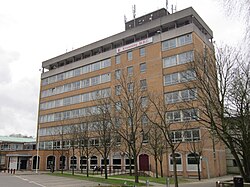
Huyton Municipal Building
Huyton Municipal Building is a municipal building in Archway Road, Huyton, a town in Merseyside, England. The building currently serves as the headquarters of Knowsley Metropolitan Borough Council.

83 Welsh Row, Nantwich
83 Welsh Row is a Georgian town house in Nantwich, Cheshire, England, dating from the late 18th century, located on the south side of Welsh Row (at SJ6466852394). It is currently used as offices. It is listed at grade II*; in the listing, English Heritage describes it as "a good tall late C18 house", featuring a "good doorway".
Number 83 is one of many Georgian buildings on Welsh Row, which Nikolaus Pevsner calls "the best street of Nantwich". Townwell House, also listed at grade II*, stands on the opposite side at number 52.

Institute for Advanced Studies in the Humanities
The Institute for Advanced Studies in the Humanities (IASH, University of Edinburgh) was founded in 1969 at the University of Edinburgh, for visiting fellows to engage in study and research in the arts, humanities and social sciences. The current Director (since 2022) is Lesley McAra. Other Directors have included David Daiches, Susan Manning, Jo Shaw and Steve Yearley.
Since 1969, IASH has received visits from over 1,500 fellows. Up to 25 Fellows are in residence at any one time, and visits last between two months and ten months. Each year IASH hosts the University of Edinburgh's annual Fulbright-Scotland Visiting Professorship. Notable former Fellows include Marianne Boruch, William C. Dowling, Sébastien Fath, Ruth Barcan Marcus, Edward Mendelson, Garry Wills, and Charles W.J. Withers.
IASH hosts or organises over 100 events per year.
The IASH Advisory Board includes Rosi Braidotti and Allan Little. It is chaired by Sarah Prescott.
IASH's premises are located in Hope Park Square off Meadow Lane in Edinburgh. The Institute, its Fellows and its building appear in three of Alexander McCall Smith's novels, and a Fellowship named after their heroine Isabel Dalhousie was founded in 2012.

Midland Hotel, Manchester
The Midland Hotel is a grand hotel in Manchester, England. Opened in 1903, it was built by the Midland Railway to serve Manchester Central railway station, its northern terminus for its rail services to London St Pancras. It faces onto St Peter's Square. The hotel was designed by Charles Trubshaw in Edwardian Baroque style and is a Grade II* listed building.
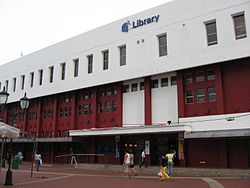
Toa Payoh Public Library
The Toa Payoh Public Library (Chinese: 大巴窑图书馆), formerly Toa Payoh Community Library (Chinese: 大巴窑社区图书馆) and Toa Payoh Branch Library, is an established library located in the Toa Payoh Town Centre, Singapore, opened on 7 February 1974. It consists of three floors and has a large floor area of approximately 4125 m2. The building which the library currently based in once housed the Southeast Asian Peninsular Games Secretariat for the 1973 Southeast Asian Peninsular Games in Singapore. The library is also within walking distance of HDB Hub, Toa Payoh Bus Interchange and Toa Payoh MRT station.

Grimston Park
Grimston Park is a grade II* listed Georgian country house in Grimston, North Yorkshire, England, some 1.7 miles (3 km) south of Tadcaster. Since being owned by the Fielden family, it has been converted into a number of luxury homes.
The house is built on two storeys of Tadcaster limestone ashlar with a Welsh slate roof. It has a 7-bay frontage with a projecting portico, and a three-storey tower and a single-storey entrance lodge at each end. A limestone tower in the grounds, designed like the house by Decimus Burton, is also grade II listed.

Dunoon Sheriff Court
Dunoon Sheriff Court is a judicial building on George Street in Dunoon, Argyll and Bute in Scotland. The building, which continues to be used as a courthouse, is a Category C listed building.

Shotton Surface Mine
Shotton Surface Mine was an open cast coal mine located on the estate of Blagdon Hall, Northumberland, England, operated by Banks Group. The mine was granted permission by the government in 2007, despite being refused permission by Blyth Valley Council, with an initial agreement to mine 3.4 million tonnes of coal, 2 million tonnes of shale and 750,000 tonnes of fireclay. This was subsequently extended by two years in 2011 to allow an additional 2 million tonnes of coal to be mined, set to end in 2016. An additional expansion approved in 2014 saw two new pits being opened on the site, Shotton Triangle (290,000 tonnes of coal) and Shotton South West (250,000 tonnes of coal), with the end date pushed back a year to October 2017; the land was expected to be restored by 2019. The mine eventually ceased production in summer 2020.
In total, over 8% of British coal output comes from the Shotton site. The mine produced over one million tonnes of coal in 2014 and employs around 150 people. These jobs are temporary, although when the mine closes some former employees may be transferred to Banks' new site at Highthorn, near Druridge Bay.
The land on which the mine was developed is owned by science writer and Conservative hereditary peer Matthew White Ridley, 5th Viscount Ridley, who is a prominent climate change sceptic. As a result, the "Keep it in the Ground" fossil fuel divestment campaign had protested against the site; they picketed the site on 26 October 2015 and halted operations for the day. Royalties from the site go to the Government, but the Blagdon Estate receives a way leave payment estimated at between three and four million pounds.
Over 1.5 million tonnes of waste material from the site was used to build the Northumberlandia sculpture on an adjoining site. Northumberlandia, which takes the form of a naked reclining female figure, was constructed as planning gain by the Banks Group to allow development of the Shotton site, and was opened as a public park in 2012.

Dewartown
Dewartown is a small hamlet in Midlothian, Scotland (near Pathhead and Mayfield).
Its name relates to the Dewar family who owned the nearby Vogrie House and Estate which is now in Vogrie Country Park. The village is reputed to have had five public houses during the 19th century, providing for the many farm workers, miners and house staff from the local community.
Dewartown is still not listed on many maps, despite the fact a number of the cottages date back to the early 18th century.
Signs erected in the late 1990s depicted the village as 'Dewarton', rather than 'Dewartown'. These were replaced with the latter spelling, despite the fact both spellings are competent, the former being a regional contraction, vis 'ton' meaning 'town'.
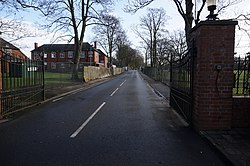
Queen Elizabeth Barracks, Strensall
Queen Elizabeth Barracks is a British Army installation in Strensall, North Yorkshire, England. It opened in the 1880s, and since 2016, it has been under threat of closure, but was reprieved in 2024.

Mam Tor
Mam Tor is a 517 m (1,696 ft) hill near Castleton in the High Peak of Derbyshire, England. Its name means "mother hill", so called because frequent landslips on its eastern face have resulted in a multitude of "mini-hills" beneath it. These landslips, which are caused by unstable lower layers of shale, also give the hill its alternative name of Shivering Mountain.
In 1979, the continual battle to maintain the A625 road (Sheffield to Chapel en le Frith) on the crumbling eastern side of the hill was lost when the road officially closed as a through-route, with the Fox House to Castleton section of the road being re-designated as the A6187.
The hill is crowned by a late Bronze Age and early Iron Age univallate hill fort, and two Bronze Age bowl barrows. At the base of the Tor and nearby are four show caves: Blue John Cavern, Speedwell Cavern, Peak Cavern and Treak Cliff Cavern where lead, Blue John, fluorspar and other minerals were once mined. Mam Tor was declared to be one of the Seven Wonders of the Peak by Thomas Hobbes in his 1636 book De Mirabilibus Pecci.

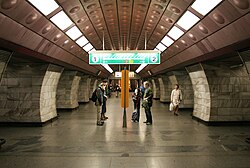
Flora (Prague Metro)
Flora is a Prague Metro station on Line A. It is located under the shopping mall Atrium Flora, on the border of the Vinohrady and Žižkov districts near the Olšany Cemetery. The station was opened on 19 December 1980 as part of the extension of the line between Náměstí Míru and Želivského.

Coria (Corbridge)
Coria was a fort and town 2.5 miles (4.0 km) south of Hadrian's Wall, in the Roman province of Britannia. It was strategically located on the junction of a major Roman north–south road (Dere Street) with the River Tyne and the Roman Stanegate road, which was also the first frontier line which ran east–west between Coria and Luguvalium (the modern Carlisle). Corbridge Roman Site is in the village of Corbridge in the county of Northumberland.
It is in the guardianship of English Heritage and is partially exposed as a visitor attraction, including a site museum.

Ye Old Sun Inn
Ye Old Sun Inn is a historic pub in Colton, North Yorkshire, a town in England.
The pub was built in the early 18th century. Various extensions were added at the rear in the 19th and 20th centuries. In 2004, the pub was taken over by Ashley and Kelly McCarthy, and in 2009 they bought the freehold. They developed the food offer at the pub, and won awards including the 2013 National Licensee of the Year. They also opened a village shop in the premises. Following the COVID-19 pandemic, they reduced its opening hours to two days a week, introduced a still, and started selling spirits and chocolates that they made on the premises.
The pub is built of colourwashed brick, with a floor band, a cogged band above, and a pantile roof with the remains of a stone kneeler on the right. It has two storeys and three bays. On the front is a porch, and the windows are sashes, most of them sliding horizontally. It has been Grade II listed since 1985.

Whalley Range, Manchester
Whalley Range is an area of Manchester, England, 2 miles (3.2 km) south-west of the city centre. The population at the 2011 census was 15,430. Historically in Lancashire, it was one of the earliest of the city's suburbs, built by local businessman Samuel Brooks.