The Pleasance is a street just outside the Old Town of Edinburgh, Scotland, located in the Southside area. A remnant of the Flodden Wall flanks the west side of the street between Drummond Street and the Cowgate. The University of Edinburgh owns a complex of buildings on the street known as The Pleasance which, for nine months of the year, operate as one of the four Student Union venues that serve the Edinburgh University Students' Association. In August, the complex is converted to use as one of the major venues of the Edinburgh Festival Fringe, for which it is most publicly well-known. The street runs in a predominantly north–south direction for about 600 m (1⁄3 mile), from the junction of Cowgate, St Mary's Street, and Holyrood Road to the junction with East Crosscauseway, where it becomes St Leonards Street. The first section rises quite steeply, from 190 to 250 feet (58 to 76 m), then is relatively flat south of East Adam Street Historically, the street was one of the main routes into Edinburgh from the south, meeting St Mary's Wynd (now St Mary's Street) at St Mary's Wynd Port, one of the gateways of the town walls. The name Pleasance derives from the Scots plesance, meaning a park or garden. It first appears in 1507 as the name of a nearby house, and was later transferred to the street and then the suburb which was part of the regality of the Canongate. The derivation of the name from a nunnery of St Mary of Placentia, often mentioned in histories of Edinburgh, is an invention by William Maitland in his 1753 History of Edinburgh.

1. Buildings along the Pleasance

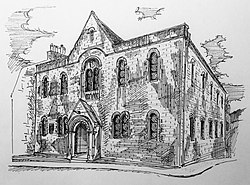
The street is largely residential, mainly 19th century tenements and 20th century flats, with a few shops, cafes and offices. The University of Edinburgh owns property in the area, including The Pleasance venue and the adjacent Pleasance Sports Complex. Part of this was formerly the site of Bell's Brewery, part of Edinburgh United Breweries. Between 1926 and 1933, duty was only paid on part of the beer production at the facility, in an effort to save money. After the fraud was exposed, the company went bankrupt. The Pleasance Free Church opened in 1858 at what is now 48A Pleasance, it was altered by 1893 for the New College Missionary Society next door at 48. It was later converted to an examination hall for Edinburgh University. Also on this site, set back from the road, is the grade B listed former Quakers Meeting House. This was built in 1791 near to a Quaker burial ground but ceased being used in 1944. It was listed in December 1974. The Pleasance Church was located by the road on the other side of the burial ground, on the corner with Arthur Street (now New Arthur Place). Built in 1811, it closed in 1953, and was demolished in 1982, and has been replaced with flats. Towards the southern end, at 138–140 Pleasance is the Greyfriars Charteris Centre, a social enterprise and event space located in the former Charteris Memorial Church. The building was modernised between 2019 and 2022, improving accessibility. Next to this at 156 is Deaconess House, formerly the Deaconess Hospital which opened in 1894. It was converted into student flats in 2014, having latterly been used as the NHS Lothian headquarters until 2010. Although not listed, the original façade on the Pleasance was retained and restored. The University of Edinburgh also owns a large new [2017] student flats complex on St Leonard's Street, the southerly extension of the Pleasance, on a site formerly occupied by a Homebase home improvements and gardening store. In addition, although the Pleasance along with St Leonard's Street is a quieter area than the nearby main commercial centres and streets of the Southside there are several restaurants, pubs, a few shops, lawyers' offices, churches, and the modern St Leonard's police station. After years of planning blight from the 1960s and 1970s in which redevelopment of the formerly rather run-down area was hampered after the abandonment of bizarre plans to build a major road comparable to a motorway, from the late 20th century onwards the area benefited from a gradual renaissance.

1. References
Nearby Places View Menu
Location Image
0 m

The Pleasance

The Pleasance is a theatre, bar, sports and recreation complex in Edinburgh, Scotland, situated on a street of the same name. It is owned by the University of Edinburgh, and for nine months of the year it serves the Edinburgh University Students' Association as a societies centre, sports complex, student union bar and entertainment venue. Every August, it is converted into one of the main venues for the Edinburgh Festival Fringe. The Pleasance Theatre Trust operate the venue during this time, and in this guise the complex is sometimes referred to as Pleasance Edinburgh to distinguish it from a sister venue, also called The Pleasance, that the trust opened in Islington in London in 1995.
Location Image
44 m

Pleasance Church

Pleasance Church was a Presbyterian church on the Pleasance in the Southside of Edinburgh, Scotland. Originating in the Relief Church in the 1820s, the congregation united with Charteris Memorial in 1953. In 1842, the congregations of Arthur Street Relief Church (founded in 1825 and known as Brighton Street Relief Church between 1827 and 1835) and Roxburgh Terrace Relief Church (founded as Bethel Relief Church in 1824) united. As with the rest of the Relief Church, they joined the United Presbyterian Church in 1847, adopting the name Pleasance United Presbyterian Church. On union with the United Free Church in 1900, the congregation became Arthur Street United Free Church. Historically one of the Southside's smaller congregations, it was strengthened in 1919 by its union with Pleasance Mission Church and the attached New College Settlement, after which it adopted the name Pleasance United Free Church. The congregation, as with most of the United Free Church, joined the Church of Scotland in 1929, becoming Pleasance Parish Church. The settlement closed in 1952 and Pleasance united with the nearby Charteris Memorial Church the following year. The church's building was constructed for a congregation of Baptists in 1811. The Relief congregation occupied it from 1835 and the addition of galleries the following year increased its capacity from 700 to 1,000. In 1883, David Robertson recast the building in the Norman style. The building was demolished in 1982, having latterly been occupied as a store by Henry Willis & Sons.
Location Image
52 m

New College Settlement

The New College Settlement was a student settlement based on the Pleasance in the Southside of Edinburgh, Scotland. Founded by students of New College in 1893, its work continued until 1952. New College was the ministerial training college for the Free Church of Scotland. The New College Missionary Society had undertaken home mission work in deprived areas of Edinburgh since 1845, settling in the former buildings of Pleasance Free Church in 1876. In 1893, a tenement for resident student workers was added to the mission premises, establishing the mission as part of the growing settlement movement. Having previously relied on student wardens, a permanent, ordained warden, John Harry Miller, was appointed in 1908. In 1913, the settlement was constituted as Pleasance Mission Church. In 1919, this united with nearby Arthur Street United Free Church. Miller became minister of the united charge of Pleasance United Free Church, holding the role in tandem with the wardenship of the settlement. By the wake of the Second World War the Pleasance area was experiencing depopulation and the settlement closed in 1952. The settlement's buildings consisted of the former Pleasance Free Church and, next door, a tenement of 1891–1893 designed by Henry F. Kerr. The tenement is an example of both Arts and Crafts architecture and of the Old Edinburgh movement, popularised by Patrick Geddes. The buildings now form part of the University of Edinburgh's Pleasance complex.
Location Image
112 m

School of GeoSciences, University of Edinburgh

The University of Edinburgh School of GeoSciences is a department within the College of Science and Engineering at the University of Edinburgh in Scotland. It was formed in 2002 by the merger of four departments. It is split between the King's Buildings and the Central Area of the university. The institutes of Ecological Sciences and Earth Science are located at the King's Buildings, whilst the Institute of Geography is located on Drummond Street in the Central Area. In 2013 the department was ranked 8th best place to study geography in the country by The Guardian University Rankings, down from 2nd in 2006. The school is ranked as one of the best in the UK for Earth Sciences. A 2008 Research Assessment Exercise assessment ranked the "Earth Systems and Environmental Science" department as the best in the UK by number of world leading research and staff. Its Geography department was ranked 15th in the world according to the 2015 QS rankings. There are over 1100 undergraduate students and 250 postgraduate students in the School of GeoSciences. There are also around 100 research and teaching staff within the school. The School collaborates with the University of Edinburgh Business School and the School of Economics, to offer a Carbon Management MSc degree, the first in the world, which has students from over 20 countries. The school also has exchange programmes though the Erasmus programme, in addition to universities in Canada, the United States, Australia and New Zealand. The head of the School of GeoSciences is currently Professor Bryne Ngwenya. Famous recent alumni of the School include former BP chief executive Tony Hayward. Former Rector of the university Peter McColl matriculated at one of the predecessors, the Department of Geography. Competition for entry is highly selective, in 2010, the School received 2221 applications, but only 275 offers were made, representing a 16.9% of an applicant receiving an offer. The school currently offers 11 undergraduate courses and a range of postgraduate degrees.