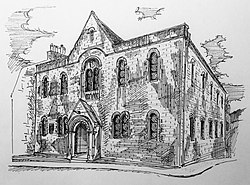
Pleasance Church was a Presbyterian church on the Pleasance in the Southside of Edinburgh, Scotland. Originating in the Relief Church in the 1820s, the congregation united with Charteris Memorial in 1953. In 1842, the congregations of Arthur Street Relief Church (founded in 1825 and known as Brighton Street Relief Church between 1827 and 1835) and Roxburgh Terrace Relief Church (founded as Bethel Relief Church in 1824) united. As with the rest of the Relief Church, they joined the United Presbyterian Church in 1847, adopting the name Pleasance United Presbyterian Church. On union with the United Free Church in 1900, the congregation became Arthur Street United Free Church. Historically one of the Southside's smaller congregations, it was strengthened in 1919 by its union with Pleasance Mission Church and the attached New College Settlement, after which it adopted the name Pleasance United Free Church. The congregation, as with most of the United Free Church, joined the Church of Scotland in 1929, becoming Pleasance Parish Church. The settlement closed in 1952 and Pleasance united with the nearby Charteris Memorial Church the following year. The church's building was constructed for a congregation of Baptists in 1811. The Relief congregation occupied it from 1835 and the addition of galleries the following year increased its capacity from 700 to 1,000. In 1883, David Robertson recast the building in the Norman style. The building was demolished in 1982, having latterly been occupied as a store by Henry Willis & Sons.

Nearby Places View Menu
Location Image
44 m

The Pleasance

The Pleasance is a theatre, bar, sports and recreation complex in Edinburgh, Scotland, situated on a street of the same name. It is owned by the University of Edinburgh, and for nine months of the year it serves the Edinburgh University Students' Association as a societies centre, sports complex, student union bar and entertainment venue. Every August, it is converted into one of the main venues for the Edinburgh Festival Fringe. The Pleasance Theatre Trust operate the venue during this time, and in this guise the complex is sometimes referred to as Pleasance Edinburgh to distinguish it from a sister venue, also called The Pleasance, that the trust opened in Islington in London in 1995.
Location Image
44 m

Pleasance (street)

The Pleasance is a street just outside the Old Town of Edinburgh, Scotland, located in the Southside area. A remnant of the Flodden Wall flanks the west side of the street between Drummond Street and the Cowgate. The University of Edinburgh owns a complex of buildings on the street known as The Pleasance which, for nine months of the year, operate as one of the four Student Union venues that serve the Edinburgh University Students' Association. In August, the complex is converted to use as one of the major venues of the Edinburgh Festival Fringe, for which it is most publicly well-known. The street runs in a predominantly north–south direction for about 600 m (1⁄3 mile), from the junction of Cowgate, St Mary's Street, and Holyrood Road to the junction with East Crosscauseway, where it becomes St Leonards Street. The first section rises quite steeply, from 190 to 250 feet (58 to 76 m), then is relatively flat south of East Adam Street Historically, the street was one of the main routes into Edinburgh from the south, meeting St Mary's Wynd (now St Mary's Street) at St Mary's Wynd Port, one of the gateways of the town walls. The name Pleasance derives from the Scots plesance, meaning a park or garden. It first appears in 1507 as the name of a nearby house, and was later transferred to the street and then the suburb which was part of the regality of the Canongate. The derivation of the name from a nunnery of St Mary of Placentia, often mentioned in histories of Edinburgh, is an invention by William Maitland in his 1753 History of Edinburgh.
Location Image
92 m

New College Settlement

The New College Settlement was a student settlement based on the Pleasance in the Southside of Edinburgh, Scotland. Founded by students of New College in 1893, its work continued until 1952. New College was the ministerial training college for the Free Church of Scotland. The New College Missionary Society had undertaken home mission work in deprived areas of Edinburgh since 1845, settling in the former buildings of Pleasance Free Church in 1876. In 1893, a tenement for resident student workers was added to the mission premises, establishing the mission as part of the growing settlement movement. Having previously relied on student wardens, a permanent, ordained warden, John Harry Miller, was appointed in 1908. In 1913, the settlement was constituted as Pleasance Mission Church. In 1919, this united with nearby Arthur Street United Free Church. Miller became minister of the united charge of Pleasance United Free Church, holding the role in tandem with the wardenship of the settlement. By the wake of the Second World War the Pleasance area was experiencing depopulation and the settlement closed in 1952. The settlement's buildings consisted of the former Pleasance Free Church and, next door, a tenement of 1891–1893 designed by Henry F. Kerr. The tenement is an example of both Arts and Crafts architecture and of the Old Edinburgh movement, popularised by Patrick Geddes. The buildings now form part of the University of Edinburgh's Pleasance complex.
Location Image
118 m

Royal College of Surgeons of Edinburgh

The Royal College of Surgeons of Edinburgh (RCSEd) is a professional organisation of surgeons. The RCSEd has five faculties, covering a broad spectrum of surgical, dental, and other medical and healthcare specialities. Its main campus is located on Nicolson Street, Edinburgh, centred around the 1832 Surgeons' Hall. The campus includes Surgeons' Hall Museums, a medical and surgical library, a skills laboratory, a symposium hall, administrative offices and a hotel. A second UK office was opened in Birmingham in 2014 and an international office opened in Kuala Lumpur, Malaysia, in 2018. It is one of the oldest surgical corporations in the world and traces its origins to 1505 when the Barber Surgeons of Edinburgh were formally incorporated by the then Edinburgh Town Council by the granting of a seal of cause or charter. RCSEd represents members and fellows across the UK and the world, spanning several disciplines, including surgery, dentistry, perioperative care, pre-hospital care, and remote, rural, and humanitarian healthcare. The majority of its UK members are based in England. Its membership includes those at all career stages from medical students to trainees, consultants, and those who have retired from practice. The council is the governing body of RCSEd and represents the professional interests of the college membership. As a charitable organisation, the members of the council are also trustees of the college. The council comprises five office-bearers, 15 elected members, one trainee member, and the Dean of the Faculty of Dental Surgery.