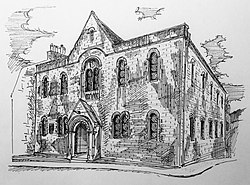
Pleasance Church was a Presbyterian church on the Pleasance in the Southside of Edinburgh, Scotland. Originating in the Relief Church in the 1820s, the congregation united with Charteris Memorial in 1953. In 1842, the congregations of Arthur Street Relief Church (founded in 1825 and known as Brighton Street Relief Church between 1827 and 1835) and Roxburgh Terrace Relief Church (founded as Bethel Relief Church in 1824) united. As with the rest of the Relief Church, they joined the United Presbyterian Church in 1847, adopting the name Pleasance United Presbyterian Church. On union with the United Free Church in 1900, the congregation became Arthur Street United Free Church. Historically one of the Southside's smaller congregations, it was strengthened in 1919 by its union with Pleasance Mission Church and the attached New College Settlement, after which it adopted the name Pleasance United Free Church. The congregation, as with most of the United Free Church, joined the Church of Scotland in 1929, becoming Pleasance Parish Church. The settlement closed in 1952 and Pleasance united with the nearby Charteris Memorial Church the following year. The church's building was constructed for a congregation of Baptists in 1811. The Relief congregation occupied it from 1835 and the addition of galleries the following year increased its capacity from 700 to 1,000. In 1883, David Robertson recast the building in the Norman style. The building was demolished in 1982, having latterly been occupied as a store by Henry Willis & Sons.

Lieux à Proximité Voir Menu
Location Image
206 m

Surgeons' Hall

Le Surgeons' Hall d'Édimbourg, en Écosse, est le siège du Royal College of Surgeons of Edinburgh (Collège royal des chirurgiens d'Édimbourg). Il abrite le musée du Surgeons' Hall, ainsi que la bibliothèque et les archives du Collège. L'actuel Surgeons' Hall, conçu par William Henry Playfair et achevé en 1832, est classé monument historique.
Location Image
228 m

Royal College of Surgeons of Edinburgh

Le Royal College of Surgeons of Edinburgh (RCSEd) est une institution britannique de chirurgiens, basé à Édimbourg. Il fait partie des plus anciennes institutions chirurgicales au monde et fait remonter ses origines à 1505, lorsque les barbiers-chirurgiens d’Édimbourg reçoivent une charte (Seal of Cause) de la ville, fixant notamment des exigences de formation et d’examen.
Location Image
282 m

Edinburgh Festival Theatre

Le Théâtre du festival d'Édimbourg (Edinburgh Festival Theatre en anglais) est une salle de spectacle située dans la rue Nicolson à Édimbourg en Écosse, utilisée principalement pour des représentations d'opéra et de ballet, d'événements musicaux à grande échelle et pour des tournées de compagnies. Cepuis sa rénovation la plus récente en 1994, le nombre de sièges est de 1915. C'est l'un des lieux principaux lieux du Festival international d'Édimbourg annuel d'été et c'est le siège de l'Opéra écossais et du Ballet écossais.
Location Image
353 m

Kirk o' Field

Kirk o 'Field, situé à Édimbourg, en Écosse, est surtout connu comme le lieu du meurtre, le 10 février 1567, de Lord Darnley, deuxième époux de Marie Stuart, reine d'Écosse, et père du roi Jacques VI. Le site était occupé par la collégiale St Mary in the Fields, ou le Kirk o 'Field. Il était à environ dix minutes à pied du palais de Holyrood, adjacent au mur de la ville, près de Cowgate. Le site est proche de l'emplacement du National Museum of Scotland.
Location Image
357 m

Collection Russell

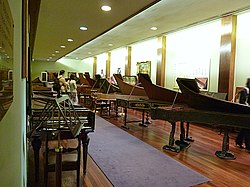
La collection Russell est une importante collection d'instruments à clavier anciens assemblés par le claveciniste et organologue britannique Raymond Russell. Elle fait partie de la collection des musées d'instruments musicaux de l'Université d'Edimbourg et se trouve dans le St Cecilia's Hall. Son nom complet est la Raymond Russell Collection of Early Keyboard Instruments (« Collection Raymond Russell des instruments anciens à clavier »).