

 English
 Français

Boulevard Louis-XIV (Lille)
Le boulevard Louis-XIV est une voie de Lille.
Nearby Places View Menu

186 m
Pasteur Institute of Lille
The Pasteur Institute of Lille (French: Institut Pasteur de Lille, Pasteur-Lille, IPL) is a research centre and member of the Pasteur Institute network.
It includes 14 research units and 1,150 employees including 626 researchers located in Lille, France. There are also 300 employees located outside the Pasteur site. Several neuroscience start-up companies have emerged from the Pasteur Institute of Lille.
196 m
Canton of Lille-4
The canton of Lille-4 is an administrative division of the Nord department, northern France. It was created at the French canton reorganisation which came into effect in March 2015. Its seat is in Lille.
It consists of the following communes:
Lezennes
Lille (partly)
Ronchin
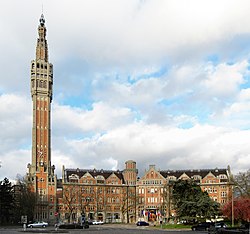
228 m
Hôtel de Ville, Lille
The Hôtel de Ville (French pronunciation: [otɛl də vil], City Hall) is a municipal building in Lille, France. Built between 1924 and 1932 in Art Deco style of Flemish neo-Renaissance inspiration, it was designated a Monument historique by the French Government in May 2002. Its belfry is a UNESCO World Heritage Site, inscribed in 2005 along with many other Belfries of Belgium and France in recognition of its architecture and importance in the history of municipal power in Europe. The latter should not be confused with the belfry of Lille's Chamber of Commerce, also emblematic of the city.
The Town Hall is located on the Place Roger Salengro, next to the Porte de Paris, in the eastern part of the city centre. This site is served by the Mairie de Lille metro station on line 2 of the Lille Metro.

302 m
Lille-Saint-Sauveur station
Lille-Saint-Sauveur is a former goods train station of Lille which had some of its buildings converted into recreational areas and an exhibition hall on the occasion of the events of Lille 3000 in 2009.

364 m
University of Lille
The University of Lille (French: Université de Lille, abbreviated as ULille, UDL or univ-lille) is a French public research university based in Lille, in the Nord department of Upper France. It has its origins in the University of Douai (1559), and resulted from the merger of three universities – Lille 1 University of Science and Technology, Lille 2 University of Health and Law, and Charles de Gaulle University – Lille III in 2018. With more than 80,000 students, it is one of the largest universities in France and one of the largest French-speaking universities in the world.
Since 2017, the university has been funded as one of the French universities of excellence. It benefits from an endowment of 500 million euros to accelerate its strategy in education, research, international development and outreach.
With 66 research labs, 350 PhD theses supported per year and 3,000 scientific publications each year, it is well represented in the research community; it collaborates with many organizations (Pasteur Institute of Lille, CHU Lille University Hospital, CNRS, INSERM, INRA, INRIA etc.) and schools (École Centrale de Lille, École des Mines-Télécom de Lille-Douai (IMT Lille Douai), Sciences Po Lille etc.).
Until 2019, the university was the main component of the Community of Universities and Institutions (COMUE) Lille Nord de France. It still operates the European Doctoral College, which federates universities and other higher learning institutes in the Hauts-de-France region.