Lille-Saint-Sauveur is a former goods train station of Lille which had some of its buildings converted into recreational areas and an exhibition hall on the occasion of the events of Lille 3000 in 2009.

1. History

Ten years after the opening of the first railway station of Lille, Lille-Flandres station in 1848, the city annexed the neighboring towns of Moulins, Wazemmes, Fives, and Esquermes. That was when the idea of building a larger station in the south emerged. The new station was created in 1861 by imperial decree, and construction finished in 1864. Station Fives-Saint-Sauveur was initially supposed to become the main train station in Lille, but due to its location, which then seemed relatively far from the historical center, eventually led to a freight station. After entering into service of multimodal Dourges Delta 3, the station stopped its activities in 2001 and Sernam ceased to operate in December 2003. This raised the question of how to convert the 20 acres it occupies. The project is not yet finalized, but in 2008 the rehabilitation work of two of its halls have been undertaken as part of the organization of events in 2009 Lille 3000: Hall A, with an area of 1,000 m2 (11,000 sq ft). The building, which dates from the nineteenth century, now houses a bar, a restaurant and a cinema. Hall B, with an area of 5,000 m2 (54,000 sq ft). The building, constructed during the 1920s, was converted into an exhibition space and event planning. Martine Aubry, mayor of Lille, announced her candidacy for president in this former train station.

Nearby Places View Menu
Location Image
156 m

Pasteur Institute of Lille

The Pasteur Institute of Lille (French: Institut Pasteur de Lille, Pasteur-Lille, IPL) is a research centre and member of the Pasteur Institute network. It includes 14 research units and 1,150 employees including 626 researchers located in Lille, France. There are also 300 employees located outside the Pasteur site. Several neuroscience start-up companies have emerged from the Pasteur Institute of Lille.
Location Image
483 m

Sciences Po Lille

Institut d'études politiques de Lille (French pronunciation: [ɛ̃stity detyd pɔlitik də lil], Lille Institute of Political Studies), officially referred to as Sciences Po Lille ([sjɑ̃s po lil]), is a grande école located in Lille, France. It is a part of the Conférence des Grandes Écoles. It was created as one of the French Institutes of Political Studies. The school's focus is on educating France's political and diplomatic personnel, but its academic focus spans not only the political and economic sciences, but also law, communications, finance, business, urban policy, management, and journalism.
498 m

Canton of Lille-4

The canton of Lille-4 is an administrative division of the Nord department, northern France. It was created at the French canton reorganisation which came into effect in March 2015. Its seat is in Lille. It consists of the following communes: Lezennes Lille (partly) Ronchin
Location Image
511 m

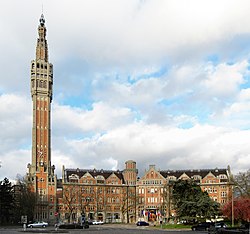
Hôtel de Ville, Lille

The Hôtel de Ville (French pronunciation: [otɛl də vil], City Hall) is a municipal building in Lille, France. Built between 1924 and 1932 in Art Deco style of Flemish neo-Renaissance inspiration, it was designated a Monument historique by the French Government in May 2002. Its belfry is a UNESCO World Heritage Site, inscribed in 2005 along with many other Belfries of Belgium and France in recognition of its architecture and importance in the history of municipal power in Europe. The latter should not be confused with the belfry of Lille's Chamber of Commerce, also emblematic of the city. The Town Hall is located on the Place Roger Salengro, next to the Porte de Paris, in the eastern part of the city centre. This site is served by the Mairie de Lille metro station on line 2 of the Lille Metro.