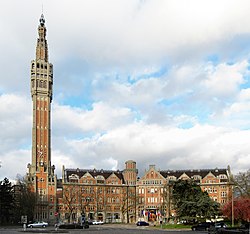
The Pasteur Institute of Lille (French: Institut Pasteur de Lille, Pasteur-Lille, IPL) is a research centre and member of the Pasteur Institute network. It includes 14 research units and 1,150 employees including 626 researchers located in Lille, France. There are also 300 employees located outside the Pasteur site. Several neuroscience start-up companies have emerged from the Pasteur Institute of Lille.

1. Research

Since Louis Pasteur became the dean of the faculty of sciences in Lille in 1854, the research activities of the institute have been associated with University of Lille, CNRS, INSERM (Community of Universities and Institutions (COMUE) Lille Nord de France; Institute of Biology of Lille - IBL). It is in its premises that the Bacillus Calmette-Guérin (BCG) vaccine against tuberculosis was invented by Albert Calmette and Camille Guérin. Research areas include

Microbiology Parasitology Immunology Cancer, Cardiovascular diseases, metabolic diseases, Neurodegenerative diseases

1. Notable students

Patrick Francheterre, French ice hockey player, coach and manager.

1. See also

Institut national de la santé et de la recherche médicale

1. References


1. External links

Website of the Pasteur Institute of Lille

Nearby Places View Menu
Location Image
156 m

Lille-Saint-Sauveur station

Lille-Saint-Sauveur is a former goods train station of Lille which had some of its buildings converted into recreational areas and an exhibition hall on the occasion of the events of Lille 3000 in 2009.
Location Image
366 m

Hôtel de Ville, Lille

The Hôtel de Ville (French pronunciation: [otɛl də vil], City Hall) is a municipal building in Lille, France. Built between 1924 and 1932 in Art Deco style of Flemish neo-Renaissance inspiration, it was designated a Monument historique by the French Government in May 2002. Its belfry is a UNESCO World Heritage Site, inscribed in 2005 along with many other Belfries of Belgium and France in recognition of its architecture and importance in the history of municipal power in Europe. The latter should not be confused with the belfry of Lille's Chamber of Commerce, also emblematic of the city. The Town Hall is located on the Place Roger Salengro, next to the Porte de Paris, in the eastern part of the city centre. This site is served by the Mairie de Lille metro station on line 2 of the Lille Metro.
369 m

Canton of Lille-4

The canton of Lille-4 is an administrative division of the Nord department, northern France. It was created at the French canton reorganisation which came into effect in March 2015. Its seat is in Lille. It consists of the following communes: Lezennes Lille (partly) Ronchin
Location Image
418 m

Lille 2 University of Health and Law

The Lille 2 University of Health and Law (French: Université Lille 2 : Droit et Santé) was a French university for health, sports, management and law. It was located in Lille and was part of the Community of Universities and Institutions (COMUE) Lille Nord de France. The University of Lille II inherits from the Faculty of Law established as the Université de Douai in 1559. After, sciences and technologies are taught in an independent campus of Université de Lille I - USTL, while literature and social sciences are taught as part of the independent campus of Université de Lille III - Charles de Gaulle. Altogether, the universities of Lille include more than 90,000 students and are the core parts of the European Doctoral College Lille-Nord-Pas de Calais Archived 2007-10-29 at the Wayback Machine that includes 3,000 PhD Doctorate students supported by university research laboratories. Henri Warembourg was president of this university. His son, Nicolas Warembourg, is professor of law in Sorbonne. Since 1970, the main campus of University de Lille II in situated in Ronchin, in the southern part of Lille. It includes 24,000 students 1,050 faculty members and 830 staff 50 research labs, associated to the European Doctoral College Lille Nord-Pas de Calais 250 courses towards nationally accredited degrees and 170 courses towards university diploma. At the beginning of 2018, the three universities of Lille (Lille 1, Lille 2, Lille 3) merged to form the University of Lille.