

 English
 Français
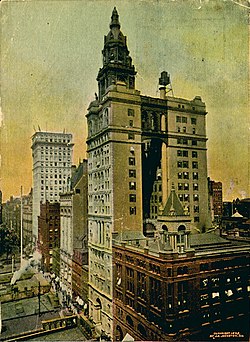
Manhattan Life Insurance Building
The Manhattan Life Insurance Building was a 348 ft (106 m) tower on Broadway in the Financial District of Manhattan, New York City.
Nearby Places View Menu
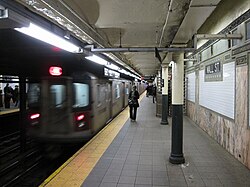
9 m
Wall Street station (IRT Lexington Avenue Line)
The Wall Street station is a station on the IRT Lexington Avenue Line of the New York City Subway. The station is located at the intersection of Broadway and Wall Street in the Financial District of Lower Manhattan. It is served by the 4 train at all times and the 5 train at all times except late nights.
The Wall Street station was constructed for the Interborough Rapid Transit Company (IRT) as part of the city's first subway line, which was approved in 1900. Construction of the tunnel around the Wall Street station was complicated by the shallow foundations of the nearby Trinity Church, as well as the need to avoid disrupting the street surface of Broadway. The station opened on June 12, 1905, as an extension of the original line. The station's platforms were lengthened in the late 1950s, and it was renovated in the 1970s and 2000s.
The Wall Street station contains two side platforms and two tracks, and it was built with tile and mosaic decorations. The platforms contain exits to Broadway's intersections with Wall and Rector Streets, outside Trinity Church, and into the basements of several buildings. An additional passageway extends east to an out-of-system connection with the Broad Street station and the basement of 28 Liberty Street. The original station interior is a New York City designated landmark and listed on the National Register of Historic Places.
37 m
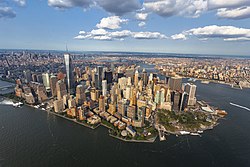
Lower Manhattan
Lower Manhattan, also known as Downtown Manhattan, is the southernmost part of the New York City borough of Manhattan. The area is the historical birthplace of New York City and in the 17th and 18th centuries composed the entirety of the city. Lower Manhattan serves as the seat of government of both Manhattan and the entire City of New York. Because there are no municipally defined boundaries for the area, a precise population cannot be quoted, but several sources have suggested that it was one of the fastest-growing locations in New York City between 2010 and 2020, related to the influx of young adults and significant development of new housing units.
Despite various definitions of Lower Manhattan, they generally include all of Manhattan Island south of 14th Street, with the
Bowling Green and the Battery near the southern end. Anchored by Wall Street and the Financial District in Lower Manhattan, New York City is the leading global center for finance and fintech. The Financial District houses the New York Stock Exchange, the Federal Reserve Bank of New York, and other major financial institutions. A center of culture and tourism, Lower Manhattan is home to many of New York City's most iconic structures, including New York City Hall, the Woolworth Building, the Stonewall Inn, the Bull of Wall Street, and One World Trade Center, the tallest skyscraper in the Western Hemisphere.

41 m
Statue of John Watts
An outdoor bronze sculpture depicting U.S. Congressman John Watts by George Edwin Bissell is installed in the Trinity Church Cemetery outside Manhattan's Trinity Church, in the U.S. state of New York. It was erected by Watt's grandson, John Watts de Peyster, in 1893.

53 m
American Surety Building
The American Surety Building (also known as the Bank of Tokyo Building or 100 Broadway) is an office building and early skyscraper at Pine Street and Broadway in the Financial District of Manhattan in New York City, across from Trinity Church. The building was designed in a Neo-Renaissance style by Bruce Price with a later expansion by Herman Lee Meader. It is 388 feet (118 m) tall, with either 23 or 26 stories. It was one of Manhattan's first buildings with steel framing and curtain wall construction.
The American Surety Building contains a facade of Maine granite. Its articulation consists of three horizontal sections similar to the components of a column, namely a base, shaft, and capital, making the American Surety Building one of the earliest New York City skyscrapers to feature such a layout. The facade contains several ornamental features, including sculptural elements designed by J. Massey Rhind. In addition, the American Surety Building uses an interior skeleton of structural steel, as well as a cantilevered steel structure for its foundations.
The building was erected between 1894 and 1896 as a 21-story structure, which was the second tallest building in New York City when completed. Between 1920 and 1922, an annex was built to designs by Meader, increasing the floor area and adding two stories to the building. A later tenant, the Bank of Tokyo, hired Kajima International to restore the lower 13 stories between 1973 and 1975. The American Surety Building was made a New York City designated landmark in 1995.