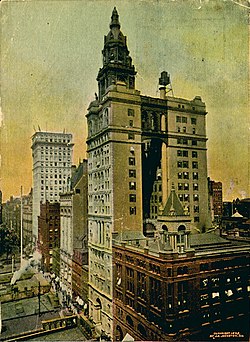
The American Surety Building (also known as the Bank of Tokyo Building or 100 Broadway) is an office building and early skyscraper at Pine Street and Broadway in the Financial District of Manhattan in New York City, across from Trinity Church. The building was designed in a Neo-Renaissance style by Bruce Price with a later expansion by Herman Lee Meader. It is 388 feet (118 m) tall, with either 23 or 26 stories. It was one of Manhattan's first buildings with steel framing and curtain wall construction. The American Surety Building contains a facade of Maine granite. Its articulation consists of three horizontal sections similar to the components of a column, namely a base, shaft, and capital, making the American Surety Building one of the earliest New York City skyscrapers to feature such a layout. The facade contains several ornamental features, including sculptural elements designed by J. Massey Rhind. In addition, the American Surety Building uses an interior skeleton of structural steel, as well as a cantilevered steel structure for its foundations. The building was erected between 1894 and 1896 as a 21-story structure, which was the second tallest building in New York City when completed. Between 1920 and 1922, an annex was built to designs by Meader, increasing the floor area and adding two stories to the building. A later tenant, the Bank of Tokyo, hired Kajima International to restore the lower 13 stories between 1973 and 1975. The American Surety Building was made a New York City designated landmark in 1995.

Nearby Places View Menu
Location Image
27 m

New York Law Institute

The New York Law Institute is the oldest circulating law library in New York City and is open to Institute members and to scholars of history and the law.
Location Image
47 m

Trinity Church Cemetery

The parish of Trinity Church has three separate burial grounds associated with it in the New York City borough of Manhattan. The first, Trinity Churchyard, is located in Lower Manhattan at 74 Trinity Place, near Wall Street and Broadway. Alexander Hamilton and his wife Elizabeth Schuyler Hamilton, Albert Gallatin, and Robert Fulton are buried in the downtown Trinity Churchyard. The second Trinity parish burial ground is the St. Paul's Chapel Churchyard, which is also located in lower Manhattan, six blocks (roughly 440 yards (400 m)) north of Trinity Church. It was established in 1766. Both of these churchyards are closed to new burials. Trinity's third place of burial, Trinity Church Cemetery and Mausoleum, located in Hamilton Heights in Upper Manhattan, is one of the few active burial sites in Manhattan. Trinity Church Cemetery and Mausoleum is listed on the National Register of Historic Places and is the burial place of notable people including John James Audubon, John Jacob Astor IV, Mayor Edward I. Koch, Governor John Adams Dix, Ralph Ellison, and Eliza Jumel. In 1823, all burials south of Canal Street became forbidden by New York City due to city crowding, yellow fever, and other public health fears. After considering locations in the Bronx and portions of the then-new Green-Wood Cemetery, in 1842 Trinity Parish purchased the plot of land now bordered by 153rd Street, 155th Street, Amsterdam Avenue, and Riverside Drive to establish the Trinity Church Cemetery and Mausoleum. The cemetery is located beside the Chapel of the Intercession that Audubon co-founded in 1846, but this chapel is no longer part of Trinity parish. James Renwick, Jr., is the architect of Trinity Church Cemetery and further updates were made by Calvert Vaux. The uptown cemetery is also the center of the Heritage Rose District of New York City. A no-longer-extant Trinity Parish burial ground was the Old Saint John's Burying Ground for St. John's Chapel. This location is bounded by Hudson, Leroy and Clarkson streets near Hudson Square. It was in use from 1806 to 1852 with over 10,000 burials, mostly poor and young. In 1897, it was turned into St. John's Park, with most of the burials left in place. The park was later renamed Hudson Park, and is now James J. Walker Park. (This park is different from a separate St. John's Park, a former private park and residential block approximately one mile to the south that now serves as part of the Holland Tunnel access.)
Location Image
53 m

Manhattan Life Insurance Building

The Manhattan Life Insurance Building was a 348 ft (106 m) tower on Broadway in the Financial District of Manhattan, New York City.
Location Image
60 m

Equitable Life Building (Manhattan)

The Equitable Life Assurance Building, also known as the Equitable Life Building, was the headquarters of the Equitable Life Assurance Society of the United States, at 120 Broadway in Manhattan, New York. Arthur Gilman and Edward H. Kendall designed the building, with George B. Post as a consulting engineer. The Equitable Life Building was made of brick, granite, and iron, and was originally built with seven above-ground stories and two basement levels, with a height of at least 130 feet (40 m). An expansion in 1885 brought the total height to 155 feet (47 m) and nine stories. Construction began in 1868 and was completed in 1870 under the leadership of Equitable's president Henry Baldwin Hyde. It was the world's first office building to feature passenger elevators and consequently became successful attracting tenants. The Equitable Life Building was expanded numerous times; after the construction of annexes during the late 1880s, the building occupied its entire block, bounded by Broadway and Cedar, Pine and Nassau streets. Although it was advertised as fireproof, the Equitable Life Building was destroyed in a 1912 fire that killed six people. The 40-story Equitable Building was completed on the site in 1915.