

 English
 Français
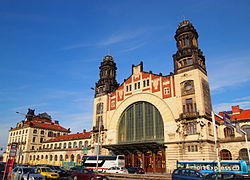
Gare centrale de Prague
La gare centrale de Prague (en tchèque : Praha hlavní nádraží, également appelée Praha Wilsonovo nádraží) est la plus grande et la plus importante gare ferroviaire de Prague.
Nearby Places View Menu

67 m
Praha hlavní nádraží
Praha hlavní nádraží (IATA: XYG) is the largest railway station in Prague, Czech Republic. It opened in 1871 as Franz Josef Station, after Franz Joseph I of Austria. During the First Republic and from 1945 to 1948 the station was called Wilson Station (Czech: Wilsonovo nádraží), after the former President of the United States Woodrow Wilson.
The station is the largest Art Nouveau monument in the Czech Republic. Since 31 December 1976, it has been a cultural monument of the Czech Republic and since 1993 it has been part of the urban monument zone of Vinohrady, Žižkov and Vršovice.
In 2014, the station served 224,505 trains (610 daily) and more than 53,000,000 passengers (71,000 daily) and a number of regional, national and international trains, for which it is often the starting or final station. The station is connected to Prague Metro Line C and the Hlavní nádraží railway station.

76 m
Hlavní nádraží (Prague Metro)
Hlavní nádraží (Czech pronunciation: [ˈɦlavɲiː ˈnaːdraʒiː]) is a Prague Metro station on Line C. The metro station serves Praha hlavní nádraží, Prague's principal mainline railway station. The metro station is situated underground, below the railway station.

174 m
Woodrow Wilson Monument
The Woodrow Wilson Monument (Czech: Pomník Woodrowa Wilsona), created by Czech-American sculptor Albin Polasek, is installed outside Praha hlavní nádraží in Prague, Czech Republic. It was unveiled in October 2011, and honors the 28th president of the United States, Woodrow Wilson. It was erected to honor the role that Wilson had in Czech independence after World War I.

294 m
Brotherhood (sculpture)
Brotherhood (Czech: Sbratření, lit. 'Fraternation') is a sculpture by the Czech sculptor Karel Pokorný (1891–1962). Initially placed in Česká Třebová, Czechoslovakia in 1951, it was dedicated to the end of the Prague Offensive during World War II. Its replicas were established in Prague (1960, replaced in 1988), Saint Petersburg (1977) and Kurpaty, Crimea (1985). The sculpture depicts the meeting of a Soviet Red Army soldier and a Czech militiaman in May 1945. Soviet art critics evaluated Brotherhood as one of the best works of socialist realism. This sculpture became a symbol of friendship between the peoples of the Soviet Union and Czechoslovakia. Its image was used on stamps, coins, banknotes, etc.
After the dismantling of the Monument to Soviet Tank Crews in 1991 and the Statue of Ivan Konev in 2020, Brotherhood became the main memorial of World War II in Prague.
From the first years after its creation, some viewers of the sculpture saw homoerotic overtones in it.

298 m
State Opera (Prague)
The State Opera (Czech: Státní opera) is an opera house in Prague, Czech Republic. It is part of the National Theatre of the Czech Republic, founded by Ministry of Culture of the Czech Republic in 1992. The theatre itself originally opened in 1888 as the New German Theatre and from 1949 to 1989 it was known as the Smetana Theatre. More recently it was renamed the Prague State Opera. Currently it is home to approximately 300 performances a year.