


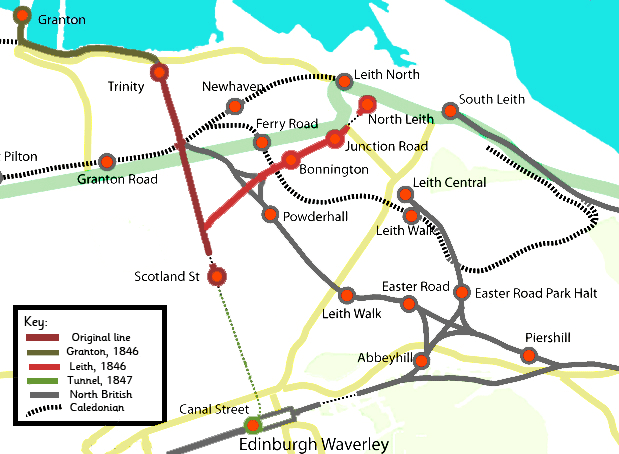
Easter Road Park Halt railway station was a railway station located in Lochend, Edinburgh, Scotland from 1950 to 1967 on the Leith Central Branch. It was built to serve the nearby Easter Road stadium.
Gallery


Sponsored
Location
1 explorer visited this place
173 m
Beechwood Park, initially known as Bank Park, was a football ground in the Leith area of Edinburgh, Scotland. It was the home ground of Leith Athletic during their first seven seasons in the Scottish Football League.

221 m
Easter Road is a football stadium located in the Leith area of Edinburgh, Scotland, which is the home ground of Scottish Premiership club Hibernian. The stadium currently has an all-seated capacity of 20,421, which makes it the fifth-largest football stadium in Scotland. Easter Road is also known by Hibs fans as "The Holy Ground" or "The Leith San Siro". The venue has also been used to stage international matches, Scottish League Cup semi-finals and was briefly the home ground of the Edinburgh professional rugby union team.
Hibs first played at the present site of Easter Road in 1893. The ground holds the record attendance for a Scottish match outside Glasgow, when 65,860 attended an Edinburgh derby on 2 January 1950. The size of the terracing was greatly reduced in the 1980s. After the publication of the Taylor Report, Hibs considered leaving Easter Road and moving to a different site, but these plans were abandoned in 1994. Redevelopment of the stadium began in 1995 and was completed in 2010. The Easter Road pitch had a pronounced slope until it was removed in 2000.

307 m
Lochend House, also known as Restalrig Castle and Lochend Castle, is an occupied house, incorporating the remains of a 16th-century L-plan tower house, in Edinburgh, Scotland. It is located in the Lochend area, about 1.5 miles east of Edinburgh Castle. The house is protected as a category B listed building.

335 m
Lochend is a mainly residential suburb of Edinburgh, the capital of Scotland. It is named after Lochend Castle and the adjacent Lochend Loch, located in the western part of Restalrig, approximately two miles from Edinburgh city centre. The suburb consists largely of a 1930s public housing estate, and is bounded on the west by Easter Road.
Lochend Loch is fed from underground springs. With no outlet stream, it was once used for a piped water supply to Leith but was partially filled in the 1960s to reduce water depth for safety reasons, and is now fenced and partly overgrown, providing a wildlife area. It forms a central feature of Lochend Park. Nearby, Lochend Castle was largely demolished in the 16th century, but surviving elements of it form part of the 19th century Lochend House. A 16th century beehive doocot, associated with the castle, stands in Lochend Park.
James IV of Scotland came to the Lochend to hunt wildfowl in September 1507, and four men were paid to row a boat on the "loch of Restalrig" to start the birds.
History
This short-lived station was opened in 1950 by British Railways. It consisted of one wooden platform and was solely open on match days for arrivals only. Fans would have to make their return journey after the match from neighbouring stations in Leith, Abbeyhill or at Waverley.
Book your tour near
Easter Road Park Halt railway station
Book Now
4.3
in partnership with
GetYourGuide.com