La Société britannique de mycologie (British Mycological Society) est une société savante fondée en 1896. Ses origines sont à rechercher du côté de deux sociétés locales, le Woolhope Field Naturalists’ Club d’Hereford et le Yorkshire Naturalists’ Union. C’est le conservateur du club d’Hereford, le Dr H.G. Bull, qui, en 1867, incite ses membres à commencer à s’intéresser particulièrement aux champignons. À la mort de Bull, les activités du club commencent à diminuer lorsque l’Union du Yorkshire prend le relais et fonde un comité mycologique en 1892. Celui-ci attire de nombreux mycologue comme Mordecai Cubitt Cooke (1825-1914), Carleton Rea (1861-1946), George Edward Massee (1850-1917), Charles Bagge Plowright (1849-1910) et d’autres. Le besoin de pouvoir disposer d’une revue pour publier leurs observations, conduit M.C. Cooke, C. Rea, G.E. Massee, Charles Crossland (1844-1916) et d’autres mycologues à préparer en 1895 à la fondation, le 19 septembre 1896 à Selby, de la British Mycological Society. On procède à l’élection du premier bureau avec G.E. Massee à la présidence, C. Crossland à la trésorerie et C. Rea au secrétariat. Le choix de G.E. Massee s’explique par sa fonction dans les Jardins botaniques royaux de Kew (où il a remplacé M.C. Cooke comme mycologue en 1893) et sa réputation internationale (il a à son actif plus de 250 publications). À partir de 1897, C. Rea cumule les fonctions de trésorier, de secrétaire (jusqu’en 1918) et d’éditeur des comptes rendus (jusqu’en 1930). À partir de 1903, la société compte cent membres, au lendemain de la Seconde Guerre mondiale, elle compte plus de quatre cents membres pour atteindre aujourd’hui presque deux mille. Le premier membre honoraire fut Émile Boudier (1828-1920) en 1905, suivi de Pier Andrea Saccardo (1845-1920) en 1916, de C. Rea en 1918 et de Narcisse Théophile Patouillard (1854-1926) en 1920. La Société fait paraître les Transactions of the British Mycological Society depuis 1897, en 1989 la revue devient Mycological Research puis en 2010 Fungal Biology. Le Bulletin de la Société à commencer à paraître en 1967 avant d’être remplacé par The Mycologist en 1897. Régulièrement, des volumes de Symposium thématique sont publiés, leur nombre s’élève aujourd’hui à vingt. La Société porte particulièrement son attention sur l’enseignement de la mycologie. Des sorties régulières sur le terrain sont organisés, parfois à l’étranger, parfois en relation avec d’autres sociétés mycologiques comme en 1952 avec la Société mycologique de France. Elle est également à l’origine de l’organisation du premier congrès international en 1971 à Exeter sous la présidence de Cecil Terence Ingold (1905-), huit sociétés mycologiques y furent représentées.

Nearby Places View Menu
Location Image
294 m

Ardwick Green

Ardwick Green is a public space in Ardwick, Manchester, England. It began as a private park for the residents of houses surrounding it before Manchester acquired it in 1867 and turned it into a public park with an ornamental pond and a bandstand. It contains a cenotaph commemorating the dead of the Eighth Ardwicks, a former unit of the Territorial Army belonging to the Manchester Regiment. The old drill hall at one end of the park is still used by volunteer soldiers. The other end of the park contains a large boulder, a glacial erratic. The business premises of Thomas Brown, surveyor and Resident Engineer for the construction of the Peak Forest Canal, were in Manchester and by 1841 he was living in Allerton Place at 16 Ardwick Green. He died here on the 30 January 1850, aged 78 years. Allerton Place was demolished and by 1915 a tyre works had been built on the site. The early 19th-century cast iron railings on the north and west sides of Ardwick Green were Grade II listed on 3 October 1974. Many of the grand buildings have been demolished, including the Ardwick Empire Music Hall (later Manchester Hippodrome) at the eastern end.
Location Image
326 m

Ardwick

Ardwick is an area of Manchester, England, one mile (1.5 kilometres) southeast of the city centre. The population at the 2011 census was 19,250. Historically in Lancashire, by the mid-nineteenth century Ardwick had grown from being a village into a pleasant and wealthy suburb of Manchester, but by the end of that century became heavily industrialised. When its industries fell into decline so did Ardwick, becoming one of the city's most deprived areas. Substantial development has since taken place, including the construction of facilities for the 2002 Commonwealth Games at the nearby City of Manchester Stadium. In the late nineteenth century, Ardwick had many places of entertainment, but the only remnant of that today is the Art Deco-style Manchester Apollo, a venue for pop and rock music concerts.
342 m

Ardwick Hall

Ardwick Hall was a large country house set amongst grounds and conservatories on the eastern side of Ardwick Green in Manchester. Ardwick Hall was constructed at some time before 1794, though there may have been an older Ardwick Hall which was associated with the locally prominent Birch family. The new house was originally occupied by Samuel Hyde, after his death the hall was passed on to linen merchant Robert Hyde who was the uncle of British textile mill owner Samuel Greg (1758–1834). Robert died in 1785, and the Hall was inherited by brother Nathan Hyde, who owned it until his death on 24 October 1795. It was owned in the mid-19th century by textile magnate John Kennedy. There were large gardens in front of the Hall, which looked onto Ardwick Green. These grounds were developed in the early 20th century to form the Empire Music Hall and adjoining cinema and billiards hall. The land to the north of the Hall, abutting Dolphin Street, was developed in the late 19th century with a large factory. Ardwick Hall remained standing, hidden amongst surrounding development until the 1970s when it was demolished. Although the hall has now gone, one part of the pre-1794 house still survives as part of the adjacent factory, where a short service wing of the original house, as seen on the 1794 map of the area, remains in-situ.
Location Image
382 m

O2 Apollo Manchester

The O2 Apollo Manchester (known locally as The Apollo and formerly Manchester Apollo and ABC Ardwick) is a concert venue in Ardwick Green, Manchester, England. It is a Grade II listed building, with a capacity of 3,500 (2,514 standing, 986 seats).
Location Image
389 m

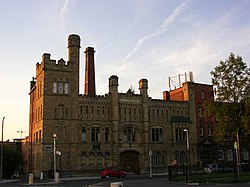
Ardwick Green Barracks

Ardwick Green Barracks is a former military installation in Ardwick, Manchester.