Ardwick Hall was a large country house set amongst grounds and conservatories on the eastern side of Ardwick Green in Manchester. Ardwick Hall was constructed at some time before 1794, though there may have been an older Ardwick Hall which was associated with the locally prominent Birch family. The new house was originally occupied by Samuel Hyde, after his death the hall was passed on to linen merchant Robert Hyde who was the uncle of British textile mill owner Samuel Greg (1758–1834). Robert died in 1785, and the Hall was inherited by brother Nathan Hyde, who owned it until his death on 24 October 1795. It was owned in the mid-19th century by textile magnate John Kennedy. There were large gardens in front of the Hall, which looked onto Ardwick Green. These grounds were developed in the early 20th century to form the Empire Music Hall and adjoining cinema and billiards hall. The land to the north of the Hall, abutting Dolphin Street, was developed in the late 19th century with a large factory. Ardwick Hall remained standing, hidden amongst surrounding development until the 1970s when it was demolished. Although the hall has now gone, one part of the pre-1794 house still survives as part of the adjacent factory, where a short service wing of the original house, as seen on the 1794 map of the area, remains in-situ.

Nearby Places View Menu
Location Image
120 m

Ardwick

Ardwick is an area of Manchester, England, one mile (1.5 kilometres) southeast of the city centre. The population at the 2011 census was 19,250. Historically in Lancashire, by the mid-nineteenth century Ardwick had grown from being a village into a pleasant and wealthy suburb of Manchester, but by the end of that century became heavily industrialised. When its industries fell into decline so did Ardwick, becoming one of the city's most deprived areas. Substantial development has since taken place, including the construction of facilities for the 2002 Commonwealth Games at the nearby City of Manchester Stadium. In the late nineteenth century, Ardwick had many places of entertainment, but the only remnant of that today is the Art Deco-style Manchester Apollo, a venue for pop and rock music concerts.
Location Image
223 m

Ellen Wilkinson High School

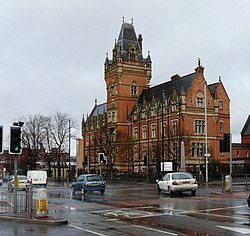
Ellen Wilkinson High School was housed, until it closed in 2000, in a Grade II* listed building in Ardwick, Manchester, England, designed in 1865–67 by the prolific Manchester architect Thomas Worthington. Formerly known as Nicholls Hospital, the building was funded by Benjamin Nicholls as a memorial to his son, John Ashton Nicholls. Nicholls commissioned Worthington to prepare designs, with instructions that building was only to commence after his own death. It was built in 1878–1880 and Worthington's last significant commission in the city. The original usage was as an orphanage; the Ashton family gave over £100,000 to its construction and endowment. The style is flamboyant Flemish Gothic in red brick with sandstone dressings and steeply pitched slate roofs. The main range is double-pile with 11 bays and a massive central tower, which shows clear similarities to that of Worthington's City Police Courts at Minshull Street. The tower was originally embellished by Worthington's trade-mark animal carving but the majority were removed in the 20th century. From 1952 to 1967, the building was used as the Nicholls Secondary Boys School. The school later amalgamated with Ardwick High School. Initially the school was known as Nicholls Ardwick High School but was later renamed in honour of Ellen Wilkinson, socialist, feminist and first female Minister for Education, who was born in Ardwick. The school achieved renown because of its heavy emphasis on the arts, thereby anticipating 'specialist school' status by some decades. In 2000 the building changed use again when Ellen Wilkinson High School was merged into Cedar Mount High School, with the old hospital becoming Nicholls Campus of Manchester City College.
Location Image
241 m

Ardwick railway station

Ardwick railway station serves the industrial area of Ardwick, in east Manchester, England; it is located about one mile (1.5 km) south-east of Manchester Piccadilly, on both the Glossop line and Hope Valley Line. Plans to close the station permanently were shelved in 2006, due to increasing activity in the area. From the Summer 2024 timetable, the station has just two trains calling per day on Mondays–Fridays and one train per day on Saturdays.
Location Image
255 m

Miles Platting and Newton Heath

Miles Platting and Newton Heath is an electoral ward in the city of Manchester, North West England which covers the districts of Miles Platting and Newton Heath. The population of this ward at the 2011 census was 14,693.