

 English
 Français
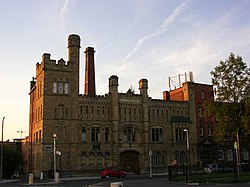
Ardwick Green Barracks
Ardwick Green Barracks is a former military installation in Ardwick, Manchester.
Lieux à Proximité Voir Menu

109 m
Ardwick Green
Ardwick Green is a public space in Ardwick, Manchester, England. It began as a private park for the residents of houses surrounding it before Manchester acquired it in 1867 and turned it into a public park with an ornamental pond and a bandstand.
It contains a cenotaph commemorating the dead of the Eighth Ardwicks, a former unit of the Territorial Army belonging to the Manchester Regiment. The old drill hall at one end of the park is still used by volunteer soldiers. The other end of the park contains a large boulder, a glacial erratic.
The business premises of Thomas Brown, surveyor and Resident Engineer for the construction of the Peak Forest Canal, were in Manchester and by 1841 he was living in Allerton Place at 16 Ardwick Green. He died here on the 30 January 1850, aged 78 years. Allerton Place was demolished and by 1915 a tyre works had been built on the site.
The early 19th-century cast iron railings on the north and west sides of Ardwick Green were Grade II listed on 3 October 1974.
Many of the grand buildings have been demolished, including the Ardwick Empire Music Hall (later Manchester Hippodrome) at the eastern end.

303 m
O2 Apollo Manchester
The O2 Apollo Manchester (known locally as The Apollo and formerly Manchester Apollo and ABC Ardwick) is a concert venue in Ardwick Green, Manchester, England. It is a Grade II listed building, with a capacity of 3,500 (2,514 standing, 986 seats).

540 m
Miles Platting and Newton Heath
Miles Platting and Newton Heath is an electoral ward in the city of Manchester, North West England which covers the districts of Miles Platting and Newton Heath. The population of this ward at the 2011 census was 14,693.
612 m
Ardwick Hall
Ardwick Hall was a large country house set amongst grounds and conservatories on the eastern side of Ardwick Green in Manchester.
Ardwick Hall was constructed at some time before 1794, though there may have been an older Ardwick Hall which was associated with the locally prominent Birch family. The new house was originally occupied by Samuel Hyde, after his death the hall was passed on to linen merchant Robert Hyde who was the uncle of British textile mill owner Samuel Greg (1758–1834). Robert died in 1785, and the Hall was inherited by brother Nathan Hyde, who owned it until his death on 24 October 1795. It was owned in the mid-19th century by textile magnate John Kennedy.
There were large gardens in front of the Hall, which looked onto Ardwick Green. These grounds were developed in the early 20th century to form the Empire Music Hall and adjoining cinema and billiards hall. The land to the north of the Hall, abutting Dolphin Street, was developed in the late 19th century with a large factory. Ardwick Hall remained standing, hidden amongst surrounding development until the 1970s when it was demolished. Although the hall has now gone, one part of the pre-1794 house still survives as part of the adjacent factory, where a short service wing of the original house, as seen on the 1794 map of the area, remains in-situ.