

 English
 Français

The O2 Apollo Manchester (known locally as The Apollo and formerly Manchester Apollo and ABC Ardwick) is a concert venue in Ardwick Green, Manchester, England. It is a Grade II listed building, with a capacity of 3,500 (2,514 standing, 986 seats).
Nearby Places View Menu

232 m
Ardwick Green
Ardwick Green is a public space in Ardwick, Manchester, England. It began as a private park for the residents of houses surrounding it before Manchester acquired it in 1867 and turned it into a public park with an ornamental pond and a bandstand.
It contains a cenotaph commemorating the dead of the Eighth Ardwicks, a former unit of the Territorial Army belonging to the Manchester Regiment. The old drill hall at one end of the park is still used by volunteer soldiers. The other end of the park contains a large boulder, a glacial erratic.
The business premises of Thomas Brown, surveyor and Resident Engineer for the construction of the Peak Forest Canal, were in Manchester and by 1841 he was living in Allerton Place at 16 Ardwick Green. He died here on the 30 January 1850, aged 78 years. Allerton Place was demolished and by 1915 a tyre works had been built on the site.
The early 19th-century cast iron railings on the north and west sides of Ardwick Green were Grade II listed on 3 October 1974.
Many of the grand buildings have been demolished, including the Ardwick Empire Music Hall (later Manchester Hippodrome) at the eastern end.

247 m
Miles Platting and Newton Heath
Miles Platting and Newton Heath is an electoral ward in the city of Manchester, North West England which covers the districts of Miles Platting and Newton Heath. The population of this ward at the 2011 census was 14,693.
303 m
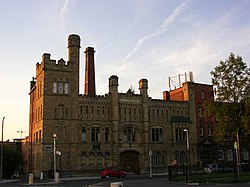
Ardwick Green Barracks
Ardwick Green Barracks is a former military installation in Ardwick, Manchester.
383 m
Ellen Wilkinson High School
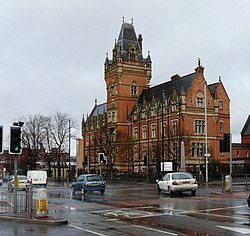
Ellen Wilkinson High School was housed, until it closed in 2000, in a Grade II* listed building in Ardwick, Manchester, England, designed in 1865–67 by the prolific Manchester architect Thomas Worthington. Formerly known as Nicholls Hospital, the building was funded by Benjamin Nicholls as a memorial to his son, John Ashton Nicholls. Nicholls commissioned Worthington to prepare designs, with instructions that building was only to commence after his own death. It was built in 1878–1880 and Worthington's last significant commission in the city. The original usage was as an orphanage; the Ashton family gave over £100,000 to its construction and endowment.
The style is flamboyant Flemish Gothic in red brick with sandstone dressings and steeply pitched slate roofs. The main range is double-pile with 11 bays and a massive central tower, which shows clear similarities to that of Worthington's City Police Courts at Minshull Street. The tower was originally embellished by Worthington's trade-mark animal carving but the majority were removed in the 20th century.
From 1952 to 1967, the building was used as the Nicholls Secondary Boys School. The school later amalgamated with Ardwick High School. Initially the school was known as Nicholls Ardwick High School but was later renamed in honour of Ellen Wilkinson, socialist, feminist and first female Minister for Education, who was born in Ardwick. The school achieved renown because of its heavy emphasis on the arts, thereby anticipating 'specialist school' status by some decades. In 2000 the building changed use again when Ellen Wilkinson High School was merged into Cedar Mount High School, with the old hospital becoming Nicholls Campus of Manchester City College.