
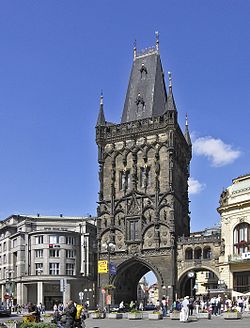
La tour poudrière (en tchèque Prašná brána) est un des édifices les plus connus de la ville de Prague. Elle est la limite entre la vieille Ville et la nouvelle Ville.

1. Histoire

À l'origine, l'une des onze portes de la fortification de la Vieille Ville, la porte Saint-Ambroise (cs), se trouvait à sa place. Après que les murs de la Vieille Ville ont perdu leur importance avec la fondation de Nové Město en 1348 et ont cessé d'être entretenus, la porte est devenue si délabrée que les échevins de la Vieille Ville décidèrent de la démolir et d'en construire une nouvelle à sa place, qui plutôt qu'une garantie de sécurité serait une digne carte de visite de la ville, tout comme la tour du pont de la Vieille Ville à l'extrémité opposée. Sa riche décoration sculptée devait ajouter au prestige du Palais royal adjacent qui se trouvait sur l'emplacement de l'actuelle Maison municipale. La construction a commencé en 1475 et est réalisée par Matěj Rejsek. La tour, appelée à l'origine Nová, a été fondée à près de neuf mètres sous le niveau du terrain actuel et mesurait 42 mètres de haut. Cependant, la construction est restée inachevée, car après le déménagement du roi Vladislas IV au château de Prague en 1483, la Vieille Ville s'est désintéressée de son achèvement. La tour a progressivement perdu toute fonction et a même été considérée comme abandonnée. Elle retrouva un usage à partir du milieu du XVIIIe siècle en servant d'entrepôt de poudre à canon, ce qui lui donna son nom par la suite. Gravement endommagée pendant l’occupation prussienne de 1757, elle fut dépouillée de sa décoration abîmée. Elle n'a acquis son aspect actuel qu'après une modification puriste néogothique entre 1878 et 1886, menée par l'architecte Joseph Mocker, qui réalisa également la restructuration de la Tour Henri située à proximité. L'image de la tour du pont de la vieille ville a servi de modèle. Les principales modifications apportées par Mocker ont été l'ajout d'un nouveau toit ciselé beaucoup plus haut avec des tourelles d'angle, la réfection des décorations des façades et la suppression d'une horloge qui avait été placée au sommet de la tour au début du XIXe siècle.

1. Voir aussi


1. = Articles connexes =

Poudrière Poudre à canon Nitre

1. = Liens externes =

Site officiel Ressources relatives à l'architecture : MonumNet Structurae

1. = Bibliographie =


1. Notes et références

Portail de l’architecture et de l’urbanisme Portail de Prague Portail du patrimoine mondial

Nearby Places View Menu
Location Image
3 m

Powder Tower, Prague

The Powder Tower or Powder Gate (Czech: Prašná brána) is a Gothic tower in Prague, Czech Republic. It is one of the original city gates. It separates the Old Town from the New Town. Powder Tower, as with many historical sites in Prague, undergoes periodic preservation and restoration. The most recent treatment began Summer 2024 and is scheduled to be completed in October. Jiří Pospíšil, Deputy Mayor for Culture and Tourism stated, ”It is our duty to take care of Prague’s heritage buildings, which are a symbol of Prague and the legacy of our ancestors… Now, in cooperation with Prague City Tourism, we are starting the repair of the Powder Tower, and I am very happy that the tower will have a literal new coat.”
Location Image
29 m

Municipal House

Municipal House (Czech: Obecní dům) is a civic building that houses Smetana Hall, a celebrated concert venue, in Prague, Czech Republic. It is located on Náměstí Republiky next to the Powder Gate in the centre of the city.
Location Image
50 m

Czech National Bank

The Czech National Bank, (Czech: Česká národní banka, ČNB) is the central bank and financial market supervisor in the Czech Republic, headquartered in Prague. It is a member of the European System of Central Banks. It was established on 1 January 1993 from the division of the State Bank of Czechoslovakia as part of the process of dissolution of Czechoslovakia, together with the National Bank of Slovakia. In accordance with its primary objective, the CNB sets monetary policy, issues banknotes and coins and manages the circulation of the Czech koruna, the payment system and settlement between banks. It also performs supervision of the banking sector, the capital market, the insurance industry, pension funds, credit unions and electronic money institutions, as well as foreign exchange supervision. Under European Union policy frameworks, the ČNB is a voting member of the respective Boards of Supervisors of the European Banking Authority (EBA), European Insurance and Occupational Pensions Authority (EIOPA), and European Securities and Markets Authority (ESMA). It also provides the permanent single common representative for Czechia in the Supervisory composition of the General Board of the Anti-Money Laundering Authority (AMLA). It is also a member of the European Systemic Risk Board (ESRB).
Location Image
86 m

Broadway Theatre (Prague)

Broadway Theatre (Czech: Divadlo Broadway) is a theatre in Prague, Czech Republic. It is situated in the Celetná and Na Příkopě streets of the Old Town district of Prague. It opened in 2002. It focuses on production of musicals. Broadway Theatre is a part of the Palace Sevastopol, which was originally built in functionalist style in 1938. The Celetná and Na Příkopě streets are connected by Broadway Passage. The palace is listed in the register of protected buildings. The theatre's first production was the musical Cleopatra, which made its début on 22 February 2002 and featured Bára Basiková, Ilona Csáková, Monika Absolonová and Radka Fišarová alternating in the title role.
Location Image
121 m

Hotel Paris (Prague)

Hotel Paris Prague (Czech: Hotel Paříž Praha) is a 5-star luxury hotel in Prague, Czech Republic. It is located in the centre of Prague in Old Town. It was built in 1904 according to plans of Jan Vejrych. Its architectural style is a mixture of Art Nouveau and Gothic Revival. It featured as a location in Bohumil Hrabal's book I Served the King of England. In 1984 it was declared as a historical monument.