John Ericsson is a Heroic-Scale bronze statue depicting John Ericsson, and is located in Battery Park in New York City

1. History

The statue depicts the esteemed Swedish-American engineer and inventor John Ericsson (1803–1889), who helped to revolutionize military-maritime technology with his ironclad warship, the USS Monitor. Less than four years after Ericsson's death, sculptor Jonathan Scott Hartley (1845–1912) was commissioned by the state of New York to create a larger-than-life bronze portrait of Ericsson, which was dedicated April 26, 1893 in Battery Park. The pedestal was designed by architect Frank Wallis; Hartley and Wallis also collaborated on the Algernon Sydney Sullivan Memorial, unveiled in Van Cortlandt Park in 1906. Ten years later the sculptor, dissatisfied with his first version, crafted a modified statue, cast at the local Roman Bronze Works, and dedicated on August 1, 1903, a day after the centennial of Ericsson’s birth. The modified statue predates the John Ericsson Memorial in Washington, D.C. by 13 years. The statue is located on the perimeter of Battery Park, on State Street, across from Bridge Street. Over time the monument suffered extensive damage, the result of weathering, vandalism, and even a fire. In 1996 the sculpture was conserved by Parks’ monuments crew, and as part of overall improvements to Battery Park, the sculpture is slated to be moved from its present location to a more prominent site near a perimeter entrance.

1. Physical description

The figure (heroic scale) depicts Ericsson standing, holding a model of the USS Monitor in his hand. The bronze figure is 8'7"(2.6m) tall, atop a 7'11"(2.4) polished black diamond granite pedestal. Each side of the pedestal has bronze plaques with dimensions of 1'x2'3.5"(0.3mx0.7m) that illustrate significant naval battles involving the Monitor and Princeton, as well as an array of Ericsson’s mechanical inventions. The right side of the plinth is signed by the sculptor, and reads "J.S. Hartley 1902". On the front of the pedestal the name "Ericsson" is engraved. On the back of the pedestal, it reads:

The City of New York Erects this statue to the memory of a citizen whose genius has contributed to the greatness of the republic and the progress of the world. April 26, 1893

On July 31 1803 John Ericsson was Born in Långbanshyttan Sweden Died in New York March 8 1889

1. References
Nearby Places View Menu
Location Image
59 m

Bowling Green station

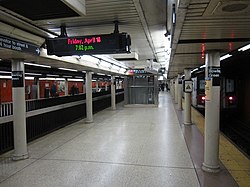
The Bowling Green station is a station on the IRT Lexington Avenue Line of the New York City Subway, located at Broadway and Battery Place (at Bowling Green), in the Financial District of Manhattan. It is served by the 4 train at all times and the 5 train at all times except late nights. It is the southern terminal for the 5 train on weekends. The station opened in 1905 as an extension of the Interborough Rapid Transit (IRT)'s original subway line to South Ferry. At the time, there was a single island platform with one exit at Battery Park and another in Bowling Green. When the Lexington Avenue Line was expanded to Brooklyn in 1908, some trains continued going to South Ferry, resulting in the creation of a short island platform at the Bowling Green station for the Bowling Green–South Ferry shuttle. The shuttle operated until 1977. During the 1970s, the station was completely renovated, a new exit was built, and a third, side platform was created for northbound trains. The Bowling Green station contains two island platforms and one side platform. The westernmost island platform, formerly used by the shuttle, has been closed since 1977. The station retains its original head house in Battery Park, which is listed on the National Register of Historic Places and a New York City designated landmark. There are two other exits to Bowling Green, one of which contains an elevator that makes the station compliant with the Americans with Disabilities Act of 1990.
Location Image
80 m

George Gustav Heye Center

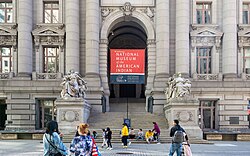
The National Museum of the American Indian–New York, the George Gustav Heye Center, is a branch of the National Museum of the American Indian at the Alexander Hamilton U.S. Custom House in Manhattan, New York City. The museum is part of the Smithsonian Institution. The center features contemporary and historical exhibits of art and artifacts by and about Native Americans. The center has its origin in the Museum of the American Indian founded by George Heye in 1916. It became part of the national museum and Smithsonian in 1987.
Location Image
82 m

United States Bankruptcy Court for the Southern District of New York

The United States Bankruptcy Court for the Southern District of New York is the United States bankruptcy court within the Southern District of New York. The Southern District of New York is a major venue for bankruptcy, as it has jurisdiction over the corporate headquarters and major financial institutions located in Manhattan. Originally, the District Court itself handled bankruptcies; these and admiralty court cases dominated nearly to the exclusion of all other cases, which were primarily handled by a Circuit Court for the District of New York and its successor Circuit Court for the Southern District of New York, until that court was abolished and its cases handled by the District Court as well. The district became widely recognized for its expertise in handling large bankruptcies, leading companies to seek a way to file in this court. Modern examples include the General Motors Chapter 11 reorganization and the Enron and WorldCom bankruptcies. From 1980 through 2014, the Southern District Bankruptcy Court for New York handled over 18% of all large, public-company bankruptcy filings in the United States while the Delaware District Bankruptcy Court handled nearly 36%.
Location Image
84 m

Fort George (New York)

Fort George was the name of five different forts in what is now the state of New York.