

 English
 Français

Fort George (New York)
Fort George was the name of five different forts in what is now the state of New York.
Nearby Places View Menu

30 m
Four Continents (French)
Four Continents is the collective name of four sculptures by Daniel Chester French, installed outside the Alexander Hamilton U.S. Custom House at Bowling Green in Manhattan, New York City. French performed the commissions with associate Adolph A. Weinman.
30 m
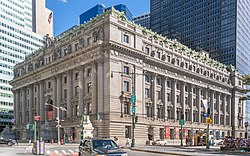
Alexander Hamilton U.S. Custom House
The Alexander Hamilton U.S. Custom House (originally the New York Custom House) is a government building, museum, and former custom house at 1 Bowling Green, near the southern end of Manhattan in New York City, New York, United States. Designed by Cass Gilbert in the Beaux-Arts style, it was erected from 1902 to 1907 by the government of the United States as a headquarters for the Port of New York's duty collection operations. The building contains the George Gustav Heye Center museum, the United States Bankruptcy Court for the Southern District of New York, and the New York regional offices of the National Archives. The facade and part of the interior are New York City designated landmarks, and the building is listed on both the New York State Register of Historic Places and the National Register of Historic Places (NRHP) as a National Historic Landmark. It is also a contributing property to the Wall Street Historic District, listed on the NRHP.
The Custom House is a seven-story steel-framed structure with a stone facade and elaborate interiors. The exterior is decorated with nautical motifs and sculptures by twelve artists. The second through fourth stories contain colonnades with Corinthian columns. The main entrance consists of a grand staircase flanked by Four Continents, a set of four statues by Daniel Chester French. The second-story entrance vestibule leads to a transverse lobby, a rotunda, and offices. The rotunda includes a skylight and ceiling murals by Reginald Marsh. The George Gustav Heye Center, a branch of the National Museum of the American Indian, operates on the ground and second stories, while the upper stories contain U.S. government offices.
The building was proposed in 1889 as a replacement for the previous New York Custom House at 55 Wall Street. Because of various disagreements, the Bowling Green Custom House was not approved until 1899; Gilbert was selected as architect following a competition. The building opened in 1907, and the murals in the rotunda were added in 1938 during a Works Progress Administration project. The United States Customs Service moved out of the building in 1974, and it remained vacant for over a decade until renovations in the late 1980s. The Custom House was renamed in 1990 to commemorate Alexander Hamilton, one of the Founding Fathers of the United States and its first Secretary of the Treasury. The Heye Center opened in 1994.

34 m
Fort Amsterdam
Fort Amsterdam (later Fort George, among other names) was a fortification on the southern tip of Manhattan Island at the confluence of the Hudson and East rivers in what is now New York City. The fort and the island were the center of trade and the administrative headquarters for the Dutch rule of the colony of New Netherland and thereafter British rule of the Province of New York. The fort was the nucleus of the settlement on the island which was at first named New Amsterdam and is central to New York's early history.
Before the fort was constructed, it was the scene where the purchase of Manhattan Island occurred. In its subsequent history, the fort was known under various names such as Fort James, Fort Willem Hendrick and its anglicized Fort William Henry, Fort Anne, and Fort George. The fort changed hands eight times in various battles, the first episode involving Dutch Governor Peter Stuyvesant, who surrendered the fort to Richard Nicolls of England in 1664. In the 18th century, the fort was at the center of the Stamp Act riots in New York when it was used to store shipments of stamped paper brought over from England, while serving as a safe haven for a number of stamp tax collectors. During the American Revolution, it was involved in the Battle of Brooklyn, when volleys were exchanged between the fort and British emplacements on Governor's Island. After 165 years of service, involving a number of conflicts, the fort was finally torn down in 1790 after the American Revolution. After the fort's demolition, the Government House was constructed on the site as a possible house for the United States President. The site is now occupied by the Alexander Hamilton U.S. Custom House, which houses a branch of the National Museum of the American Indian; Bowling Green is nearby.
The construction of the fort marked the official founding date of New York City as recognized by its seal. In October 1683, what would become the first session of the New York legislature convened at the fort. Artillery guns outside the fort overlooking the harbor formed a battery that would later be the namesake of nearby Battery Park.
38 m
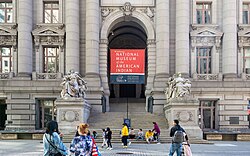
George Gustav Heye Center
The National Museum of the American Indian–New York, the George Gustav Heye Center, is a branch of the National Museum of the American Indian at the Alexander Hamilton U.S. Custom House in Manhattan, New York City. The museum is part of the Smithsonian Institution. The center features contemporary and historical exhibits of art and artifacts by and about Native Americans.
The center has its origin in the Museum of the American Indian founded by George Heye in 1916. It became part of the national museum and Smithsonian in 1987.