
Location Image

La Nación (Argentine)

La Nación est un quotidien argentin conservateur, originellement fondé le 4 janvier 1870 par l'ancien président Bartolomé Mitre et des associés. Ses ventes constituent à peu près un tiers des ventes de tous les journaux vendus à Buenos Aires. Diffusé dans le monde entier, il a pour principal rival le quotidien centriste Clarín.

1. Histoire

Originellement nommé La Nación Argentina, il a été renommé La Nación le 28 août 1945. Jusqu'en 1914, son directeur de rédaction était José Luis Murature (es) (ministre des Affaires étrangères de 1914 à 1916). Le quotidien soutient la campagne de « moralisation » de la société engagée par la dictature de la Révolution argentine en 1966. Sous la dictature militaire de 1976-83, La Nación bénéficia notamment, avec Clarín et La Razón, de mesures illégales appuyées par le gouvernement, en 1976-77, visant à leur faire prendre contrôle de l'entreprise de papeterie Papel Prensa, qui appartenait auparavant à David Graiver. Le journal provoque une controverse au lendemain de l'élection du conservateur Mauricio Macri à la présidence du pays pour avoir appelé à amnistier les tortionnaires de la dictature argentine.

1. Références


1. Liens externes

(es) Site officiel

Portail de la presse écrite Portail de l’Argentine

Nearby Places View Menu
Location Image
37 m

La Nación

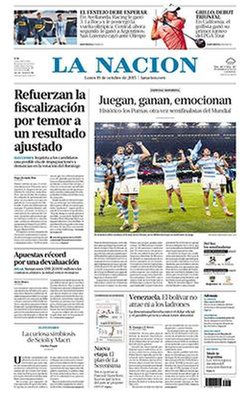
La Nación (transl. "The Nation") is an Argentine daily newspaper. As the country's leading conservative newspaper, La Nación's main competitor is the more liberal Clarín. It is regarded as a newspaper of record for Argentina. Its motto is: "La Nación will be a tribune of doctrine." It is the second most read newspaper in print, behind Clarín, and the third in digital format, behind Infobae and Clarín. In addition, it has an application for Android and iOS phones. The newspaper's printing plant is in the City of Buenos Aires and its newsroom is in Vicente López, Province of Buenos Aires. The newsroom also acts as a studio for the newspaper's TV channel, LN+.
Location Image
37 m

Bouchard Plaza

Bouchard Plaza is an architecturally significant office building in the San Nicolás ward of Buenos Aires, Argentina.
Location Image
119 m

Torre Bouchard

Torre Bouchard is a 30-story high skyscraper in Buenos Aires, Argentina. The building houses offices for several international companies, such as The Boston Consulting Group, Weatherford, and Aerolíneas Argentinas. The World Bank has also placed its Argentina offices in the tower. The building was designed in 1991 by SEPRA Arquitectos, a local architectural firm whose stamp is on numerous other high-rises in the Catalinas Norte office park. The Bouchard Tower was inaugurated in 1996 and is 110 m (361 ft) high, and includes 36,025 m2 (388,000 ft²) of indoor space.
Location Image
180 m

Estadio Luna Park

Estadio Luna Park (commonly known as Luna Park) is a multi-purpose arena in Buenos Aires. Located at the corner of Avenida Corrientes and Avenida Bouchard; in the San Nicolás neighborhood. Initially, the arena primarily hosted boxing and other sporting events. In the 1950s, it was expanded to host stage shows and concerts. The stadium has hosted countless internationally famous personalities, including Pope John Paul II, several ballets, tennis and volleyball matches, world championship and important non-championship boxing fights involving Nicolino Locche, Hugo Corro, Santos Laciar, Carlos Monzón, Omar Narvaez, Juan Roldán, Julio César Vásquez and many other famous boxers, circuses, the Harlem Globetrotters, Holiday on Ice and many more. The arena also hosted the 1950 FIBA World Championship, the final phase of the 1990 Basketball World Championship and the 1976 Basketball Intercontinental Cup in which Real Madrid won the competition. The arena also hosted the Six Days of Buenos Aires cycle race.
203 m

Six Days of Buenos Aires

The Six Days of Buenos Aires was a former six-day cycling event, held in Luna Park stadium, Buenos Aires, Argentina. As many as 27 editions took place from 1936 until 2000, though there were at times single years or even long gaps (such as 1950-55 and 1965-82) when the event was not raced.