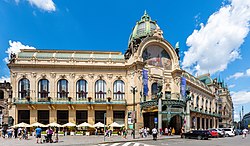
La Maison municipale (en tchèque : Obecní dům) est un complexe architectural appartenant à la ville de Prague battit en style dit « sezessionstil ». Elle réunit une salle de concerts dédiée à Bedřich Smetana, un espace d'exposition, des salles de réception dont certaines décorées par Alfons Mucha, un café et un restaurant de style Art nouveau au rez-de-chaussée, un cocktail-bar, une brasserie et un dancing au sous-sol.

1. Histoire

À l'origine, à l'emplacement de la Maison municipale, se trouvait le Palais royal des souverains de Bohême dont la construction est entreprise en 1380 par Venceslas IV et qui sert pendant un siècle, de 1383 à 1484, de résidence principale aux rois de Bohême, Sigismond Ier, Ladislas le Posthume, Georges de Poděbrady avant que Vladislas IV Jagellon ne réintègre le Château de Prague. Les bâtiments palatins comprenaient des bains, des appartements pour les courtisans, une fosse aux lions et des jardins. La splendide Tour poudrière attenante témoigne des raffinements de la cour des rois de Bohême enrichie par les mines d'argent de Kutná Hora. La « voie royale » qui traverse la Vieille Ville de Prague et emprunte les rues Celetná et Karlova témoigne du chemin que parcouraient les rois pour se rendre à leur couronnement en la Cathédrale Saint-Guy de Prague. C'est, symboliquement, depuis le balcon de la Maison municipale que le 28 octobre 1918 a été proclamée l'indépendance du pays et la création de la Première République tchécoslovaque. C'est en ses murs encore qu'ont eu lieu, à la suite de la Révolution de velours, les négociations entre les représentants du Forum civique avec, à leur tête Václav Havel et ceux du Parti communiste tchécoslovaque.

1. Architecture

La Maison municipale est construite entre 1905 et 1912 sur les plans des architectes Antonín Balšánek et Osvald Polívka. Les principaux artistes de la Sécession tchèque sont invités à participer à la décoration de cet ensemble unique, destiné à affirmer le prestige de la ville et à offrir à ses concitoyens un lieu de détente, de réunion, de spectacle. Parmi ces artistes citons Mikoláš Aleš, Max Švabinský, František Ženíšek, Ladislav Šaloun, Karel Novák, Josef Mařatka, Josef Václav Myslbek, Alfons Mucha et Jan Preisler. Sous un dôme de cuivre, le fronton du bâtiment est dominé par une mosaïque impressionnante sur un carton de Karel Špillar. Deux ailes en « V » dont la base serait l'entrée principale encadrent la salle de concert dite « Salle Smetana » en l'honneur du musicien Bedřich Smetana. Elle peut accueillir mille deux cents auditeurs et sert, entre autres, pour les concerts dans le cadre du festival du Printemps de Prague.

La Maison municipale a été entièrement restaurée entre 1994 et 1997.

1. Voir aussi

Art nouveau à Prague

1. = Notes et références =


1. = Liens externes =

Site internet

Portail de l’architecture et de l’urbanisme Portail de l’Art nouveau Portail de la musique Portail de Prague

Lieux à Proximité Voir Menu
Location Image
56 m

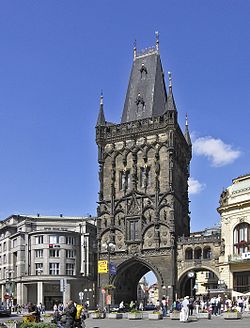
Powder Tower, Prague

The Powder Tower or Powder Gate (Czech: Prašná brána) is a Gothic tower in Prague, Czech Republic. It is one of the original city gates. It separates the Old Town from the New Town. Powder Tower, as with many historical sites in Prague, undergoes periodic preservation and restoration. The most recent treatment began Summer 2024 and is scheduled to be completed in October. Jiří Pospíšil, Deputy Mayor for Culture and Tourism stated, ”It is our duty to take care of Prague’s heritage buildings, which are a symbol of Prague and the legacy of our ancestors… Now, in cooperation with Prague City Tourism, we are starting the repair of the Powder Tower, and I am very happy that the tower will have a literal new coat.”
Location Image
71 m

Municipal House

Municipal House (Czech: Obecní dům) is a civic building that houses Smetana Hall, a celebrated concert venue, in Prague, Czech Republic. It is located on Náměstí Republiky next to the Powder Gate in the centre of the city.
Location Image
75 m

Czech National Bank

The Czech National Bank, (Czech: Česká národní banka, ČNB) is the central bank and financial market supervisor in the Czech Republic, headquartered in Prague. It is a member of the European System of Central Banks. It was established on 1 January 1993 from the division of the State Bank of Czechoslovakia as part of the process of dissolution of Czechoslovakia, together with the National Bank of Slovakia. In accordance with its primary objective, the CNB sets monetary policy, issues banknotes and coins and manages the circulation of the Czech koruna, the payment system and settlement between banks. It also performs supervision of the banking sector, the capital market, the insurance industry, pension funds, credit unions and electronic money institutions, as well as foreign exchange supervision. Under European Union policy frameworks, the ČNB is a voting member of the respective Boards of Supervisors of the European Banking Authority (EBA), European Insurance and Occupational Pensions Authority (EIOPA), and European Securities and Markets Authority (ESMA). It also provides the permanent single common representative for Czechia in the Supervisory composition of the General Board of the Anti-Money Laundering Authority (AMLA). It is also a member of the European Systemic Risk Board (ESRB).
Location Image
84 m

Náměstí Republiky, Prague

Náměstí Republiky (Republic Square) is a city square in Prague, Czech Republic, lying at the boundary of the Old Town and New Town. On the square, or in the very near vicinity, are these significant buildings: Kotva Department Store, Municipal House, Powder Tower, Czech National Bank and Palladium shopping mall. From the square leads Na příkopě street, the most expensive street in all of the V4, connecting it with the Wenceslas Square.
Location Image
105 m

Hotel Paris (Prague)

Hotel Paris Prague (Czech: Hotel Paříž Praha) is a 5-star luxury hotel in Prague, Czech Republic. It is located in the centre of Prague in Old Town. It was built in 1904 according to plans of Jan Vejrych. Its architectural style is a mixture of Art Nouveau and Gothic Revival. It featured as a location in Bohumil Hrabal's book I Served the King of England. In 1984 it was declared as a historical monument.