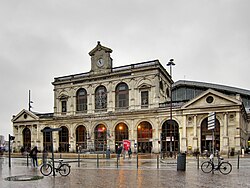
Institut de biologie de Lille

Créé en 1996 par le Centre national de la recherche scientifique (CNRS), l'Agence nationale de la recherche (ANR) et le conseil régional, l'Institut de biologie de Lille (IBL) est localisé sur le site de l'Institut Pasteur de Lille. Il collabore également notamment avec l'Université de Lille et l'INSERM. Il a été fondé pour renforcer la capacité de recherche de la région, en accueillant par exemple des groupes de pointe en leur permettant de développer une recherche très compétitive. Les programmes de recherche initiaux étaient axés sur la génétique humaine, la biologie cellulaire, le cancer, la microbiologie et la biochimie. L'Institut couvre près de 12 000 m2 et emploie plus de 300 personnes.

1. Notes et références


1. Liens externes

Institut de biologie de Lille

Portail des sciences Portail de la France

Nearby Places View Menu
188 m

Parc Henri Matisse

The Parc Henri Matisse is a public park and gardens in the Euralille district of Lille, adjacent to Lille-Europe station. The park was designed by Gilles Clément, after he opposed plans to construct a multi-purpose urban building in this location. A principal feature is a 3,500 sqm 7m high plinth in the centre named Derborence Island. It used spoil from constructing the station, and was laid out in the same shape as Antipodes Island. The area is monitored every few years to check the diversity of wildlife, and see if certain plant species can survive or thrive there.
238 m

ESC Lille

ESC Lille is a French business school founded in 1892. It has two campuses, one in Lille and one in Paris. ESC Lille is EQUIS accredited by the EFMD (European Foundation for Management Education) and the Conference Of The Grandes Ecoles. In 2005, it was the first European business school to be accredited by Project Management Institute’s Global Accreditation Center for Project Management (GACPM), and is still the only PMI-accredited business school in France. In July 2009 the union of Ceram Business School and ESC Lille was announced. It will create the largest French business school in terms of student numbers. The new school, named Skema Business School (School of Knowledge Economy and MAnagement), span three sites in France in Lille, Paris and Sophia Antipolis near Nice and three sites: in China (Suzhou) United States (Raleigh, NC) and Brazil (Belo Orizonte). In May 2019 SKEMA Business School announced the opening of a new site in Cape Town (South Africa) and the possibility to enter in Russia and India.
Location Image
253 m

Braderie de Lille

The Lille Braderie (French: Braderie de Lille) is a braderie, or annual street market/flea market, that takes place on the weekend of the first Sunday of September in Lille, France, in the northern Hauts-de-France region. It dates back to the 12th century, attracting nearly three million visitors each year. The Braderie de Lille is one of the largest gatherings in France and the largest flea market in Europe. In 2014 the Braderie was reported to host 100km of market stalls to over 10,000 exhibitors. During the Braderie, the city hosts a music festival. The traditional food eaten during the festival, moules-frites, typically results in built-up heaps of mussel shells around the city. In 2016, the Braderie was cancelled by Lille mayor Martine Aubry, following terrorist incidents in France.
Location Image
253 m

Lille-Flandres station

Lille-Flandres station (French: Gare de Lille-Flandres, Dutch: Station Lille-Flandres) is the main railway station of Lille, capital of French Flanders. It is a terminus for SNCF Intercity and regional trains. It opened in 1842 as the Gare de Lille, but was renamed in 1993 when Lille Europe station opened. There is a 500 metres (1,600 ft) walking distance between the two stations, which are also adjacent stops on one of the lines of the Lille Metro.
Location Image
324 m

Lille-Europe station

Lille–Europe station (French: Gare de Lille-Europe) is a SNCF railway station in Lille, France, on the LGV Nord high-speed railway. The station is primarily used for international Eurostar and long-distance SNCF TGV services, although some high-speed regional trains also call at the station. The station was built in 1993 to be used as a through station for trains between the UK, Belgium, and the Netherlands, as well as French TGV services, except those coming from Paris, which normally terminate at Lille-Flandres station. There is a 400-metre (1,300 ft) walking distance between the two stations, which are also connected by the Lille Metro and Lille tramway. Lille-Europe has 2 Island platforms serving 4 tracks, plus 2 gated through tracks for non-stopping trains in the middle of the station. The Main concourse is situated above the bypass.