

 English
 Français

Royal Scottish Academy Building
The Royal Scottish Academy building, the home of the Royal Scottish Academy, is an art museum in Edinburgh, Scotland. It is situated at the junction of The Mound and Princes Street in the centre of the city. It was built by William Henry Playfair in 1822–6. Along with the adjacent National Gallery of Scotland, their neo-classical design helped to transform Edinburgh into the cityscape known as "the Athens of the North". Today the structure is a Category A listed building.

St John Fisher Catholic High School, Harrogate
St John Fisher Catholic High School is a coeducational Roman Catholic secondary school and sixth form. It is located in Harrogate, North Yorkshire, England, and has developed steadily during the past 50 years and has around 1,400 pupils.
The school is set in 22 acres (8.9 ha) on the south side of Harrogate and skirted by Hookstone woods.

Holy Trinity Armenian Church, Manchester
Holy Trinity Armenian Church is an Armenian Apostolic Church in the Chorlton-on-Medlock area of Manchester, England and a Grade II listed building. Consecrated in 1870, it is the oldest purpose-built Armenian Church in Western Europe.

The Ridding
The Ridding is a Victorian country house located in the village of Bentham, North Yorkshire, England. It is recorded in the National Heritage List for England as a designated Grade II listed building.
It was built in Scottish Baronial style for B. H. Bent by E. G. Paley in 1857–60, the only building designed in this style by Paley. It is built of squared rubble with sandstone ashlar dressings and a slate roof. The frontage has three bays in two storeys and incorporates a short two-stage tower at the left.

Heathfield, North Yorkshire
Heathfield is a hamlet in the civil parish of Stonebeck Down in upper Nidderdale, in North Yorkshire, England. It lies on a broad terrace on the west side of the dale, overlooking a steep slope down to the River Nidd.
Heathfield was first recorded in Domesday Book as Higrefeld. The name is derived from Old English, and means "open land frequented by jays". By the 17th century the name had become Hearfield, and in the 18th century was recorded as Heathfield. In the Middle Ages the land was owned by Byland Abbey, which mined lead and established a grange there.
Heathfield Moor rises west of the hamlet, and is managed for grouse shooting.

Crarae Reservoir
The Crarae Reservoir is located 2.5 kilometres north west of the village of Crarae, on the west side of Loch Fyne. The concrete dam is 13.7 metres high.
Nine Mile Burn
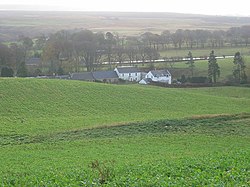
Nine Mile Burn is a hamlet in Midlothian, Scotland, the last in Midlothian when heading south on the A702 road.
It is located at the foot of the Pentland Hills, near Penicuik and about 2 km north-east of the village of Carlops.

St Vincent's Church, Sheffield
St Vincent's Church is a redundant Roman Catholic church situated on Solly Street at its junction with Hollis Croft in the centre of the City of Sheffield, South Yorkshire, England.
The church fell into a worsening state of disrepair since closure, however the site was redeveloped recently, along with the surrounding area.

Sir G B Hunter Memorial Hospital
The Sir G B Hunter Memorial Hospital is a health facility at Wallsend Green, Wallsend, Tyne and Wear, England. It is managed by Cumbria, Northumberland, Tyne and Wear NHS Foundation Trust.

Ailsa Hospital
Ailsa Hospital is a mental health facility located in the southeastern outskirts of Ayr, South Ayrshire, Scotland. It is managed by NHS Ayrshire and Arran.
Newcastle Racecourse
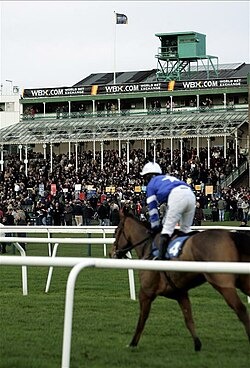
Newcastle Racecourse is a horse racing course located at Gosforth Park in Newcastle upon Tyne, England, owned by Arena Racing Company. It stages both flat and National Hunt racing, with its biggest meeting being the Northumberland Plate held annually in June.
Leuchars railway station
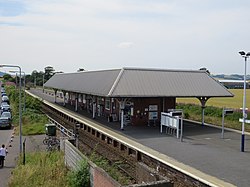
Leuchars railway station ( LEW-khərs, sometimes known as Leuchars (for St. Andrews)) serves the towns of Leuchars and St Andrews in Fife, Scotland. The station is the last northbound stop before Dundee.
The station was built as Leuchars Junction station for the route over the Tay Bridge to Dundee, the previous Leuchars station being on the line to Tayport.
There are buses and taxis available to transfer passengers to nearby St. Andrews, which does not have its own railway station; integrated tickets with the destination "St Andrews Bus" are sold.
The station is located near Leuchars Station, a British Army installation, formerly RAF Leuchars airbase.
Previous station operator First ScotRail announced plans during March 2008 to erect a wind turbine to meet the electricity requirements of the station, and hope to generate a small surplus of electricity which they can sell back to the National Grid. Leuchars will be the first station to be powered this way, and if the project, which was funded by Transport Scotland proves successful, it may be rolled out across other stations.

Shri Swaminarayan Mandir, Oldham
Shree Swaminarayan Mandir, Oldham is a Swaminarayan Hindu temple in Oldham, England. It became the third Swaminarayan temple to open in the United Kingdom under the NarNarayan Dev Gadi of the Swaminarayan Sampraday on 22 October 1977.

Wellesley Barracks
Wellesley Barracks is a former military installation in Halifax, West Yorkshire, England.
Beverley Friary
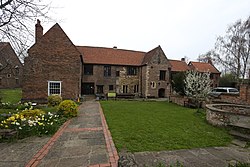
Beverley Friary (also known as The Old Friary) is a row of buildings in Beverley, East Riding of Yorkshire, England. It is a Grade II* listed building and has been used since 1984 as a youth hostel.

St Helens, Merseyside
St Helens () is a large town in Merseyside, England, with a population of 117,308. It is the administrative centre of the Metropolitan Borough of St Helens which had a population of 183,200 at the 2021 Census.
The town is 6 miles (10 kilometres) north of the River Mersey, in the south-west part of historic Lancashire. The town was initially a small settlement within the historic county's ancient hundred of West Derby in the township of Windle but by the mid-1700s the town had developed into a larger urban area beyond the townships borders. By 1838 the council was formally made responsible for the administration of Windle and the three other townships of Eccleston, Parr and Sutton that were to form the town's traditional shape. In 1868 the town was incorporated as a municipal borough, then later became a county borough in 1887. In 1974 the town was made a metropolitan borough within the new Metropolitan County of Merseyside by the Local Government Act 1972, with an expanded administrative responsibility for several nearby towns and villages.
The town was famous for its heavy industry, particularly its role in the coal mining industry, glassmaking, chemicals and copper smelting and sail making that drove its growth throughout the Industrial Revolution. Originally home to a large number of industrial employers such as Beechams, the Gamble Alkali Works, Ravenhead Glass, United Glass Bottles (UGB), Triplex, Daglish Foundry, Greenall's brewery, the glass producer Pilkington is the town's only remaining large industrial employer.
The town is today most famous for its Rugby League team St Helens R.F.C. who have won 3 World Club Challenge cups in recent years, and museums such as the North West Museum of Road Transport, the World of Glass and art installations such as Dream.

Broomhead Reservoir
Broomhead Reservoir is a reservoir located in the Ewden Valley, near Sheffield in South Yorkshire, England. The reservoir is located to the south of Bolsterstone and is linked to the More Hall Reservoir to the east. It covers 50 hectares (120 acres) of land and can hold more than 1,000 million gallons of water.

Preston Pipe Bridge
The Preston Pipe Bridge carries three water pipes across the River Tees between Ingleby Barwick and Preston-on-Tees in the borough of Stockton-on-Tees, northern England.
The bridge is situated over 3.1 miles (5 km) upriver from Stockton town centre, and some 660 feet (200 m) upriver from Jubilee Bridge.

Drigg railway station
Drigg is a railway station on the Cumbrian Coast Line, which runs between Carlisle and Barrow-in-Furness. The station, situated 31 miles (50 km) north-west of Barrow-in-Furness, serves the villages of Drigg and Holmrook in Cumbria. It is owned by Network Rail and managed by Northern Trains.
The station is unstaffed, but the main station building still stands and is in private commercial use as a cafe and craft shop.
At the south end of the station is a level crossing with manually operated gates, controlled from the adjacent signal box. There is step-free access to each platform, however the platforms are lower than the standard ones and are therefore not suitable for mobility-impaired passengers.
Waiting shelters and timetable posters are located on each side of the track, train running information for the station can also obtained by telephone. A ticket machine and digital information screens were installed by operator Northern in 2019, so passengers can now purchase tickets before boarding the train.
A short distance from the station, heavy secured sidings take special trains carrying nuclear materials from the Sellafield nuclear site (which is located close by) to the Low Level Waste Repository where the material is buried. Paul Merton visited the station en route to the Repository in the first episode of his 2016 travel documentary Paul Merton's Secret Stations.

The Crown Inn, Glossop
The Crown Inn is a public house at 142 Victoria Street, Glossop, Derbyshire SK13 8JF.
It is on the Campaign for Real Ale's National Inventory of Historic Pub Interiors.
It was built in the 1840s.