

 English
 Français

St Vincent's Church, Sheffield
St Vincent's Church is a redundant Roman Catholic church situated on Solly Street at its junction with Hollis Croft in the centre of the City of Sheffield, South Yorkshire, England. The church fell into a worsening state of disrepair since closure, however the site was redeveloped recently, along with the surrounding area.
Nearby Places View Menu
69 m
St Vincent's Quarter
St Vincent's Quarter is one of Sheffield's eleven designated quarters, centring on and named after St Vincent's Church. Primarily an office and industrial location, its regeneration has increased rapidly over the past few years, with the new Metier residential block and Velocity Village office and residential accommodation springing up on the north side of Tenter Street. Despite recent development, the area still contains several dilapidated or derelict workshops and prostitution is common in the area.
It is broadly triangular in shape, with Tenter Street and Broad Lane to the south, Netherthorpe Road and Hoyle Street to the north-west and Shalesmoor, Moorfields, Gibraltar Street and West Bar to the north-east.
Currently, the A57 runs through the middle of the quarter but upon the completion of the Northern Relief Road, a dedicated route will be provided around the quarter, with the intention of improving the character of the area.
It currently has three designated character areas: Furnace Hill, Solly Street, Well Meadow.
The quarter played an important part in Sheffield's industrial heritage and examples include the cementation furnace on Doncaster Street and the crucible furnace and buildings at 35 Well Meadow Street.
156 m
The School Room
The School Room is a rock climbing training facility in Sheffield, South Yorkshire, England. The facility was originally built in 1993 by Gavin Ellis, Ben Tye and Andy Coish, as conditions at Peak District Limestone venues (at which they trained) were not always ideal. The facility was made famous by its reputation for its extremely difficult problems. Many notable international rock climbers were trained at The School Room, including Ben Moon,
The School Room received its name from the fact that its original location, in the Heeley Bank School community centre, formed a portion of an old school building. Another portion of the building was used for an art studio. The facility consisted of four plywood climbing walls, which are covered with wooden and plastic holds, at angles of between 15 and 52 degrees.
In 2006, the School Room was under threat of closure and Sheffield City Council had asked all users of the centre to vacate the premises. Despite a successful petition being established to save the facility, the original School Room closed in 2006, but was reopened with the same walls in a different warehouse space in 2014 by Moon.
245 m
Pennine Five
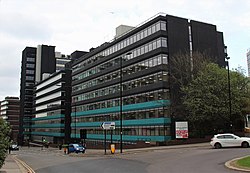
Pennine Five (P5), known as the Pennine Centre prior to 2020, is a tower on Tenter Street in Sheffield, England. Construction started in 1973 on this immense building and was completed in 1975.
The tower is 50 m (164 ft) tall and has 13 floors of office space. It was built in the International style, like the Arts Tower in Sheffield and Tower 42 in London.
The Pennine Centre was built for HSBC and used as their regional headquarters. HSBC moved to a new-build regional headquarters at Charter Square on the other side of the city centre in 2019. The unoccupied building was subsequently purchased by RBH Properties for £18 million, who then carried out a £30 million refurbishment of the complex, rebranding it as Pennine Five or P5. The first phase of the refurbished project, codenamed Block Three, reopened for commercial use in June 2020.

288 m
Well Meadow Street Crucible Furnace
35 Well Meadow Street is the site of a house, attached workshops, courtyard complex and a crucible furnace. It is located in the St Vincent's Quarter of the City of Sheffield in England, it is also part of the Well Meadow Conservation Area. The buildings and furnace are grade II* listed buildings because of their importance as part of Sheffield’s industrial heritage and it is regarded as, “One of the most significant of the city’s 19th century industrial monuments”. It has now been converted into residences.