

 English
 Français

Belle Isle (Windermere)
Belle Isle is the largest of 18 islands on Windermere, a mere in the English Lake District, and the only one ever to have been inhabited. It is 1 km in length.
It is rumoured that in Roman times a villa was once built on the island, with a possible connection to the Roman fort at Ambleside. In 1250 it was the seat of the district's Lord of the Manor. It was also a Royalist stronghold during the English Civil War.
Island House was built in 1774 to designs by John Plaw. It is unusual in that it is circular in plan, built of brick, three floors high with a four column portico; it draws closely on the Pantheon, Rome. The house was sold along with the island to the wealthy Curwen family who renamed the island after their daughter, Isabella. It was then sold on to Isabella Curwen by her family in 1781 for £1,720 and was permanently renamed after her. The descendants of Isabella and her husband John Christian Curwen lived on the island until 1993.
It is called 'Bell Island' not 'Isabella Island' because of use of the shortened form of Isabella- Bella, which lost the 'a' to become 'Bell', spelt 'Belle' by the Ordnance Survey map of 1925 over the years. It was known locally as the Great Island or Long Holme and formerly known as Longholm, before its renaming in 1774.
In 1996 (some records suggest 23 December 1994), Belle Isle House suffered serious damage following a large fire. However, it was repaired and is once again a place of residence.

2 The Shambles
2 The Shambles is a historic building in York, England. A Grade II listed building, part of the structure dates to the early 18th century, with alterations occurring in the early and mid-19th century, including the addition of a shopfront. The building was modernised around 1970.
Its bricks are in Flemish bond, while the shopfront is made of timber. The windows on the upper floors are in three sections.
As of 2025, the building is occupied by Roly's Fudge Pantry.

Colne Valley Museum
The Colne Valley Museum is in the Colne Valley at Golcar, Huddersfield, West Yorkshire, England. The museum consists of four converted 19th-century weavers' cottages. The museum provides an insight into what life was like for a weaver in the early 1850s. The museum includes a clog-maker's workshop, a handloom chamber, a spinning room, a cropping room, kitchen and living rooms. The museum is run entirely by volunteers.

Mosedale Beck (Wast Water)
Mosedale Beck is a stream in Cumbria which runs into Wast Water, which is the deepest lake in England.
Mosedale Beck rises in Little Scoat Fell, it then flows south west until it reaches Ritson's Force waterfall. It then turns to the south and flows through the hamlet of Wasdale Head. It then flows through Down-in-the-Dale before it empties into Wast Water near the parallel Lingmell Beck.
The Mosedale Horseshoe is a celebrated mountain walk around Mosedale: starting at Wasdale Head it includes Yewbarrow, Red Pike, Scoat Fell, and Pillar.

Robroyston railway station
Robroyston railway station serves the suburbs of Millerston and Robroyston in Glasgow, Scotland. The station is located on the Cumbernauld Line, and is managed by ScotRail. The station, which includes a park and ride facility and a through road connecting the two communities, opened on 15 December 2019. It is part of a wider development plan for the local area including 1,600 new houses.
There was previously a Robroyston station (and a marshalling yard) at the same location, on the line originally operated by the Garnkirk and Glasgow Railway which later formed part of the Caledonian Railway main line; this operated from 1898 to 1917, and from 1919 to 1956.

Partick Burgh Hall
Partick Burgh Hall is a municipal facility in Burgh Hall Street, Partick, Scotland. The hall, which was the headquarters of Partick Burgh Council in the early 20th century, is a Category B listed building.

West Ayton
West Ayton is a village and civil parish in the county of North Yorkshire, England, located upon the west bank of the River Derwent adjacent to East Ayton.
According to the 2011 UK census, West Ayton parish had a population of 881, an increase on the 2001 UK census figure of 831.
From 1974 to 2023 it was part of the Borough of Scarborough. It is now administered by the unitary North Yorkshire Council.
The name Ayton derives from the Old English ēatūn meaning 'settlement on a river'.
The ruins of Ayton Castle can be found to the west of the village. The tower dates back to 1390 and was built by Ralph Eure. During the 1670s, stone from the castle was used to rebuild the bridge over the River Derwent.
Just south of the village is the Wykeham Lakes park. This is a fishery and water-sports complex run by the Downe family's Dawnay Estates programme. The lakes are built on the site of a former First World War Royal Flying Corps airfield (known as West Ayton) which was used by No. 251 Squadron. The airfield was abandoned after 1919.

Manfield
Manfield is a village and civil parish in the county of North Yorkshire, England. It is a parish in the wapentake of Gilling East. From 1974 to 2023 it was part of the district of Richmondshire, it is now administered by the unitary North Yorkshire Council.
The closest major town is Darlington, which is 3.5 miles (5.6 km) east of Manfield. It is close to the River Tees and Darlington and is notable for All Saints Church and Manfield Village School.
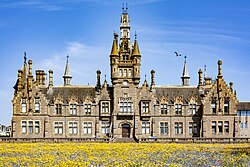
Morgan Academy
Morgan Academy is a secondary school in the Stobswell area of Dundee, Scotland. Morgan Academy was founded in 1889 and is the second oldest state school in Dundee behind Harris Academy.

Byram cum Sutton
Byram cum Sutton is a civil parish in the county of North Yorkshire, England, containing the village of Byram and the hamlet of Sutton. The River Aire runs to the south of the parish, and the town of Knottingley is the other side of the river in West Yorkshire. The A1(M) passes to the west of the parish. According to the 2001 census, it had a population of 1,406, increasing to 1,434 at the 2011 Census.
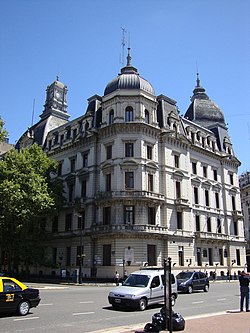
Buenos Aires City Hall
Buenos Aires City Hall (Spanish: Palacio Municipal de la Ciudad de Buenos Aires; lit. "Municipal Palace") was, until 2015, the seat of the Office of the Chief of Government of Buenos Aires, the capital city of Argentina. From its construction in 1914 to the reformation of the city's constitution in 1996, the building was the seat of the City Municipality. It faces the Plaza de Mayo, across from the Casa Rosada presidential palace, in the barrio of Monserrat.
Since 2015, the Office of the Chief of Government has been located at a new building (Casa de la Ciudad) in the barrio of Parque Patricios (south side Uspallata facing Parque de los Patricios). The City Hall still houses various government offices of the city government.

Dundee railway station
Dundee railway station serves the city of Dundee on the east coast of Scotland. It is situated on the northern, non-electrified section of the East Coast Main Line, 59+1⁄4 miles (95.4 km) northeast of Edinburgh. Dundee is the tenth busiest station in Scotland. In January 2014, the former main station building was demolished to make way for a new building as part of the Dundee Waterfront Project which opened on 9 July 2018.
Dundee railway station is where the Edinburgh–Dundee line meets the Glasgow–Dundee line, via Perth, to form the Dundee to Aberdeen line.

Hipswell
Hipswell is a village and civil parish in the county of North Yorkshire. The civil parish mainly comprises the northern part of Catterick Garrison. The village of Hipswell is at the eastern end of the civil parish, and effectively forms a suburb of Catterick Garrison.

Able UK
Able UK is a British industrial services company specialising in decommissioning of ships and offshore installations.
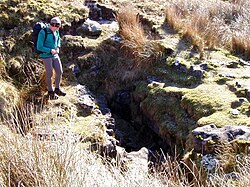
Flood Entrance Pot
Flood Entrance Pot (sometimes known as Flood Exit Pot) is one of the entrances to the Gaping Gill cave system located about 300 metres (330 yd) south of Gaping Gill Main Shaft. It was the first alternative entrance into the main system to be explored, and it is now a popular entrance into the system, with a fine 38-metre (125 ft) pitch landing in Gaping Gill's South-East Passage. It lies within the designated Ingleborough Site of Special Scientific Interest.

Silcoates School
Silcoates School is a co-educational independent school in the village of Wrenthorpe near Wakefield, England.

Ottringham
Ottringham is a village and civil parish in the East Riding of Yorkshire, England, in an area known as Holderness. It is situated approximately 12 miles (19 km) to the east of Hull city centre and 5 miles (8 km) south-west of Withernsea. It lies on the A1033 road from Hull to Withernsea.
According to the 2011 UK census, Ottringham parish had a population of 597, a reduction on the 2001 UK census figure of 637.
In 1823 parish inhabitants numbered 637. Occupations included twelve farmers, some of whom were land owners, four shoemakers, three grocers, two tailors, two wheelwrights, a blacksmith, a corn miller, a horse dealer, and the landlord of the White Horse public house. Two carriers operated between the village and Hull, South Frodingham, Holmpton, and Skeckling, on Tuesdays and Fridays. Letters were received and sent on Mondays, Wednesdays and Saturdays by Wing's caravan [accommodation coach]. A Methodist chapel existed, built in 1815.
The name Ottringham possibly derives from the Old English Oteringashām or Oteringhām, meaning 'village of Oter's people' or 'village at the otter place'.
The parish church of St Wilfrid is a Grade I listed building. In November 2024 the church was placed on the Heritage at Risk Register by Historic England who gave a grant to start repairs.
Ottringham was served from 1854 to 1964 by Ottringham railway station on the Hull and Holderness Railway.
During the Second World War, in 1943, the BBC built a transmitting station at Ottringham, called BBC Ottringham or OSE5. Its purpose was to counter the increase in German jamming signals, and to broadcast propaganda into Germany. Following the end of the war, and with lack of funds, the station was deconstructed in 1953 and its transmitters moved to Droitwich.
In 1958 a Ham class minesweeper HMS Ottringham was named after the village.
Ottringham contains two public houses and a service garage. It is close to a main bus route.

St John the Divine's Church, Pemberton
St John the Divine's Church is in Church Street, Lamberhead Green, Pemberton, Wigan, Greater Manchester, England. It is an active Anglican parish church in the deanery of Wigan, the archdeaconry of Warrington, and the diocese of Liverpool. The church is recorded in the National Heritage List for England as a designated Grade II listed building. It was a Commissioners' church, having received a grant towards its construction from the Church Building Commission.

Trinity Islands, Manchester
Trinity Islands is a residential skyscraper cluster under construction in Manchester, England, consisting of four towers between 39 and 60 storeys split over two 2.2-acre (0.89 ha) sites: Building D1 at 183 metres (600 ft), Building D2 at 169 m (555 ft), Building C2 at 146 m (479 ft) and Building C1 at 119 m (390 ft). The project was designed by SimpsonHaugh and comprises 1,950 apartments, with a total build cost of £535 million. When topped out in 2025, Building D2, renamed Vista River Gardens, became the second-tallest building in Greater Manchester, slightly surpassing Beetham Tower.

Fowlea Brook
Fowlea Brook rises in Staffordshire and flows through the northern parts of Stoke-on-Trent, England. It is a tributary stream of the River Trent, and is 6 miles (9.7 km) long.