Location Image

Belle Isle (Windermere)

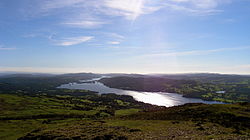
Belle Isle is the largest of 18 islands on Windermere, a mere in the English Lake District, and the only one ever to have been inhabited. It is 1 km in length. It is rumoured that in Roman times a villa was once built on the island, with a possible connection to the Roman fort at Ambleside. In 1250 it was the seat of the district's Lord of the Manor. It was also a Royalist stronghold during the English Civil War.

Island House was built in 1774 to designs by John Plaw. It is unusual in that it is circular in plan, built of brick, three floors high with a four column portico; it draws closely on the Pantheon, Rome. The house was sold along with the island to the wealthy Curwen family who renamed the island after their daughter, Isabella. It was then sold on to Isabella Curwen by her family in 1781 for £1,720 and was permanently renamed after her. The descendants of Isabella and her husband John Christian Curwen lived on the island until 1993. It is called 'Bell Island' not 'Isabella Island' because of use of the shortened form of Isabella- Bella, which lost the 'a' to become 'Bell', spelt 'Belle' by the Ordnance Survey map of 1925 over the years. It was known locally as the Great Island or Long Holme and formerly known as Longholm, before its renaming in 1774. In 1996 (some records suggest 23 December 1994), Belle Isle House suffered serious damage following a large fire. However, it was repaired and is once again a place of residence.

Nearby Places View Menu
Location Image
416 m

Windermere

Windermere (historically Winder Mere) is a ribbon lake in Cumbria, England. It is within the Lake District and is the largest lake in England by length, area, and volume, although considerably smaller than the largest Scottish lochs and Northern Irish loughs. Windermere is about 11 miles (18 km) in length and 1 mile (1.6 km) at its widest, has a maximum depth of 64 metres (210 ft), and has an elevation of 39 metres (128 ft) above sea level. Its outflow is the River Leven, which drains into Morecambe Bay. For administrative purposes the lake is in the unitary authority area of Westmorland and Furness, and it historically formed part of the boundary between Westmorland and Lancashire. The lake has been popular with tourists since the Kendal and Windermere Railway's branch line opened in 1847. The Freshwater Biological Association was established on the shore of Windermere in 1929 and much of the early work on lake ecology, freshwater biology and limnology was conducted here.
Location Image
827 m

Windermere Way

The Windermere Way is a 45-mile circuit of Windermere, a lake in the English Lake District. The route is wholly within the Lake District National Park and takes in the summits of Wansfell, Loughrigg Fell and Gummer's How as well as passing through the towns of Ambleside and Windermere.
Location Image
903 m

St Martin's Church, Bowness-on-Windermere

St Martin's Church stands in the centre of the town of Bowness-on-Windermere, Cumbria, England. It is an active Anglican parish church in the deanery of Windermere, the archdeaconry of Westmorland and Furness, and the diocese of Carlisle. The church is recorded in the National Heritage List for England as a designated Grade I listed building. Its benefice is united with that of St Anne's Church, Ings; St Cuthbert's Church, Kentmere; St James' Church, Staveley; Jesus Church, Troutbeck and St Mary's Church, Windermere.
Location Image
937 m

New Hall Inn

The New Hall Inn, also known as the Hole in t'Wall, is the oldest public house in Bowness-on-Windermere, and is a Grade II listed building.