
Location Image

Belle Isle (Windermere)

Belle Isle is the largest of 18 islands on Windermere, a mere in the English Lake District, and the only one ever to have been inhabited. It is 1 km in length. It is rumoured that in Roman times a villa was once built on the island, with a possible connection to the Roman fort at Ambleside. In 1250 it was the seat of the district's Lord of the Manor. It was also a Royalist stronghold during the English Civil War.

Island House was built in 1774 to designs by John Plaw. It is unusual in that it is circular in plan, built of brick, three floors high with a four column portico; it draws closely on the Pantheon, Rome. The house was sold along with the island to the wealthy Curwen family who renamed the island after their daughter, Isabella. It was then sold on to Isabella Curwen by her family in 1781 for £1,720 and was permanently renamed after her. The descendants of Isabella and her husband John Christian Curwen lived on the island until 1993. It is called 'Bell Island' not 'Isabella Island' because of use of the shortened form of Isabella- Bella, which lost the 'a' to become 'Bell', spelt 'Belle' by the Ordnance Survey map of 1925 over the years. It was known locally as the Great Island or Long Holme and formerly known as Longholm, before its renaming in 1774. In 1996 (some records suggest 23 December 1994), Belle Isle House suffered serious damage following a large fire. However, it was repaired and is once again a place of residence.

Lieux à Proximité Voir Menu
Location Image
416 m

Lac Windermere (Angleterre)

Le lac Windermere (en anglais : Windermere Lake) est un lac situé dans le comté de Cumbria en Angleterre, dans le parc national du Lake District. C'est le plus grand lac naturel d'Angleterre avec une superficie de 14,73 km2. Les trois villes touristiques de Windermere, Bowness-on-Windermere et Ambleside sont situées près de sa côte orientale Le lac Windermere est un lac glaciaire rubaniforme. Quelques petites rivières et ruisseaux l'alimentent, dont le Brathay, le Rothay, le Trout Beck et le Cunsey Beck. Son émissaire est le Leven qui coule jusqu'à la mer d'Irlande dans la baie de Morecambe. Le lac compte dix-huit îles. Historiquement, le lac était divisé entre deux comtés ; le côté occidental était situé dans le Furness, une partie détachée du Lancashire, tandis que le côté oriental appartenait au comté de Westmorland.
Location Image
903 m

Église Saint-Martin de Bowness-on-Windermere
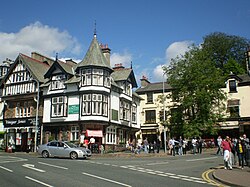
L'église Saint-Martin (anglais : St Martin's Church) se dresse au centre de la ville de Bowness-on-Windermere, Cumbria, Angleterre. C'est une église paroissiale anglicane dans le doyenné de Windermere, l'archidiaconé de Westmorland et Furness et le diocèse de Carlisle. L'église est enregistrée dans la liste du patrimoine national pour l'Angleterre en catégorie I. Son bénéfice est uni à celui de l'église Sainte-Anne, Ings ; Église St Cuthbert, Kentmere ; Église St James, Staveley ; Église de Jésus, Troutbeck et église St Mary, Windermere .
Location Image
1.1 km

Bowness-on-Windermere

Bowness-on-Windermere est une ville anglaise située au nord-ouest de l'Angleterre dans le comté de Cumbria et le district de South Lakeland. Du fait de sa position sur les rives du lac Windermere, elle est devenue une destination touristique prisée.
Location Image
1.9 km

Claife

Claife est une paroisse civile de Cumbria, située dans le nord-ouest de l'Angleterre.
Location Image
2.6 km

Hill Top

Hill Top est un cottage situé dans le Lake District, dans le nord de l'Angleterre, acheté par l'écrivain et illustratrice Beatrix Potter puis légué au National Trust à sa mort. La maison et son jardin sont devenus un musée consacré à cette artiste et à son œuvre.