Location Image

Service des archives médicales hospitalières des armées

Le service des archives médicales hospitalières des armées (SAMHA) est un centre d'archives français qui collecte les archives produites par les hôpitaux militaires (archives d'établissement et dossiers médicaux individuels) depuis le début du XXe siècle. Dépendant du ministère des Armées, il est implanté à Limoges. Au-delà d'un délai de cinq ans de conservation, les dossiers des hôpitaux sont nécessairement acheminés au SAMHA. Le SAMHA est l'un des trois sites de conservation d'archives médicales militaires en France avec le Musée du Service de santé des armées à Paris et le Service historique de la Défense à Vincennes.

1. Histoire

Le SAMHA résulte de la fusion du Service de la statistique médicale et du Bureau central de comptabilité du Service de santé des armées, rapatriés en 1940 à Limoges au moment de la déroute militaire française. L'établissement devient en 1962 le Centre d'archives et de statistique médicales des armées (CASMA), mais se recentre ensuite sur la seule conservation des archives. Il change à nouveau de nom en 1972 (Section des archives médicales des armées), puis en 1984 (Section des archives médicales hospitalières des armées). À compter du 1er janvier 2004, il est érigé en service à part entière, rattaché au Service de santé des armées. Le SAMHA est installé dans les locaux de l'ancienne usine de chaussures Monteux (dont l'activité a cessé en 1933), situés rue de Châteauroux, au nord du centre-ville de Limoges.

1. Fonds

Le service conserve l'équivalent de 83 km linéaires de documents, comprenant les dossiers médicaux issus des hôpitaux militaires depuis la Première Guerre mondiale. Les dossiers sont stockés en plusieurs supports, à la fois papier, numériques et argentiques. Les dossiers relatifs aux opérations militaires extérieures de la France sont également conservés par le SAMHA.

1. Notes et références


1. Liens externes

Portail de l’Armée française Portail de la médecine Sciences de l’information et bibliothèques Portail de Limoges

Nearby Places View Menu
Location Image
248 m

Limoges

Limoges ( lih-MOHZH, US also lee-, French: [limɔʒ] ; Occitan: Lemòtges, locally Limòtges [liˈmɔdzes]) is a city and commune, and the prefecture of the Haute-Vienne department in west-central France. It was the administrative capital of the former Limousin region. Situated on the first western foothills of the Massif Central, Limoges is crossed by the river Vienne, of which it was originally the first ford crossing point. The second most populated town in the Nouvelle-Aquitaine region after Bordeaux, a university town, an administrative centre and intermediate services with all the facilities of a regional metropolis, it has an urban area of 323,789 inhabitants in 2018. The inhabitants of the city are called the Limougeauds. Founded around 10 BC under the name of Augustoritum, it became an important Gallo-Roman city. During the Middle Ages Limoges became a large city, strongly marked by the cultural influence of the Abbey of Saint-Martial, where the Dukes of Aquitaine were invested and crowned. From the 12th century onwards, its enamels were exported throughout the Christian world. In 1765, during the industrial revolution, the discovery of a deposit of kaolin in the Saint-Yrieix-la-Perche region enabled the development of the Limoges porcelain industry. It is sometimes nicknamed "the red city" or "the Rome of socialism" because of its tradition of voting on the left and the workers' events it experienced from the 19th to the beginning of the 20th century. Since the 1990s, the city has had a basketball club, Limoges CSP, which has won several French championships and the European championship in 1993. Because of its heritage policy, it has held the label "City of Art and History" since 2008. Economic activities include butchering, electrical equipment for the building industry, and luxury goods. It is home to porcelain houses and art workshops working with enamel or stained glass. This craft expertise led it to join the UNESCO Creative Cities Network in 2017 in the thematic category "Crafts and Popular Arts".
Location Image
248 m

Siege of Limoges

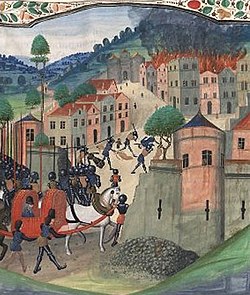
The town of Limoges had been under English control but in August 1370 it surrendered to the French, opening its gates to the Duke of Berry. The siege of Limoges was laid by the English army led by Edward the Black Prince in the second week in September. On 19 September, the town was taken by storm, followed by much destruction and the deaths of numerous civilians. The sack effectively ended the Limoges enamel industry, which had been famous across Europe, for around a century.
248 m

1958 UCI Cyclo-cross World Championships

The 1958 Cyclo-cross World Championship was the ninth edition of the UCI Cyclo-cross World Championships. It was held on Sunday, February 23 1958 in France. The city of Limoges is located 25 kilometers south of Razès, the birthplace of the then four-time (and reigning) world champion André Dufraisse. The course had a total length of 21.38 kilometers. The 31 participants came from eight countries, each sending a team of three or four riders and one rider from the Netherlands. Dufraisse secured his fifth consecutive title with his eighth consecutive podium finish after the same number of participations.
520 m

Limoges Conservatory

Limoges Conservatory or Conservatoire à rayonnement régional de Limoges is a musical conservatory in Limoges, France. As of 2012 it had an enrollment of 2000 students and 79 teachers.
Location Image
553 m

Limoges-Bénédictins station

Limoges-Bénédictins (French: Gare de Limoges-Bénédictins) is the main railway station of Limoges. It is situated on the Orléans–Montauban railway. It was named Bénédictins due to the presence of a Benedictine monastery closed during the French Revolution.