

 English
 Français
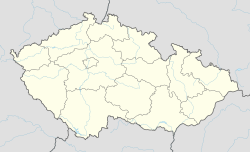
Cercle étudiant Endre-Ady
Le Cercle étudiant Endre-Ady (en hongrois : Ady Endre Diákkör, [ˈɒdi ˈɛndɾɛ ˈdiaːkˌkøɾ]) est une organisation étudiante tchèque créée en 1957. Elle rassemble les étudiants pragois de la minorité magyare de Slovaquie. Elle est membre du Réseau étudiant rassemblant les organisations étudiantes de la diaspora magyare de Slovaquie. Elle porte le nom du poète hongrois Endre Ady.
Nearby Places View Menu

49 m
Divadlo v Kotcích
The Divadlo v Kotcích, German Theater an der Kotzen, in English more usually Kotzen Theatre, was a Prague theatre and opera venue on v Kotcích street, which had its heyday from 1739 to 1783 as the second public opera theatre in Prague. Spoken plays and ballets were also presented there.
For many seasons it was run by Italian impresario Santo Lapis, then Giovanni Battista Locatelli, who staged Gluck's Prague Ezio, 1750, and other works. Later impresarios who worked there include Gaetano Molinari and Giuseppe Bustelli. The more correct "Theater an der Kotzen" was often colloquially referred to as the "Kotzentheater," Kotzen being a Slavonic-German term for a market. It closed in 1783 for safety reasons.
It was preceded by the opera theatre of Count Franz Anton von Sporck, which operated between 1724 and 1735, and succeeded by Count Nostitz's "National Theatre," now the Estates Theatre (or "Stavovské divadlo"), which opened on 21 April 1783. The current National Theatre, "Národní divadlo" did not open until 1881.

127 m
Wimmer's Fountain
Wimmer's Fountain (Czech: Wimmerova kašna), or Wimmer Fountain, is an outdoor fountain and sculpture in Old Town, Prague, Czech Republic.

166 m
Sex Machines Museum
Sex Machines Museum (abbreviated SMM) is a sex museum in Prague, Czech Republic, which has a collection of sex devices. Established in 2002, it is located near the Old Town Square. The official website of the Sex Machines Museum describes itself as "an exposition of mechanical erotic appliances, the purpose of which is to bring pleasure and allow extraordinary and unusual positions during intercourse." It is the only sex museum in the world dedicated solely to sex machines.
The three-story museum has a collection of approximately 200 gadgets, many of which are accompanied by flexible dummies for better understanding. Some of the appliances were made as early as the 16th century. Its collections include body harnesses and "copulation tables" the purpose of which were to facilitate unconventional, even weightless, sex positions, instruments for the stimulation of "penile, scrotal, anal, vaginal and clitoral tissue" including a vibrator, wicked finger-spikes, "coercive" chairs designed for "absolute domination", an Asian "Magic Box" palanquin which has sliding peepholes, throne chairs with a hole in the seat to facilitate oral sex, chastity belts with clawed teeth which dates back to the 1580s, iron corsets etc. There is an anti-masturbation appliance for boys displayed in the museum which was made in France during the 1920s. It contained an electronic ring which was placed on the penis. The ring automatically switched on when there was an erection so that the boy's parents could become aware. Shoes worn by ancient Greek prostitutes are displayed in the museum. These shoes had the sentence "follow my steps" engraved on the soles so that they could leave an imprint on the ground. It also has a collection of erotic clothing. The art gallery in SMM has collection of images pertaining to human sexuality. There is a theatrette in the museum which shows some of the world's earliest pornographic films directed in Spain during the 1920s.
After the opening of the museum, city officials in Prague criticized it for what they viewed to be its "disagreeable" content. This increased the popularity of the Sex Machines Museum among tourists.

176 m
House at the Two Golden Bears
House at the Two Golden Bears (Czech: Dům U Dvou zlatých medvědů) is a historic house in the Old Town area of Prague, Czech Republic. It is located in an alley off of Melantrichova Street in the Old Town.

211 m
Statue of Josef Jungmann
A statue of Josef Jungmann (Czech: Pomník Josefa Jungmanna) is installed in Prague, Czech Republic.
The construction of the monument was initiated by František Palacký and František Ladislav Rieger in 1866. They approached the sculptor Václav Levý, who was working in Rome at the time, and the architect Antonín Viktor Barvitius. Levý made a sketch and a small model of the statue, depicting Jungmann as a seated figure with a scroll and pen. Work on the monument was interrupted by Levy's illness and sudden death in 1870. The commission was then taken over by Ludvík Šimek, who used the original sketch and completed the statue, cast in Vienna, in 1872. The pedestal was made by Erhard Ackermann according to a design by Barvitius.The foundation stone for the monument was laid in 1873 by Palacký. The monument was unveiled in 1878.