
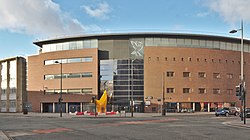
Superlambanana is a bright yellow sculpture in Liverpool, England. Designed by Japanese artist Taro Chiezo and intended to be a cross between a banana and a lamb, it weighs almost 8 tonnes (8,000 kilograms) and stands 5.2 metres (17 feet) tall. It is located outside the Avril Robarts Library on Tithebarn Street, having previously stood on Wapping Dock. Chiezo created only a four-inch-tall model, with the full-size replica being made by local artists Andy Small, Julian Taylor, Tommy Reason, and Ray Stokes. Developed for the 1998 ArtTransPennine Exhibition, the sculpture reflects the history of Liverpool, as both sheep and bananas were historically common cargo in the city's docks; it is also a commentary on the potential dangers of genetic engineering, which was becoming popular at the time. As part of Liverpool's year-long position as the 2008 European Capital of Culture, 125 replicas of the sculpture were created, each 2 metres (6.6 feet) tall and with a different design. Sponsored by local community organisations and businesses, the smaller Superlambananas were scattered throughout Liverpool and the wider Merseyside region. One sculpture, The Highest SuperLambBanana, was located on top of Moel Famau in Wales to recognise the city's close links with that region.

Nearby Places View Menu
Location Image
24 m

Avril Robarts Library

The Avril Robarts Library (formerly the Avril Robarts Learning Resource Centre (LRC)) is one of the two designated libraries belonging to Liverpool John Moores University (LJMU) in Liverpool, England. It stands at 79 Tithebarn Street and serves the City Campus located mostly on Byrom Street. Its award-winning, Tithebarn building was designed by architects Austin-Smith:Lord, and built in 1997. To its front, is the Superlambanana, a sculpture of Liverpool. The building is alternatively known locally by students as, the Tithebarn (after the building) or (Super)lambanana building (after the statue in front). The university library has a gross floor area of 6,159 m2 (66,290 sq ft), larger than the other library of the university, the Aldham Robarts Library, and the former IM Marsh library. The four-storey building contains 308 personal computers alongside countless books and online catalogues that cater mainly to the students of the Faculties of Science, Engineering and Technology and Education, Health and Community. Wi-Fi is available throughout the complex, which can be entered by scanning a relevant student ID card by the ground floor turnstiles. Other services available include research and learner support, IT Support, Skills@LJMU, welfare and counselling and employability advice. It is a member of the Libraries Together: Liverpool Learning Partnership (evolved from Liverpool Libraries Group) which formed in 1990. Under which, a registered reader at any of the member libraries can have access rights to the other libraries within the partnership.
161 m

Exchange Station

Exchange Station is a large office building on Tithebarn Street in the business district in Liverpool City Centre, Liverpool.
165 m

George Forrester and Company

George Forrester and Company was a British marine engine and locomotive manufacturer at Vauxhall Foundry in Liverpool, established by Scottish engineer George Forrester (b. 1780/81). The company opened in 1827 as iron founders and commenced building steam locomotives in 1834.
Location Image
191 m

Waterloo Tunnel

The Waterloo Tunnel in Liverpool, England, is a former railway tunnel, 852 yd (779 m) long, which opened in 1849. Its western end was at 53.414829, -2.994385, underneath Pall Mall. From here the line continued under Great Howard Street to Waterloo Goods railway station, now the site of the Kingsway Tunnel Ventilation Shaft, after 1895 continuing beyond to the dock railway system and on to Liverpool Riverside at the Pier Head for direct connection to the passenger liners. The eastern end opens into a short (69 yd (63 m)) cutting, four tracks wide between Byrom Street and Fontenoy Street, which connects to the Victoria Tunnel, which emerges at Edge Hill station. It is effectively one long tunnel from Edge Hill to Liverpool Waterloo Dock with two names along its route. The tunnels were given two different names because initially trains in the Victoria Tunnel were cable hauled and in the Waterloo Tunnel locomotive hauled. Both tunnels closed on 19 November 1972. In May 2007 it was reported that chief executive of Merseytravel, Neil Scales, had prepared a report outlining the possibilities for reuse of the Victoria/Waterloo and Wapping tunnels. Merseytravel safeguard the tunnel for future use. In 2016, work began on replacing the road bridge on Great Howard Street that crosses over the dock entrance to the tunnel. Whilst it would have been cheaper to remove the existing bridge and in fill the resulting gap, the Department for Transport insisted the bridge was replaced at a cost of £9.7 million in order to preserve the tunnel for future use.