Le Champ de Juillet est un parc public de la ville de Limoges, en France. Créé au XIXe siècle, réaménagé dans les années 1920, il est situé près de la gare des Bénédictins, dans l'axe joignant cette dernière à la place royale Denis-Dussoubs. Il recouvre 2,7 hectares pour le seul parc, plus de cinq hectares si l'on prend en compte les parkings.

1. Historique

Jusqu'à l'arrivée du train, l'actuel secteur du Champ de Juillet, qui doit son nom à la révolution de 1830, est encore assez campagnard, et accueille l'abbaye de Saint-Martin-lez-Limoges, devenue plus tard couvent des Feuillants. Il est entièrement dévolu aux cultures agricoles jusqu'à la création d'un Champ de Mars destiné au 9e régiment de Chasseurs. Vite obsolète, la zone, acquise par la mairie en 1827, est occupée par un champ de foire qui verra la tenue de grandes manifestations, telles l'« Exposition du Centre de la France » en 1858, puis plus tard la Foire-Exposition de Limoges. Cette même année 1858, le paysagiste Eugène Bühler, créateur du parc de la Tête d'or à Lyon, est chargé de réaménager complètement le Champ de Juillet afin de permettre la création d'une promenade publique. Le 5 juin 1859, le nouveau jardin est inauguré. Il est réaménagé par Roger Gonthier, architecte de la nouvelle gare en 1925. Il était connu comme un lieu où la prostitution était courante, un phénomène qui a fait l'objet de plusieurs reportages télévisés dans les années 2010.

1. = Activités =

Le Champ de Juillet accueille régulièrement des manifestations variées, comme le salon du livre Lire à Limoges, les festivités de la Fête nationale, ou des rassemblements politiques (fin habituelle du cortège des manifestations, meeting du Nouveau Front populaire en 2024...)

1. Galerie


1. Notes et références

Portail de Limoges Portail des espaces verts

Nearby Places View Menu
Location Image
160 m

Limoges

Limoges ( lih-MOHZH, US also lee-, French: [limɔʒ] ; Occitan: Lemòtges, locally Limòtges [liˈmɔdzes]) is a city and commune, and the prefecture of the Haute-Vienne department in west-central France. It was the administrative capital of the former Limousin region. Situated on the first western foothills of the Massif Central, Limoges is crossed by the river Vienne, of which it was originally the first ford crossing point. The second most populated town in the Nouvelle-Aquitaine region after Bordeaux, a university town, an administrative centre and intermediate services with all the facilities of a regional metropolis, it has an urban area of 323,789 inhabitants in 2018. The inhabitants of the city are called the Limougeauds. Founded around 10 BC under the name of Augustoritum, it became an important Gallo-Roman city. During the Middle Ages Limoges became a large city, strongly marked by the cultural influence of the Abbey of Saint-Martial, where the Dukes of Aquitaine were invested and crowned. From the 12th century onwards, its enamels were exported throughout the Christian world. In 1765, during the industrial revolution, the discovery of a deposit of kaolin in the Saint-Yrieix-la-Perche region enabled the development of the Limoges porcelain industry. It is sometimes nicknamed "the red city" or "the Rome of socialism" because of its tradition of voting on the left and the workers' events it experienced from the 19th to the beginning of the 20th century. Since the 1990s, the city has had a basketball club, Limoges CSP, which has won several French championships and the European championship in 1993. Because of its heritage policy, it has held the label "City of Art and History" since 2008. Economic activities include butchering, electrical equipment for the building industry, and luxury goods. It is home to porcelain houses and art workshops working with enamel or stained glass. This craft expertise led it to join the UNESCO Creative Cities Network in 2017 in the thematic category "Crafts and Popular Arts".
Location Image
160 m

Siege of Limoges

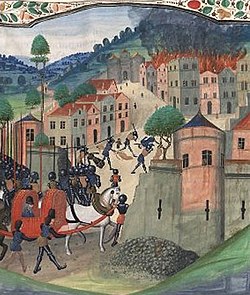
The town of Limoges had been under English control but in August 1370 it surrendered to the French, opening its gates to the Duke of Berry. The siege of Limoges was laid by the English army led by Edward the Black Prince in the second week in September. On 19 September, the town was taken by storm, followed by much destruction and the deaths of numerous civilians. The sack effectively ended the Limoges enamel industry, which had been famous across Europe, for around a century.
160 m

1958 UCI Cyclo-cross World Championships

The 1958 Cyclo-cross World Championship was the ninth edition of the UCI Cyclo-cross World Championships. It was held on Sunday, February 23 1958 in France. The city of Limoges is located 25 kilometers south of Razès, the birthplace of the then four-time (and reigning) world champion André Dufraisse. The course had a total length of 21.38 kilometers. The 31 participants came from eight countries, each sending a team of three or four riders and one rider from the Netherlands. Dufraisse secured his fifth consecutive title with his eighth consecutive podium finish after the same number of participations.
Location Image
242 m

Limoges-Bénédictins station

Limoges-Bénédictins (French: Gare de Limoges-Bénédictins) is the main railway station of Limoges. It is situated on the Orléans–Montauban railway. It was named Bénédictins due to the presence of a Benedictine monastery closed during the French Revolution.
Location Image
280 m

Haute-Vienne

Haute-Vienne (French: [ot vjɛn]; Occitan: Nauta Vinhana or Nauta Viena), also translated as Upper Vienne, is a department in the Nouvelle-Aquitaine region in southwest-central France. Named after the Vienne River, it is one of the twelve départements that together constitute Nouvelle-Aquitaine. The prefecture and largest city in the department is Limoges, the other towns in the department each having fewer than twenty thousand inhabitants. Haute-Vienne had a population of 372,359 in 2019.