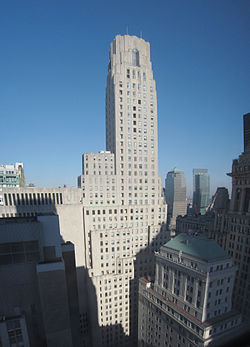
1 Wall Street (also known as the Irving Trust Company Building, the Bank of New York Building, and the BNY Mellon Building) is a 654-foot-tall (199 m) Art Deco skyscraper in the Financial District of Lower Manhattan, New York City, United States. The building, which occupies a full city block, consists of two sections. The original 50-story building was designed by Ralph Thomas Walker of the firm Voorhees, Gmelin and Walker and constructed between 1929 and 1931 for Irving Trust, an early-20th-century American bank. A 28-story annex to the south (later expanded to 36 stories) was designed by the successor firm Voorhees, Walker, Smith, Smith & Haines and built between 1963 and 1965. The limestone facade consists of slight inwardly-curved bays with fluting to resemble curtains. On the lower stories are narrow windows and elaborate entrances. The massing of 1 Wall Street incorporates numerous small setbacks, and there are chamfers at the corners of the original building. The top of the original building consists of a freestanding tower with fluted windowless bays. The facade of the annex is crafted in a style reminiscent of the original structure. The original building has an ornate lobby, known as the Red Room, with colored mosaics. The 10th through 45th floors were originally rented to tenants, while the other floors contained offices, lounges, and other spaces for Irving Trust. At the time of its construction, 1 Wall Street occupied what was one of the most valuable plots in the city. The building replaced three previous structures, including the Manhattan Life Insurance Building, which was once the world's tallest building. After Irving Trust was acquired by the Bank of New York (BNY) in 1988, 1 Wall Street served as the global headquarters of BNY and its successor BNY Mellon through 2015. After the developer Harry Macklowe purchased the building, he renovated it from 2018 to 2023, converting the interior into 566 condominium apartments with some commercial space. Sales of the condo units have been sluggish for Macklowe. The building is one of New York City's Art Deco landmarks, although architectural critics initially ignored it in favor of such buildings as the Empire State Building and the Chrysler Building. The exterior of the building's original section was designated as a city landmark in 2001, and the Red Room was similarly designated in 2024. In addition, the structure is a contributing property to the Wall Street Historic District, a National Register of Historic Places district created in 2007.

Nearby Places View Menu
Location Image
37 m

Lower Manhattan

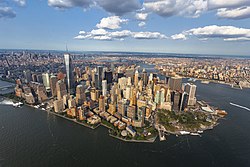
Lower Manhattan, also known as Downtown Manhattan, is the southernmost part of the New York City borough of Manhattan. The area is the historical birthplace of New York City and in the 17th and 18th centuries composed the entirety of the city. Lower Manhattan serves as the seat of government of both Manhattan and the entire City of New York. Because there are no municipally defined boundaries for the area, a precise population cannot be quoted, but several sources have suggested that it was one of the fastest-growing locations in New York City between 2010 and 2020, related to the influx of young adults and significant development of new housing units. Despite various definitions of Lower Manhattan, they generally include all of Manhattan Island south of 14th Street, with the Bowling Green and the Battery near the southern end. Anchored by Wall Street and the Financial District in Lower Manhattan, New York City is the leading global center for finance and fintech. The Financial District houses the New York Stock Exchange, the Federal Reserve Bank of New York, and other major financial institutions. A center of culture and tourism, Lower Manhattan is home to many of New York City's most iconic structures, including New York City Hall, the Woolworth Building, the Stonewall Inn, the Bull of Wall Street, and One World Trade Center, the tallest skyscraper in the Western Hemisphere.
Location Image
39 m

Mortimer Building

The Mortimer Building was a 19th-century building located at Wall Street and New Street in the Financial District of Manhattan, New York City. It was built by W.Y. Mortimer beginning on June 1, 1884, and completed for occupancy in March 1885. The architect was George B. Post. It fronted Wall Street for a distance of 57 feet (17 m) and New Street for 65 feet (20 m). Used entirely as an office building, the structure adjoined the New York Stock Exchange Building on the west and south. Tenants included lawyers, brokers, and bankers. The building was used as the general headquarters of the Industrial Workers of the World at its peak between 1912 and 1917. The New York Stock Exchange acquired the Mortimer Building for $745,000 in December 1918. Reasons for the acquisition included consolidating all the adjuncts of the exchange beneath one roof and the necessity for additional floor space for foreign issues, entertained by the NYSE. The site was valued at $710,000 in February 1920; $745,000 with the building included.
Location Image
54 m

Wall Street station (IRT Lexington Avenue Line)

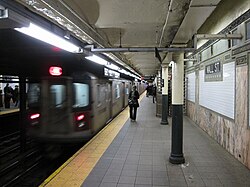
The Wall Street station is a station on the IRT Lexington Avenue Line of the New York City Subway. The station is located at the intersection of Broadway and Wall Street in the Financial District of Lower Manhattan. It is served by the 4 train at all times and the 5 train at all times except late nights. The Wall Street station was constructed for the Interborough Rapid Transit Company (IRT) as part of the city's first subway line, which was approved in 1900. Construction of the tunnel around the Wall Street station was complicated by the shallow foundations of the nearby Trinity Church, as well as the need to avoid disrupting the street surface of Broadway. The station opened on June 12, 1905, as an extension of the original line. The station's platforms were lengthened in the late 1950s, and it was renovated in the 1970s and 2000s. The Wall Street station contains two side platforms and two tracks, and it was built with tile and mosaic decorations. The platforms contain exits to Broadway's intersections with Wall and Rector Streets, outside Trinity Church, and into the basements of several buildings. An additional passageway extends east to an out-of-system connection with the Broad Street station and the basement of 28 Liberty Street. The original station interior is a New York City designated landmark and listed on the National Register of Historic Places.
Location Image
56 m

New York Stock Exchange Building

The New York Stock Exchange Building (also NYSE Building) is the headquarters of the New York Stock Exchange (NYSE), located in the Financial District of Lower Manhattan in New York City. It is composed of two connected structures occupying much of the city block bounded by Wall Street, Broad Street, New Street, and Exchange Place. The central section of the block contains the original structure at 18 Broad Street, designed in the Classical Revival style by George B. Post. The northern section contains a 23-story office annex at 11 Wall Street, designed by Trowbridge & Livingston in a similar style. The marble facade of 18 Broad Street contains colonnades facing east toward Broad Street and west toward New Street, both atop two-story podiums. The Broad Street colonnade, an icon of the NYSE, contains a pediment designed by John Quincy Adams Ward and Paul Wayland Bartlett, depicting commerce and industry. The facade of 11 Wall Street is simpler in design but contains architectural details similar to those at 18 Broad Street. Behind the colonnades at 18 Broad Street is the main trading floor, a 72-foot-tall (22 m) rectangular space. An additional trading floor, nicknamed the Garage, is at 11 Wall Street. There are offices and meeting rooms in the upper stories of 18 Broad Street and 11 Wall Street. The NYSE had occupied the site on Broad Street since 1865 but had to expand its previous building several times. The structure at 18 Broad Street was erected between 1901 and 1903. Within two decades, the NYSE's new building had become overcrowded, and the annex at 11 Wall Street was added between 1920 and 1922. Three additional trading floors were added in the late 20th century to accommodate increasing demand, and there were several proposals to move the NYSE elsewhere during that time. With the growing popularity of electronic trading in the 2000s, the three newer trading floors were closed in 2007. The building was designated a National Historic Landmark in 1978 and designated a city landmark by the New York City Landmarks Preservation Commission in 1985. The building is also a contributing property to the Wall Street Historic District, a National Register of Historic Places district created in 2007.