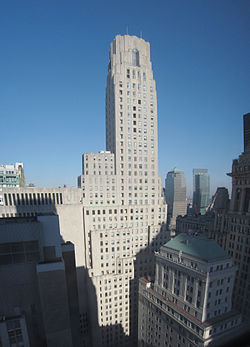
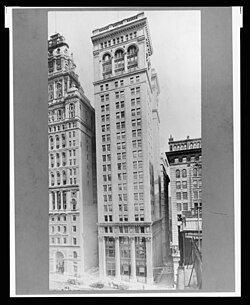
1 Wall Street (also known as the Irving Trust Company Building, the Bank of New York Building, and the BNY Mellon Building) is a 654-foot-tall (199 m) Art Deco skyscraper in the Financial District of Lower Manhattan, New York City, United States. The building, which occupies a full city block, consists of two sections. The original 50-story building was designed by Ralph Thomas Walker of the firm Voorhees, Gmelin and Walker and constructed between 1929 and 1931 for Irving Trust, an early-20th-century American bank. A 28-story annex to the south (later expanded to 36 stories) was designed by the successor firm Voorhees, Walker, Smith, Smith & Haines and built between 1963 and 1965. The limestone facade consists of slight inwardly-curved bays with fluting to resemble curtains. On the lower stories are narrow windows and elaborate entrances. The massing of 1 Wall Street incorporates numerous small setbacks, and there are chamfers at the corners of the original building. The top of the original building consists of a freestanding tower with fluted windowless bays. The facade of the annex is crafted in a style reminiscent of the original structure. The original building has an ornate lobby, known as the Red Room, with colored mosaics. The 10th through 45th floors were originally rented to tenants, while the other floors contained offices, lounges, and other spaces for Irving Trust. At the time of its construction, 1 Wall Street occupied what was one of the most valuable plots in the city. The building replaced three previous structures, including the Manhattan Life Insurance Building, which was once the world's tallest building. After Irving Trust was acquired by the Bank of New York (BNY) in 1988, 1 Wall Street served as the global headquarters of BNY and its successor BNY Mellon through 2015. After the developer Harry Macklowe purchased the building, he renovated it from 2018 to 2023, converting the interior into 566 condominium apartments with some commercial space. Sales of the condo units have been sluggish for Macklowe. The building is one of New York City's Art Deco landmarks, although architectural critics initially ignored it in favor of such buildings as the Empire State Building and the Chrysler Building. The exterior of the building's original section was designated as a city landmark in 2001, and the Red Room was similarly designated in 2024. In addition, the structure is a contributing property to the Wall Street Historic District, a National Register of Historic Places district created in 2007.

Lieux à Proximité Voir Menu
Location Image
0 m

1 Wall Street

Le One Wall Street, originellement le Irving Trust Company Building, ensuite la Bank of New York Building (après 1988), et après 2007 le BNY Mellon Building, fut terminé en 1931 après deux années de travaux. Les plans d'origine sont de l'architecte américain Ralph T. Walker.
Location Image
39 m

Lower Manhattan

Lower Manhattan, en français : « Bas Manhattan », (appelé aussi Downtown Manhattan), est le quartier le plus au sud de l'île de Manhattan, l'un des cinq arrondissements de la ville de New York, aux États-Unis. Il est généralement délimité par la rue Chambers au nord, North River (une partie du cours de l'Hudson River) à l'ouest, l'East River à l'est, et au sud par Battery Park et la Upper New York Bay. Lower Manhattan, appelé aussi Financial District, inclut Wall Street, l'hôtel de ville, le Municipal Building et le site du One World Trade Center. C'est le quatrième « Central business district » du pays après Midtown (Manhattan), le Loop (Chicago) et Washington. C'était le troisième CBD avant les attentats du 11 septembre 2001.
Location Image
56 m

Knickerbocker Trust Building

Le Knickerbocker Trust Building, anciennement appelé Columbia Trust Company Building était un gratte-ciel situé au 60 Broadway à Manhattan dans la ville de New York aux États-Unis. Il a été construit en 1909 et détruit en 1964. Il atteignait 116 mètres pour 27 étages.
Location Image
56 m

Wall Street (IRT Lexington Avenue/métro de New York)

Wall Street est une station souterraine du métro de New York située dans le Financial District au sud de Manhattan. Elle est située sur l'une des lignes (au sens de tronçons du réseau) principales, l'IRT Lexington Avenue Line (métros verts) issue du réseau de l'ancienne Interborough Rapid Transit Company (IRT), et faisait partie de la toute première ligne de métro souterraine de Manhattan (Manhattan Main Line). Comme son nom l'indique, elle dessert le quartier d'affaires de Wall Street. Sur la base de la fréquentation, la station, qui porte le même nom que celle située sur la Broadway-Seventh Avenue Line (métros rouges) figurait au 63e rang sur 421 en 2012. Au total, deux services y circulent : les métros 4 y transitent 24/7 ; les métros 5 s'y arrêtent tout le temps sauf la nuit (late nights).
Location Image
64 m

New York Stock Exchange

Le New York Stock Exchange ou NYSE (communément appelée Bourse de New York en français), aussi appelé Wall Street, fondée en 1792 est la plus importante bourse de valeurs des États-Unis. C'est aussi la plus importante bourse au monde, avec une capitalisation totale dépassant les 30 000 milliards de dollars en 2025. Le NYSE présente la particularité de fonctionner en partie physiquement avec des traders sur place. Son grand concurrent, le NASDAQ, est lui 100 % électronique. Le principal indice du NYSE est le Dow Jones Industrial Average, qui regroupe les 30 plus grosses entreprises du NYSE selon leur capitalisation boursière. Les échanges sur le NYSE se déroulent du lundi au vendredi entre 9 h 30 et 16 h (heure locale), ce qui correspond en heure normale d'Europe centrale à un créneau entre 15 h 30 et 22 h. Le commerce des actions se fait au 11, Wall Street, alors que le siège du NYSE se trouve à proximité, dans le quartier financier du sud de Manhattan, au 18, Broad Street. Le NYSE est la propriété de l'entreprise Intercontinental Exchange (ICE).