

 English
 Français
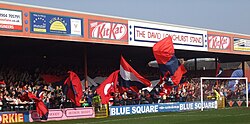
Bootham Crescent est un stade de football situé à York. Il a accueilli l'équipe de York City entre 1932 et 2020.
Nearby Places View Menu
0 m
Bootham Crescent
Bootham Crescent in York, England, was the home of York City Football Club and York City Knights rugby league club. With a capacity of 8,256, it was near the city centre, just over a mile from York railway station. As of February 2023 the ground has been fully demolished to make way for the building of new houses.
York City leased land at Bootham Crescent from York Cricket Club as a replacement for their ground at Fulfordgate on the outskirts of the city. The ground was constructed in four months, and opened on 31 August 1932. In the Second World War, the Popular Stand was converted into an air-raid shelter, and the ground suffered slight damage when a bomb landed on houses along the Shipton Street End. York purchased Bootham Crescent for £4,075 in 1948. Floodlights were fitted at the ground in 1959, and replaced by ones twice as powerful in 1995. A number of improvements were made in the early 1980s, with a gymnasium, offices and a lounge for officials built.
The David Longhurst Stand opened in 1991 after a roof was erected on the Shipton Street End, named after the former York player David Longhurst who died during a match at the ground in 1990. Bootham Crescent hosted Football League matches from 1932 to 2004 and from 2012 to 2016, both spells ending after York were relegated into non-League football. The ground was renamed KitKat Crescent from 2005 to 2010 as part of a sponsorship deal with Nestlé. York City left Bootham Crescent and moved to the York Community Stadium in Huntington in early 2021, and the Bootham Crescent site will be used for housing.
Bootham Crescent comprised four stands: the Main Stand, the Popular Stand, the David Longhurst Stand and the Grosvenor Road End. The ground held a league representative match, neutral club matches, and schoolboy and youth international matches. Other than football, it hosted a concert, firework displays, American football, rugby league matches, and beer festivals. The record attendance of 28,123 was set in March 1938, for an FA Cup match against Huddersfield Town. The highest seasonal average attendance of 10,412 was achieved in 1948–49.

285 m
Bootham Park Hospital
Bootham Park Hospital was a psychiatric hospital, located in the Bootham district of York, England. It was managed by the Tees, Esk and Wear Valleys NHS Foundation Trust. The main building is a Grade I listed building.

337 m
York Hospital
York Hospital is a teaching hospital in York, England. It is managed by York and Scarborough Teaching Hospitals NHS Foundation Trust, an NHS Foundation Trust which also runs several other hospitals in North Yorkshire and the East Riding of Yorkshire, including Scarborough Hospital, Bridlington Hospital and Malton Community Hospital.
377 m
Wigginton Road Cricket Ground
Wigginton Road Cricket Ground in York is a former cricket ground. Its one and only first-class match was held in June 1890 between Yorkshire and Kent.
The ground was then known as the Yorkshire Gentlemen Cricket Club Ground, having been used by the Yorkshire Gentlemen from its inception in 1864 to 1931. Its name was changed in 1933 to Wigginton Road and was used from 1932 to 1966 by York Cricket Club.
Wigginton Road Cricket Ground is now covered by York Hospital which lies to the west side of Wiggington Road.

401 m
The Old Manor House, Clifton
The Old Manor House, also known as Nell Gywnne's House, is a historic building in the Clifton area of York in England.
Two timber-framed tenement buildings, each of two storeys, were built on the site at some point between the 14th and 16th centuries. In the late 17th century, it was largely rebuilt in brick, in the Artisan Mannerist style. The rebuilding may have been due to damage during the Siege of York. A local legend claims that, when Charles II of England visited York, Nell Gwynne stayed in the house.
By the 19th century, the building housed working-class families in rooms which had been subdivided. At the start of the 20th century, the eastern part of the building was a tobacconist and barbers shop. In the 1930s, the building was converted into a single house, and the roof was entirely replaced. The house was Grade II* listed in 1954. In 1962, it was restored and partly rebuilt, the new work include the south-east wall and the window openings in the rear wall. The York Civic Trust purchased the building in 1985, but sold it as a private house in the early 21st century. In 2020, the house was placed on the market for £1.29 million.
The building is two storeys tall, with an attic above. There are two main gables on the front to the street named Clifton, and to their left, a smaller gable over the porch. Above ground floor level, the brickwork has been laid in an approximation of larger stone blocks.
Inside the building, most of the ceiling beams and joists are 16th-century. The chimney is in the centre of the building, and it has 17th-century fireplaces. The entrance door is also 17th-century, but has been moved from its original doorway. One room has an 18th-century fitted cupboard. There is a cellar under part of the house, reached down a 17th-century flight of stairs.