

 English
 Français

Bootham Park Hospital was a psychiatric hospital, located in the Bootham district of York, England. It was managed by the Tees, Esk and Wear Valleys NHS Foundation Trust. The main building is a Grade I listed building.
Nearby Places View Menu

253 m
Bootham School
Bootham School is a private Quaker boarding school, on Bootham in the city of York in England. It accepts boys and girls ages 3–19 and had an enrolment of 605 pupils in 2016. It is one of seven Quaker schools in England.
The school was founded by the Religious Society of Friends (Quakers) and opened on 6 January 1823 in Lawrence Street, York. Its first headmaster was William Simpson (1823–1828). He was followed by John Ford (1828–c. 1865). The school is now on Bootham, near York Minster. It is based in 51 Bootham, a building originally built in 1804 for Sir Richard Vanden Bempde Johnstone, but has expanded into several neighbouring buildings.
The school's motto Membra Sumus Corporis Magni means "We are members of a greater body", quoting Seneca the Younger (Epistle 95, 52).

258 m
The Churchill Hotel, York
The Churchill Hotel is a historic building on Bootham, north of the city centre of York in England.
The building was constructed in about 1827 as a house, for Barbara Ashton Nelson. It replaced an earlier house, but was set further back from the road. In 1879, it was converted into a girls' school, named Bootham House. In 1882, it was sold to the War Department, becoming the official residence of the General Officer Commanding Northern District. It later became government offices, housing the Command Pay Office, then the Health Authority, and finally Customs and Excise, until 1984. In 1985, it was converted into a 14-bedroom hotel, which in 2006 was extended to provide 32 bedrooms. It has been Grade II* listed since 1971.
The house has a sandstone facade, with white brick side walls, and a red brick rear wall. It has two main storeys, plus an attic and cellar. The three-bay symmetrical facade has a central bowed bay, while the windows are sashes. There is a timber lantern above the centre of the roof, with three windows, and a chimney at each corner. The main entrance is in the left wall, under a porte-cochère. Inside, the stair hall rises the full height of the building, and is lit by the lantern. There is some original plasterwork, and a curved white marble fireplace in the central front downstairs room.
285 m
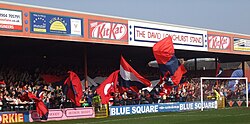
Bootham Crescent
Bootham Crescent in York, England, was the home of York City Football Club and York City Knights rugby league club. With a capacity of 8,256, it was near the city centre, just over a mile from York railway station. As of February 2023 the ground has been fully demolished to make way for the building of new houses.
York City leased land at Bootham Crescent from York Cricket Club as a replacement for their ground at Fulfordgate on the outskirts of the city. The ground was constructed in four months, and opened on 31 August 1932. In the Second World War, the Popular Stand was converted into an air-raid shelter, and the ground suffered slight damage when a bomb landed on houses along the Shipton Street End. York purchased Bootham Crescent for £4,075 in 1948. Floodlights were fitted at the ground in 1959, and replaced by ones twice as powerful in 1995. A number of improvements were made in the early 1980s, with a gymnasium, offices and a lounge for officials built.
The David Longhurst Stand opened in 1991 after a roof was erected on the Shipton Street End, named after the former York player David Longhurst who died during a match at the ground in 1990. Bootham Crescent hosted Football League matches from 1932 to 2004 and from 2012 to 2016, both spells ending after York were relegated into non-League football. The ground was renamed KitKat Crescent from 2005 to 2010 as part of a sponsorship deal with Nestlé. York City left Bootham Crescent and moved to the York Community Stadium in Huntington in early 2021, and the Bootham Crescent site will be used for housing.
Bootham Crescent comprised four stands: the Main Stand, the Popular Stand, the David Longhurst Stand and the Grosvenor Road End. The ground held a league representative match, neutral club matches, and schoolboy and youth international matches. Other than football, it hosted a concert, firework displays, American football, rugby league matches, and beer festivals. The record attendance of 28,123 was set in March 1938, for an FA Cup match against Huddersfield Town. The highest seasonal average attendance of 10,412 was achieved in 1948–49.

287 m
Ingram House
Ingram House is a historic building on the street of Bootham, York, England. It was built as an almshouse for ten poor widows between 1630 and 1632 by real estate developer and politician Sir Arthur Ingram and was originally known as Ingram's Hospital. It was damaged during the Siege of York and was restored in 1649. It is the most important mid-17th-century building in Bootham, pre-classical and composed of 11 bays of two low storeys, but with a four-storey central tower. The middle doorway dates back to the Norman period, and is believed to have once been a doorway to Holy Trinity Priory.
Charles I of England stayed at the house in 1642. It became a Grade II* listed building in 1954. In 1959, it was converted into four flats.