

 English
 Français
L'Exposition internationale du textile de 1951 est une exposition dite « spécialisée » organisée à Lille du 28 avril au 20 mai 1951. Pendant trois semaines, Lille peut s'imaginer être la capitale mondiale du textile.
Nearby Places View Menu

91 m
Zénith de Lille
The Zénith de Lille (originally Zénith Arena) is a multi-purpose indoor arena in Lille, France. Its ability to seat up to 7,000 people makes it one of the largest venues in Lille. The closest métro station is Lille Grand Palais.
Designed by the Dutch architect Rem Koolhaas with Cecil Balmond and inaugurated in 1994, the Zénith Arena is a part of the cultural complex Lille Grand Palais which includes two other spaces: a congress center and exhibition halls. Rem Koolhaas surrounded himself with Renz van Luxemburg for the acoustic studies, dUCKS scéno for the scenography and Arup Group for the engineering studies.

202 m
Lille 2 University of Health and Law
The Lille 2 University of Health and Law (French: Université Lille 2 : Droit et Santé) was a French university for health, sports, management and law. It was located in Lille and was part of the Community of Universities and Institutions (COMUE) Lille Nord de France.
The University of Lille II inherits from the Faculty of Law established as the Université de Douai in 1559. After, sciences and technologies are taught in an independent campus of Université de Lille I - USTL, while literature and social sciences are taught as part of the independent campus of Université de Lille III - Charles de Gaulle. Altogether, the universities of Lille include more than 90,000 students and are the core parts of the European Doctoral College Lille-Nord-Pas de Calais Archived 2007-10-29 at the Wayback Machine that includes 3,000 PhD Doctorate students supported by university research laboratories.
Henri Warembourg was president of this university. His son, Nicolas Warembourg, is professor of law in Sorbonne.
Since 1970, the main campus of University de Lille II in situated in Ronchin, in the southern part of Lille.
It includes
24,000 students
1,050 faculty members and 830 staff
50 research labs, associated to the European Doctoral College Lille Nord-Pas de Calais
250 courses towards nationally accredited degrees and 170 courses towards university diploma.
At the beginning of 2018, the three universities of Lille (Lille 1, Lille 2, Lille 3) merged to form the University of Lille.

333 m
University of Lille
The University of Lille (French: Université de Lille, abbreviated as ULille, UDL or univ-lille) is a French public research university based in Lille, in the Nord department of Upper France. It has its origins in the University of Douai (1559), and resulted from the merger of three universities – Lille 1 University of Science and Technology, Lille 2 University of Health and Law, and Charles de Gaulle University – Lille III in 2018. With more than 80,000 students, it is one of the largest universities in France and one of the largest French-speaking universities in the world.
Since 2017, the university has been funded as one of the French universities of excellence. It benefits from an endowment of 500 million euros to accelerate its strategy in education, research, international development and outreach.
With 66 research labs, 350 PhD theses supported per year and 3,000 scientific publications each year, it is well represented in the research community; it collaborates with many organizations (Pasteur Institute of Lille, CHU Lille University Hospital, CNRS, INSERM, INRA, INRIA etc.) and schools (École Centrale de Lille, École des Mines-Télécom de Lille-Douai (IMT Lille Douai), Sciences Po Lille etc.).
Until 2019, the university was the main component of the Community of Universities and Institutions (COMUE) Lille Nord de France. It still operates the European Doctoral College, which federates universities and other higher learning institutes in the Hauts-de-France region.

441 m
Euralille
Euralille is an urban quarter in the centre of Lille, France. Conceived as a major European business district in the late 1980s and early 1990s, it is strategically located at the intersection of the high-speed railway lines linking Paris, Brussels, and London, and incorporates the Gare de Lille Europe and Gare de Lille Flandres railway stations. The master plan was commissioned in 1988 to the Office of Metropolitan Architecture (OMA) led by Rem Koolhaas.
507 m
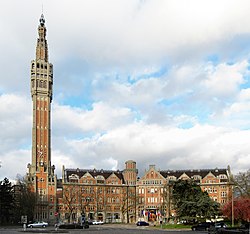
Hôtel de Ville, Lille
The Hôtel de Ville (French pronunciation: [otɛl də vil], City Hall) is a municipal building in Lille, France. Built between 1924 and 1932 in Art Deco style of Flemish neo-Renaissance inspiration, it was designated a Monument historique by the French Government in May 2002. Its belfry is a UNESCO World Heritage Site, inscribed in 2005 along with many other Belfries of Belgium and France in recognition of its architecture and importance in the history of municipal power in Europe. The latter should not be confused with the belfry of Lille's Chamber of Commerce, also emblematic of the city.
The Town Hall is located on the Place Roger Salengro, next to the Porte de Paris, in the eastern part of the city centre. This site is served by the Mairie de Lille metro station on line 2 of the Lille Metro.